Yoon Hyuk, Kim Nayoung, Park Ji Hyun, Kim Yong Sung, Lee Jongchan, Kim Hyoung Woo, Choi Yoon Jin, Shin Cheol Min, Park Young Soo, Lee Dong Ho, Jung Hyun Chae
Department of Internal Medicine, Seoul National University Bundang Hospital, Seongnam, Korea.
Department of Internal Medicine and Liver Research Institute, Seoul National University College of Medicine, Seoul, Korea.
J Cancer Prev. 2017 Jun;22(2):108-114. doi: 10.15430/JCP.2017.22.2.108. Epub 2017 Jun 30.
Studies on gut microbiota regarding colorectal carcinogenesis, including sessile serrated adenoma (SSA), have been scarce. The aim of this study is to investigate the role of mucosa-associated gut microbiota in the colorectal carcinogenesis.
We collected biopsy samples of normal rectal mucosa during colonoscopy from healthy control and patients with conventional adenoma, SSA, and colorectal cancer (CRC), respectively (n = 6). Pyrosequencing for 16S rRNA gene of bacteria was performed to compare gut microbiota.
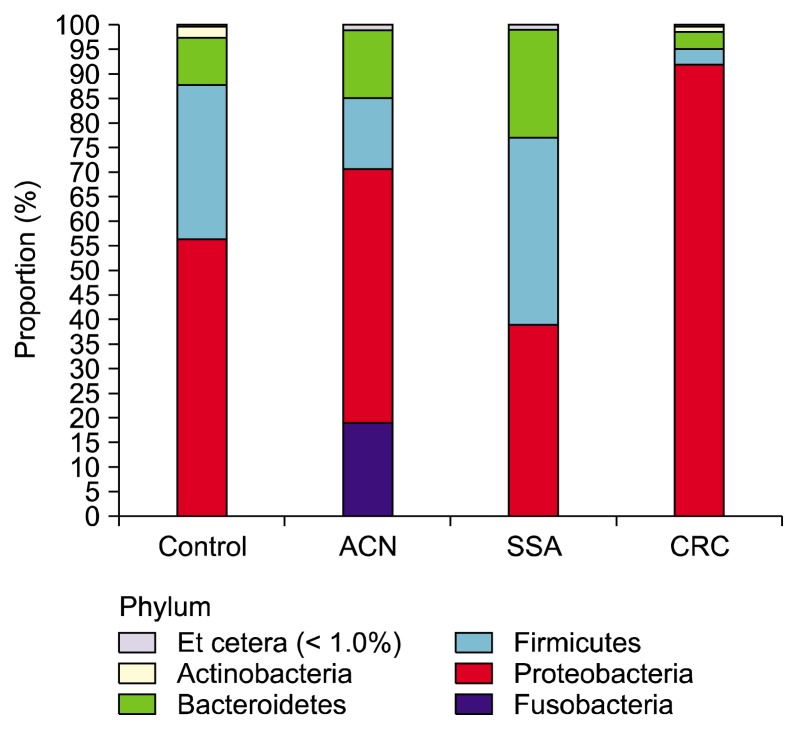
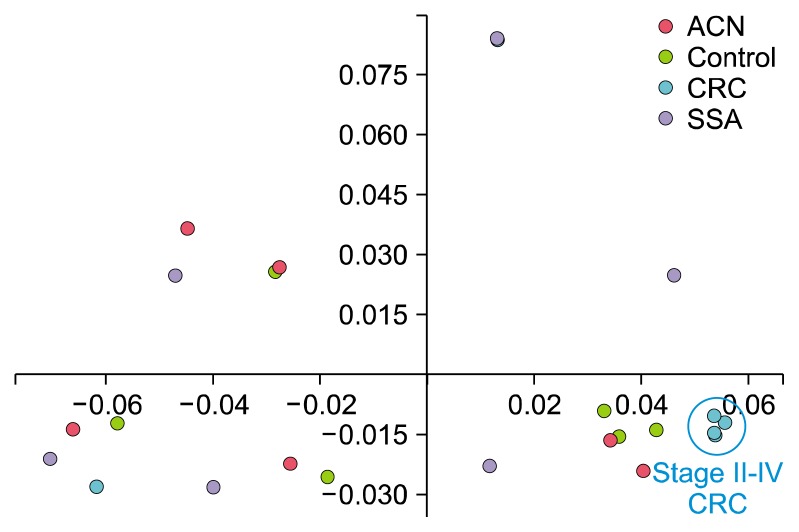
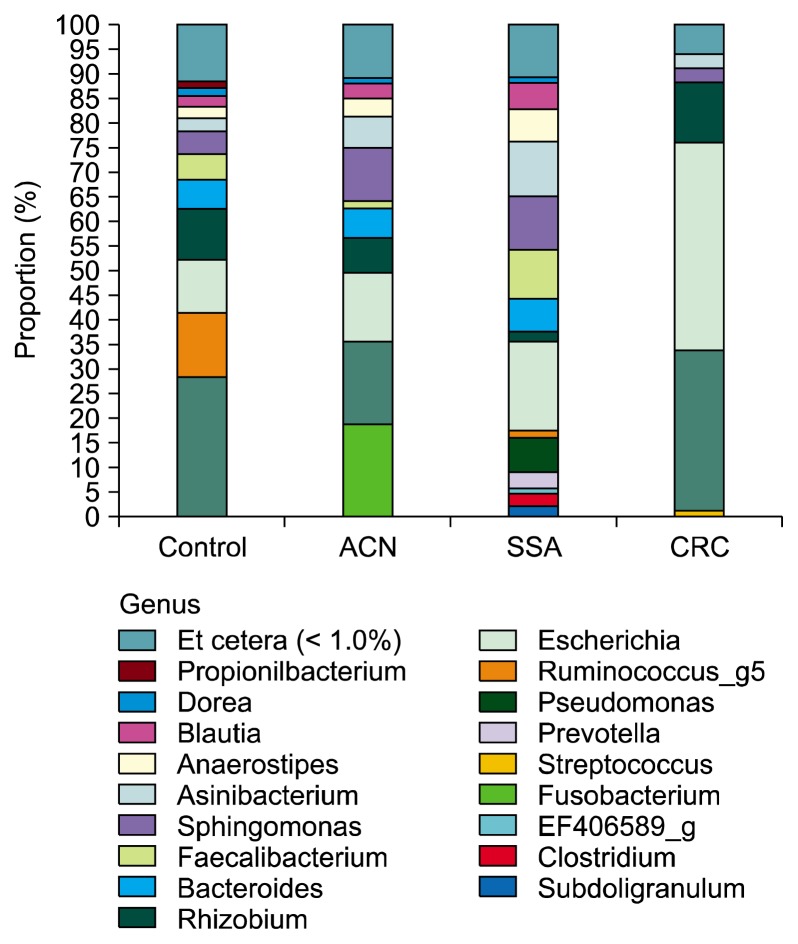
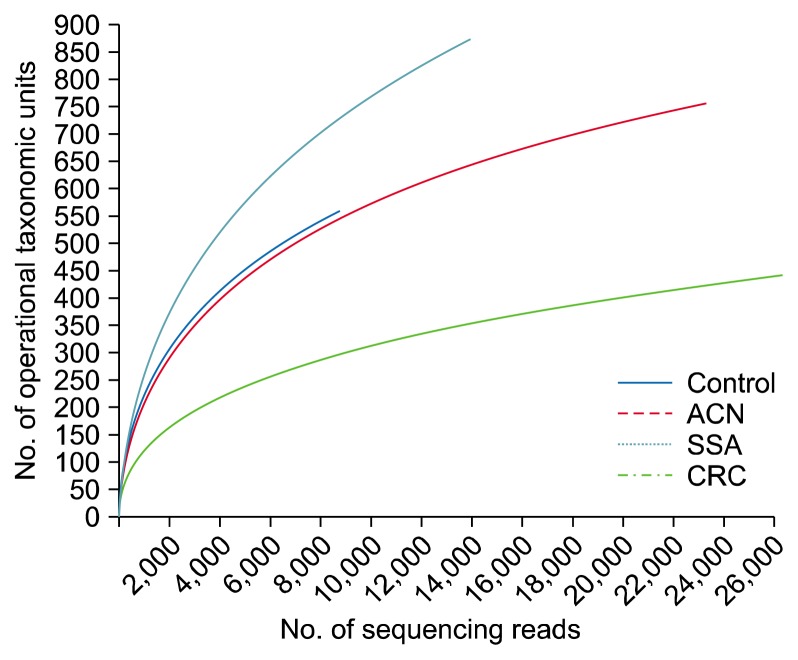
The most abundant phylum in total samples was Proteobacteria (55.6%), followed by Firmicutes (27.4%) and Bacteroidetes (11.6%). There was no significant difference in relative abundance of the phylum level among the four groups. , known to be frequently detected during colorectal carcinogenesis, was found in only one sample of patient with SSA. The rarefaction curves showed that the diversity of mucosal communities of patients with CRC is the lowest among the four groups and the diversity of mucosal communities of patients with SSA is higher than that of healthy control. Among the four groups, Shannon's and Simpson's index for diversity was the lowest and the highest in the patients with CRC, respectively; it did not reach statistical significance. The proportion of genus was very high in the samples of patients with stage II-IV CRC compared with those with stage I CRC (59.3% vs. 0.3%, = 0.064).
Our study suggests no significant role of mucosa-associated gut microbiota in the colorectal carcinogenesis. Further study for many samples or using fecal material could be helpful.
关于肠道微生物群在包括锯齿状息肉(SSA)在内的结直肠癌发生过程中的研究较少。本研究旨在探讨黏膜相关肠道微生物群在结直肠癌发生中的作用。
我们分别从健康对照者以及患有传统腺瘤、SSA和结直肠癌(CRC)的患者的结肠镜检查中收集正常直肠黏膜活检样本(n = 6)。对细菌的16S rRNA基因进行焦磷酸测序以比较肠道微生物群。
总样本中最丰富的菌门是变形菌门(55.6%),其次是厚壁菌门(27.4%)和拟杆菌门(11.6%)。四组之间菌门水平的相对丰度没有显著差异。在结直肠癌发生过程中经常检测到的 ,仅在1例SSA患者的样本中发现。稀疏曲线显示,CRC患者黏膜群落的多样性在四组中最低,SSA患者黏膜群落的多样性高于健康对照者。在四组中,CRC患者的香农多样性指数和辛普森多样性指数分别最低和最高;未达到统计学意义。与I期CRC患者相比,II-IV期CRC患者样本中的 属比例非常高(59.3%对0.3%, = = 0.064)。
我们的研究表明黏膜相关肠道微生物群在结直肠癌发生中没有显著作用。对更多样本或使用粪便材料进行进一步研究可能会有所帮助。