Houle Timothy T, Turner Dana P, Golding Adrienne N, Porter John A H, Martin Vincent T, Penzien Donald B, Tegeler Charles H
Department of Anesthesia, Critical Care, and Pain Medicine, Massachusetts General Hospital, Boston, MA.
Department of Anesthesiology, Wake Forest School of Medicine, Winston-Salem, NC.
Headache. 2017 Jul;57(7):1041-1050. doi: 10.1111/head.13137.
To develop and validate a prediction model that forecasts future migraine attacks for an individual headache sufferer.
Many headache patients and physicians believe that precipitants of headache can be identified and avoided or managed to reduce the frequency of headache attacks. Of the numerous candidate triggers, perceived stress has received considerable attention for its association with the onset of headache in episodic and chronic headache sufferers. However, no evidence is available to support forecasting headache attacks within individuals using any of the candidate headache triggers.
This longitudinal cohort with forecasting model development study enrolled 100 participants with episodic migraine with or without aura, and N = 95 contributed 4626 days of electronic diary data and were included in the analysis. Individual headache forecasts were derived from current headache state and current levels of stress using several aspects of the Daily Stress Inventory, a measure of daily hassles that is completed at the end of each day. The primary outcome measure was the presence/absence of any headache attack (head pain > 0 on a numerical rating scale of 0-10) over the next 24 h period.
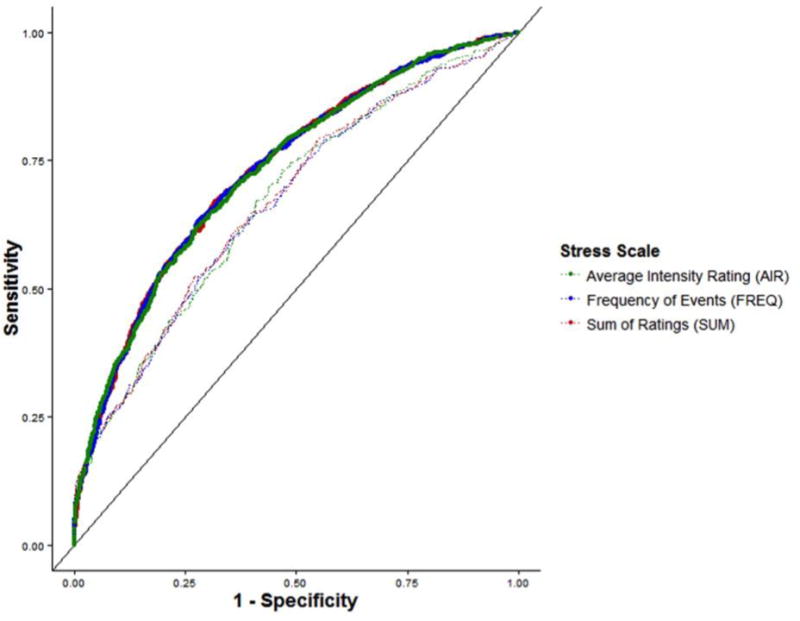
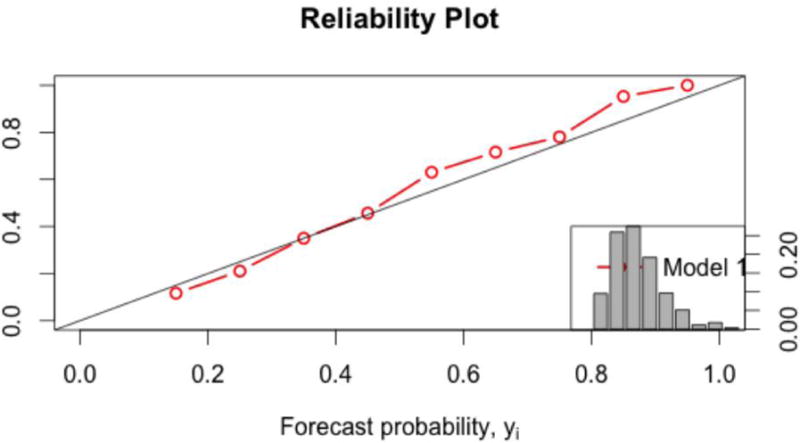
After removing missing data (n = 431 days), participants in the study experienced a headache attack on 1613/4195 (38.5%) days. A generalized linear mixed-effects forecast model using either the frequency of stressful events or the perceived intensity of these events fit the data well. This simple forecasting model possessed promising predictive utility with an AUC of 0.73 (95% CI 0.71-0.75) in the training sample and an AUC of 0.65 (95% CI 0.6-0.67) in a leave-one-out validation sample. This forecasting model had a Brier score of 0.202 and possessed good calibration between forecasted probabilities and observed frequencies but had only low levels of resolution (ie, sharpness).
This study demonstrates that future headache attacks can be forecasted for a diverse group of individuals over time. Future work will enhance prediction through improvements in the assessment of stress as well as the development of other candidate domains to use in the models.
开发并验证一种能预测个体头痛患者未来偏头痛发作的预测模型。
许多头痛患者和医生认为,可以识别并避免或控制头痛的诱发因素,以减少头痛发作的频率。在众多候选触发因素中,感知到的压力因其与发作性和慢性头痛患者头痛发作的关联而受到了相当多的关注。然而,尚无证据支持使用任何候选头痛触发因素来预测个体的头痛发作。
这项开展预测模型开发的纵向队列研究纳入了100名有或无先兆的发作性偏头痛患者,其中N = 95名患者提供了4626天的电子日记数据并被纳入分析。个体头痛预测是根据当前头痛状态和使用每日压力量表的几个方面得出的当前压力水平,每日压力量表是一种在每天结束时完成的日常烦恼测量工具。主要结局指标是在接下来的24小时内是否有任何头痛发作(在0至10的数字评分量表上头痛疼痛>0)。
在去除缺失数据(n = 431天)后,研究中的参与者在1613/4195(38.5%)天经历了头痛发作。使用压力事件频率或这些事件的感知强度的广义线性混合效应预测模型与数据拟合良好。这个简单的预测模型具有良好的预测效用,在训练样本中的AUC为0.73(95%CI 0.71 - 0.75),在留一法验证样本中的AUC为0.65(95%CI 0.6 - 0.67)。该预测模型的Brier评分为0.202,在预测概率和观察频率之间具有良好的校准,但分辨率水平较低(即清晰度)。
这项研究表明,随着时间的推移,可以为不同群体的个体预测未来的头痛发作。未来的工作将通过改进压力评估以及开发模型中使用的其他候选领域来加强预测。