Wallace H. Coulter Department of Biomedical Engineering, Georgia Institute of Technology , Atlanta, Georgia 30332, United States.
Department of Oncology and Pathology, Cancer Centrum Karolinska, Karolinska Institutet , SE-17176 Stockholm, Sweden.
ACS Nano. 2017 Jul 25;11(7):7110-7117. doi: 10.1021/acsnano.7b02755. Epub 2017 Jul 12.
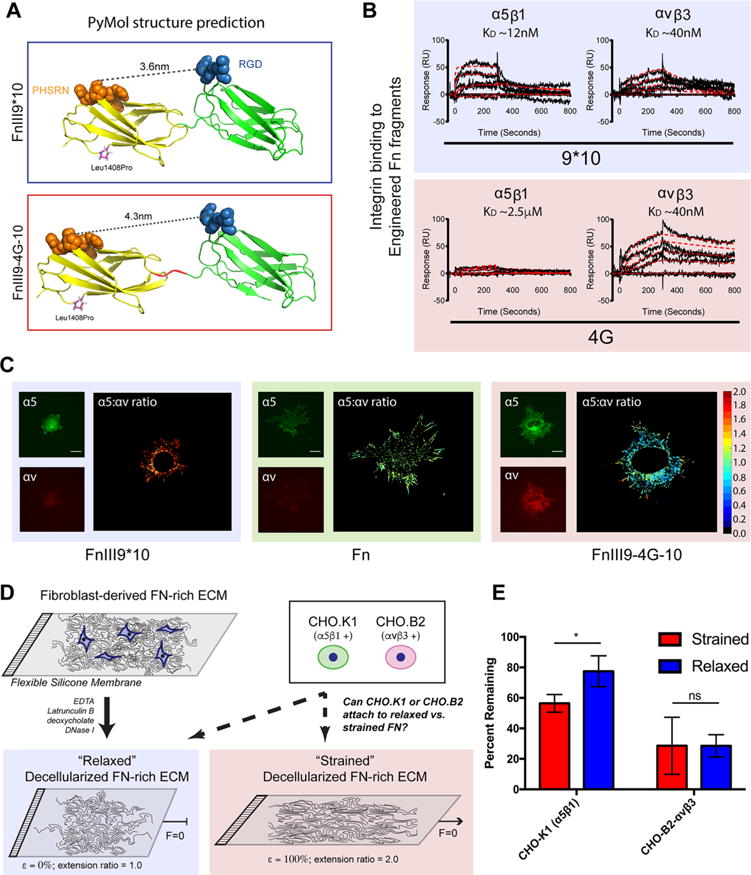
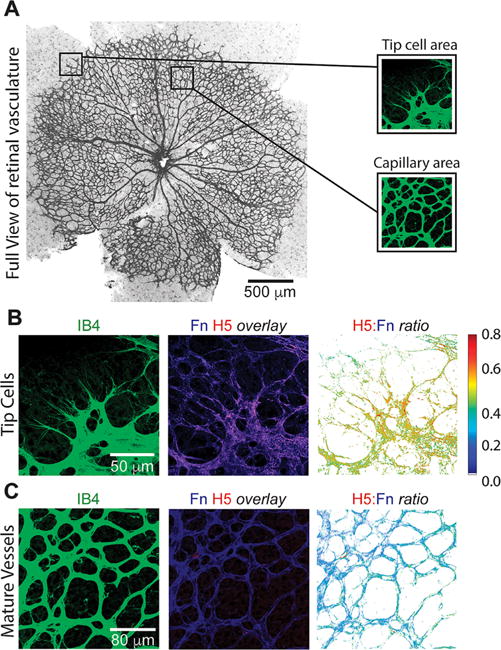
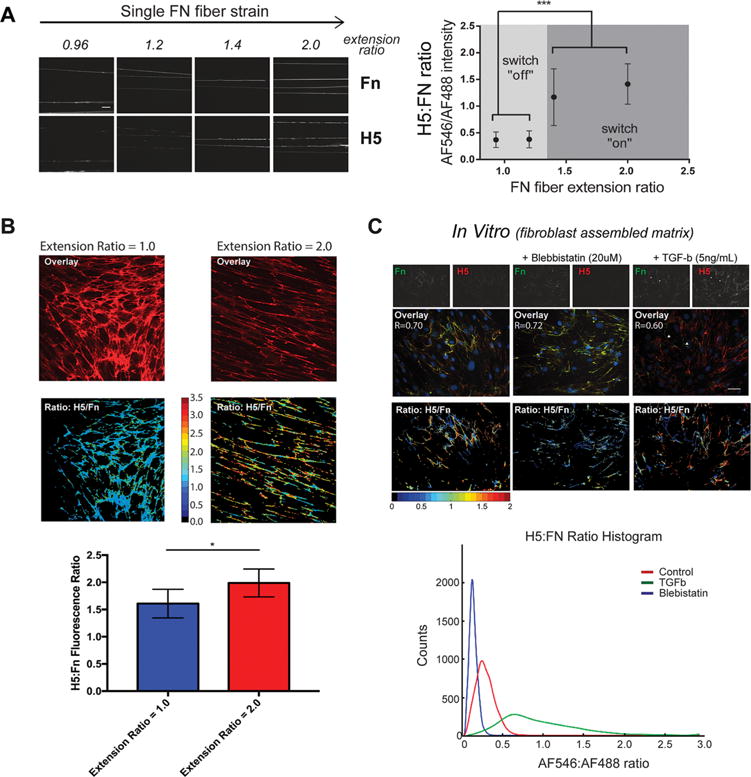
Fibronectin (Fn) is an extracellular matrix protein that orchestrates complex cell adhesion and signaling through cell surface integrin receptors during tissue development, remodeling, and disease, such as fibrosis. Fn is sensitive to mechanical forces in its tandem type III repeats, resulting in extensive molecular enlongation. As such, it has long been hypothesized that cell- and tissue-derived forces may activate an "integrin switch" within the critical integrin-binding ninth and 10th type III repeats-conferring differential integrin-binding specificity, leading to differential cell responses. Yet, no direct evidence exists to prove the hypothesis nor demonstrate the physiological existence of the switch. We report direct experimental evidence for the Fn integrin switch both in vitro and ex vivo using a scFv engineered to detect the transient, force-induced conformational change, representing an opportunity for detection and targeting of early molecular signatures of cell contractile forces in tissue repair and disease.
纤连蛋白(Fn)是一种细胞外基质蛋白,在组织发育、重塑和疾病(如纤维化)过程中,通过细胞表面整合素受体,协调复杂的细胞黏附和信号转导。Fn 在其串联的 III 型重复序列中对机械力敏感,导致广泛的分子延伸。因此,人们长期以来一直假设,细胞和组织产生的力可能会在关键的整合素结合第九和第十个 III 型重复序列内激活“整合素开关”,赋予不同的整合素结合特异性,从而导致不同的细胞反应。然而,目前还没有直接的证据来证明该假说,也没有证明该开关的生理存在。我们使用 scFv 报告了 Fn 整合素开关的直接实验证据,该 scFv 是为检测瞬时力诱导的构象变化而设计的,这为检测和靶向组织修复和疾病中细胞收缩力的早期分子特征提供了机会。