Majdan Marek, Plancikova Dominika, Maas Andrew, Polinder Suzanne, Feigin Valery, Theadom Alice, Rusnak Martin, Brazinova Alexandra, Haagsma Juanita
Department of Public Health, Faculty of Health Sciences and Social Work, Trnava University, Trnava, Slovakia.
Department of Neurosurgery, Antwerp University Hospital and University of Antwerp, Edegem, Belgium.
PLoS Med. 2017 Jul 11;14(7):e1002331. doi: 10.1371/journal.pmed.1002331. eCollection 2017 Jul.
Traumatic brain injuries (TBIs) are a major public health, medical, and societal challenge globally. They present a substantial burden to victims, their families, and the society as a whole. Although indicators such as incidence or death rates provide insight into the occurrence and outcome of TBIs in various populations, they fail to quantify the full extent of their public health and societal impact. Measures such as years of life lost (YLLs), which quantifies the number of years of life lost because the person dies prematurely due to a disease or injury, should be employed to better quantify the population impact. The aim of this study was to provide an in-depth analysis of the burden of deaths due to TBI by calculating TBI-specific YLLs in 16 European countries, analyzing their main causes and demographic patterns, using data extracted from death certificates under unified guidelines and collected in a standardized manner.
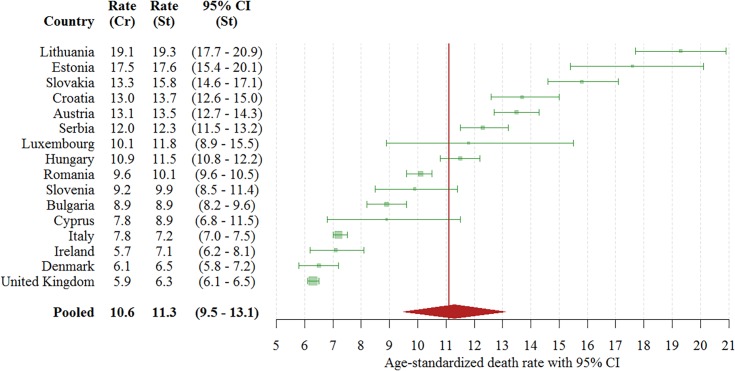
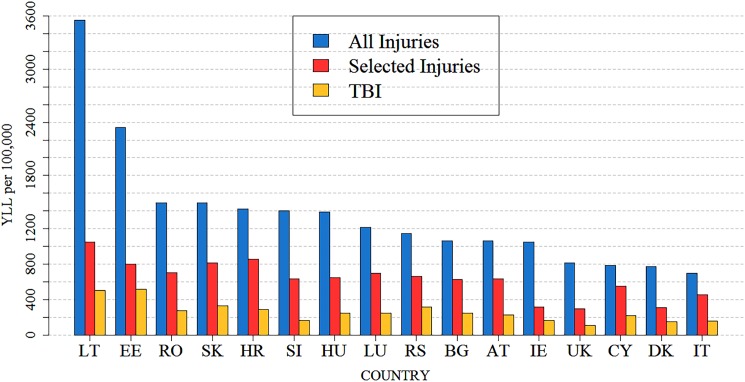
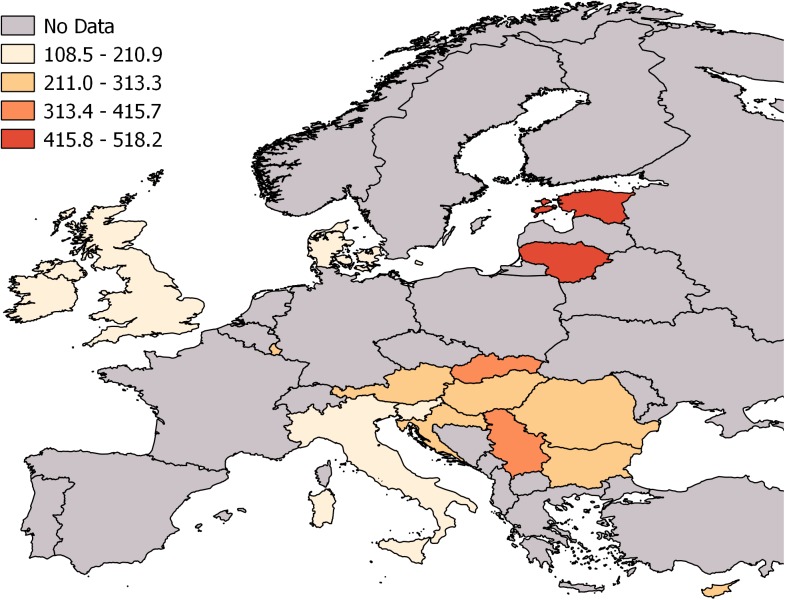
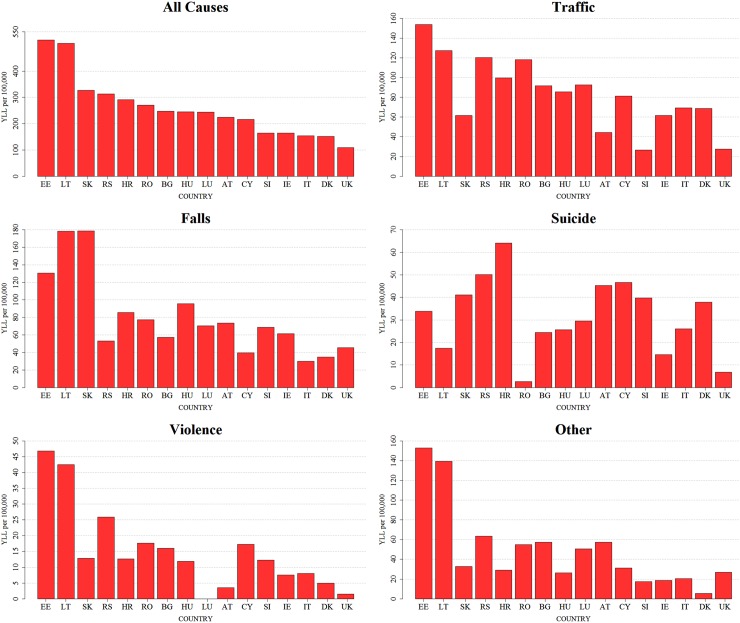
A population-wide, cross-sectional epidemiological study was conducted in 16 European countries to estimate TBI YLLs for the year 2013. The data used for all analyses in this study were acquired from the statistical office of the European Union (Eurostat). A specifically tailored dataset of micro-level data was provided that listed the external cause of death (International Classification of Diseases-10th Revision [ICD-10] codes V01-Y98), the specific nature of injury (ICD-10 codes S00-T98), the age at death, and sex for each death. Overall number of TBI YLLs, crude and age-standardized TBI YLL rates, and TBI YLLs per case were calculated stratified for country, sex, and age. Pooled analyses were performed in order to estimate summary age-standardized rates of TBI YLLs. In order to evaluate the relative importance of TBI in the context of all injuries, proportions of TBI YLLs out of overall injury YLLs were calculated. The total number of TBI YLLs was estimated by extrapolating the pooled crude rate of TBI YLLs in the 16 analyzed countries to the total population of the 28 member states of the EU (EU-28). We found that a total of 17,049 TBI deaths occurred in 2013 in the 16 analyzed countries. These translated into a total of 374,636 YLLs. The pooled age-standardized rate of YLLs per 100,000 people per year was 259.1 (95% CI: 205.8 to 312.3) overall, 427.5 (95% CI: 290.0 to 564.9) in males, and 105.4 (95% CI: 89.1 to 121.6) in females. Males contributed substantially more to TBI YLLs than females (282,870 YLLs, 76% of all TBI YLLs), which translated into a rate ratio of 3.24 (95% CI: 3.22 to 3.27). Each TBI death was on average associated with 24.3 (95% CI: 22.0 to 26.6) YLLs overall, 25.6 (95% CI: 23.4 to 27.8) in males and 20.9 (17.9 to 24.0) in females. Falls and traffic crashes were the most common external causes of TBI YLLs. TBI contributed on average 41% (44% in males and 34% in females) to overall injury YLLs. Extrapolating our findings, about 1.3 million YLLs were attributable to TBI in the EU-28 in 2013 overall, 1.1 million in males and 271,000 in females. This study is based on administratively collected data from 16 countries, and despite the efforts to harmonize them to the greatest possible extent, there may be differences in coding practices or reporting between countries. If present, these would be inherited into our findings without our ability to control for them. The extrapolation of the pooled rates from the 16 countries to the EU-28 should be interpreted with caution.
Our study showed that TBI-related deaths and YLLs have a substantial impact at the individual and population level in Europe and present an important societal and economic burden that must not be overlooked. We provide information valuable for policy-makers, enabling them to evaluate and plan preventive activities and resource allocation, and to formulate and implement strategic decisions. In addition, our results can serve as a basis for analyzing the overall burden of TBI in the population.
创伤性脑损伤(TBI)是全球主要的公共卫生、医学和社会挑战。它们给受害者、其家庭以及整个社会带来了沉重负担。尽管诸如发病率或死亡率等指标能让我们了解不同人群中TBI的发生情况和结果,但它们无法量化其对公共卫生和社会影响的全部程度。诸如寿命损失年数(YLLs)等指标,可量化因疾病或损伤导致过早死亡而损失的寿命年数,应用这些指标能更好地量化对人群的影响。本研究的目的是通过计算16个欧洲国家特定于TBI的YLLs,深入分析TBI导致的死亡负担,分析其主要原因和人口统计学模式,所使用的数据是根据统一指南从死亡证明中提取并以标准化方式收集的。
在16个欧洲国家开展了一项全人群横断面流行病学研究,以估算2013年TBI的YLLs。本研究所有分析所使用的数据均来自欧盟统计局(Eurostat)。提供了一个经过专门定制的微观层面数据集,列出了每个死亡案例的外部死因(国际疾病分类第十版[ICD - 10]编码V01 - Y98)、损伤的具体性质(ICD - 10编码S00 - T98)、死亡年龄和性别。按国家、性别和年龄分层计算了TBI的YLLs总数、粗率和年龄标准化TBI YLL率以及每个案例的TBI YLLs。进行汇总分析以估算TBI YLLs的汇总年龄标准化率。为了评估TBI在所有损伤背景下的相对重要性,计算了TBI YLLs在总体损伤YLLs中所占的比例。通过将16个分析国家中TBI YLLs的汇总粗率推算至欧盟28个成员国的总人口,估算了TBI YLLs的总数。我们发现,2013年在16个分析国家中,共有17,049例TBI死亡。这些死亡导致总计374,636个YLLs。每年每10万人的汇总年龄标准化YLL率总体为259.1(95%CI:205.8至312.3),男性为427.