Loneman Derek M, Peddicord Layton, Al-Rashid Amani, Nikolau Basil J, Lauter Nick, Yandeau-Nelson Marna D
Department of Genetics, Development & Cell Biology, Ames, Iowa, United States of America.
NSF-Engineering Research Center for Biorenewable Chemicals, Iowa State University, Ames, Iowa, United States of America.
PLoS One. 2017 Jul 11;12(7):e0180850. doi: 10.1371/journal.pone.0180850. eCollection 2017.
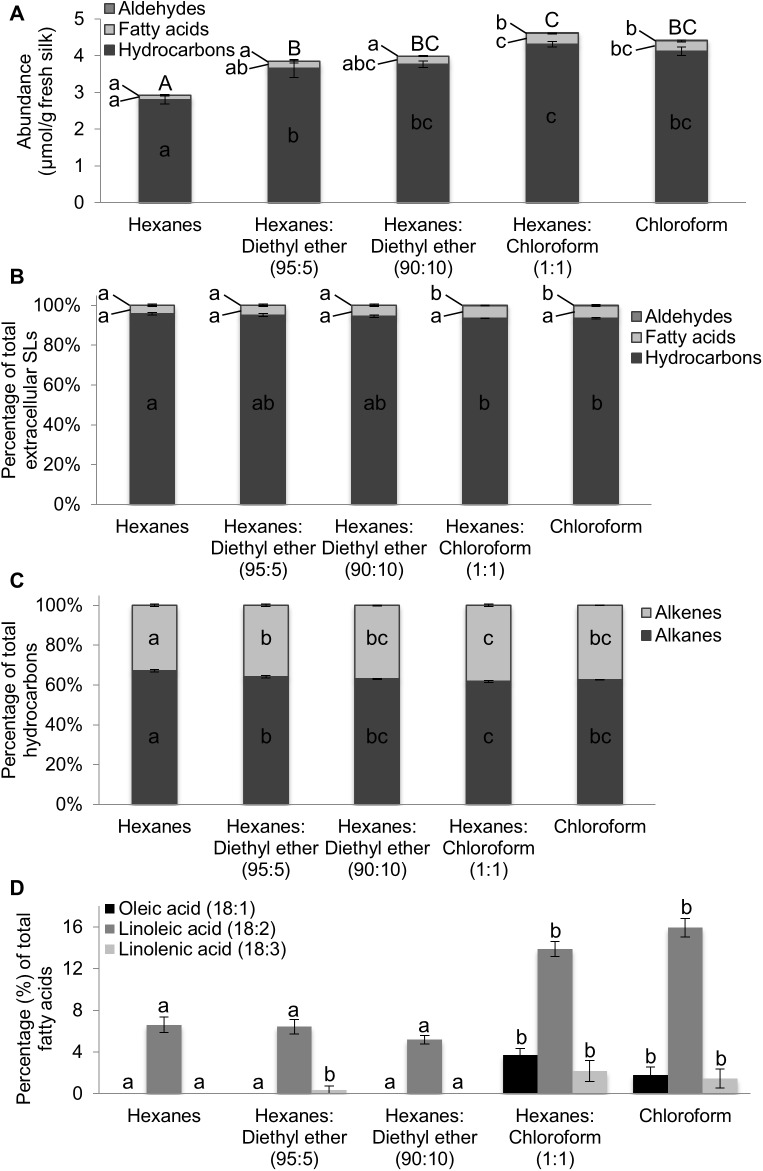
Aerial plant organs possess a diverse array of extracellular surface lipids, including both non-polar and amphipathic constituents that collectively provide a primary line of defense against environmental stressors. Extracellular surface lipids on the stigmatic silks of maize are composed primarily of saturated and unsaturated linear hydrocarbons, as well as fatty acids, and aldehydes. To efficiently extract lipids of differing polarities from maize silks, five solvent systems (hexanes; hexanes:diethyl ether (95:5); hexanes:diethyl ether (90:10); chloroform:hexanes (1:1) and chloroform) were tested by immersing fresh silks in solvent for different extraction times. Surface lipid recovery and the relative composition of individual constituents were impacted to varying degrees depending on solvent choice and duration of extraction. Analyses were performed using both silks and leaves to demonstrate the utility of the solvent- and time-optimized protocol in comparison to extraction with the commonly used chloroform solvent. Overall, the preferred solvent system was identified as hexanes:diethyl ether (90:10), based on its effectiveness in extracting surface hydrocarbons and fatty acids as well as its reduced propensity to extract presumed internal fatty acids. Metabolite profiling of wildtype and glossy1 seedlings, which are impaired in surface lipid biosynthesis, demonstrated the ability of the preferred solvent to extract extracellular surface lipids rich in amphipathic compounds (aldehydes and alcohols). In addition to the expected deficiencies in dotriacontanal and dotriacontan-1-ol for gl1 seedlings, an unexpected increase in fatty acid recovery was observed in gl1 seedlings extracted in chloroform, suggesting that chloroform extracts lipids from internal tissues of gl1 seedlings. This highlights the importance of extraction method when evaluating mutants that have altered cuticular lipid compositions. Finally, metabolite profiling of silks from maize inbreds B73 and Mo17, exposed to different environments and harvested at different ages, revealed differences in hydrocarbon and fatty acid composition, demonstrating the dynamic nature of surface lipid accumulation on silks.
气生植物器官具有多种细胞外表面脂质,包括非极性和两亲性成分,它们共同构成了抵御环境压力的第一道防线。玉米柱头丝上的细胞外表面脂质主要由饱和和不饱和直链烃、脂肪酸以及醛类组成。为了从玉米丝中有效提取不同极性的脂质,通过将新鲜的玉米丝浸泡在溶剂中不同提取时间,测试了五种溶剂体系(己烷;己烷:乙醚(95:5);己烷:乙醚(90:10);氯仿:己烷(1:1)和氯仿)。表面脂质回收率和各成分的相对组成受溶剂选择和提取时间的影响程度各不相同。使用玉米丝和叶片进行分析,以证明与常用氯仿溶剂提取相比,溶剂和时间优化方案的实用性。总体而言,基于其在提取表面烃类和脂肪酸方面有效,以及提取假定内部脂肪酸的倾向较低,首选溶剂体系被确定为己烷:乙醚(90:10)。对表面脂质生物合成受损的野生型和glossy1幼苗进行代谢物谱分析,证明了首选溶剂能够提取富含两亲性化合物(醛类和醇类)的细胞外表面脂质。除了gl1幼苗中预期的三十二烷醛和三十二烷 -1-醇缺乏外,在氯仿中提取的gl1幼苗中观察到脂肪酸回收率意外增加,这表明氯仿从gl1幼苗的内部组织中提取脂质。这突出了在评估表皮脂质组成发生改变的突变体时提取方法的重要性。最后,对暴露于不同环境并在不同年龄收获的玉米自交系B73和Mo17的玉米丝进行代谢物谱分析,揭示了烃类和脂肪酸组成的差异,证明了玉米丝表面脂质积累的动态性质。