Yeap Loh Ping, Liang Yeoh Wen, Nakashima Hiroki, Muraki Satoshi
Department of Human Science, Faculty of Design, Kyushu University.
Research Fellow of Japan Society for the Promotion of Science.
J Occup Health. 2017 Sep 28;59(5):408-417. doi: 10.1539/joh.17-0058-OA. Epub 2017 Jul 13.
The primary objective was to investigate the effects of continuous typing on median nerve changes at the carpal tunnel region at two different keyboard slopes (0° and 20°). The secondary objective was to investigate the differences in wrist kinematics and the changes in wrist anthropometric measurements when typing at the two different keyboard slopes.
Fifteen healthy right-handed young men were recruited. A randomized sequence of the conditions (control, typing I, and typing II) was assigned to each participant. Wrist anthropometric measurements, wrist kinematics data collection and ultrasound examination to the median nerve was performed at designated time block.
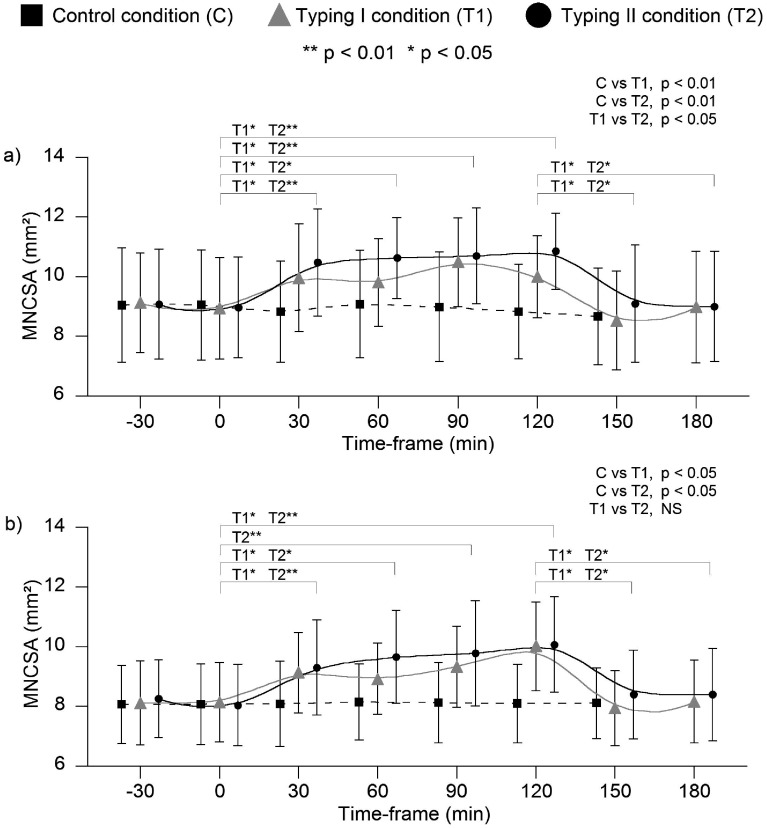
Typing activity and time block do not cause significant changes to the wrist anthropometric measurements. The wrist measurements remained similar across all the time blocks in the three conditions. Subsequently, the wrist extensions and ulnar deviations were significantly higher in both the typing I and typing II conditions than in the control condition for both wrists (p<0.05). Additionally, the median nerve cross-sectional area (MNCSA) significantly increased in both the typing I and typing II conditions after the typing task than before the typing task. The MNCSA significantly decreased in the recovery phase after the typing task.
This study demonstrated the immediate changes in the median nerve after continuous keyboard typing. Changes in the median nerve were greater during typing using a keyboard tilted at 20° than during typing using a keyboard tilted at 0°. The main findings suggest wrist posture near to neutral position caused lower changes of the median nerve.
主要目的是研究在两种不同键盘倾斜度(0°和20°)下持续打字对腕管区域正中神经变化的影响。次要目的是研究在两种不同键盘倾斜度下打字时手腕运动学的差异以及手腕人体测量学指标的变化。
招募了15名健康的右利手年轻男性。为每位参与者分配了一个随机的条件序列(对照、打字I和打字II)。在指定的时间段进行手腕人体测量、手腕运动学数据收集以及正中神经的超声检查。
打字活动和时间段对手腕人体测量指标没有显著影响。在三种条件下的所有时间段内,手腕测量结果均保持相似。随后,打字I和打字II条件下双手的手腕伸展和尺侧偏斜均显著高于对照条件(p<0.05)。此外,打字任务后打字I和打字II条件下的正中神经横截面积(MNCSA)均显著高于打字任务前。打字任务后的恢复阶段,MNCSA显著降低。
本研究证明了持续键盘打字后正中神经的即时变化。使用倾斜20°的键盘打字时正中神经的变化大于使用倾斜0°的键盘打字时。主要研究结果表明,接近中立位置的手腕姿势导致正中神经的变化较小。