Kawazoe Nozomi, Kimata Yukio, Izawa Shingo
Laboratory of Microbial Technology, Graduate School of Science and Technology, Kyoto Institute of TechnologyKyoto, Japan.
Graduate School of Biological Sciences, Nara Institute of Science and TechnologyNara, Japan.
Front Microbiol. 2017 Jun 28;8:1192. doi: 10.3389/fmicb.2017.01192. eCollection 2017.
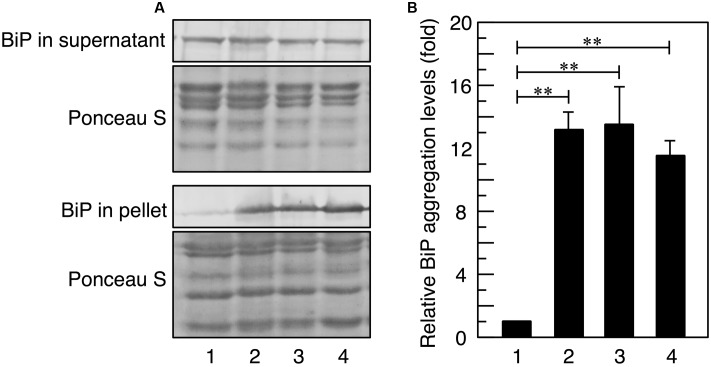
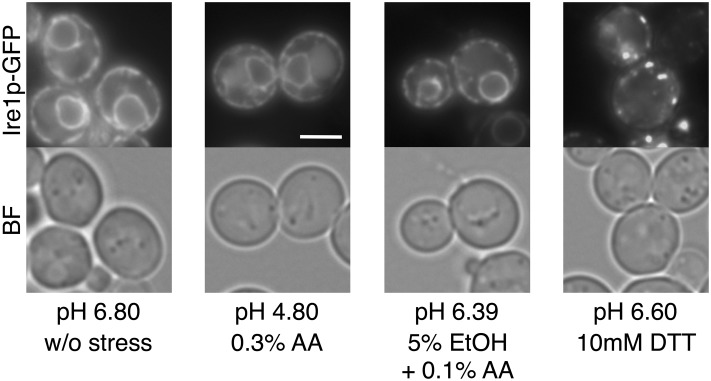
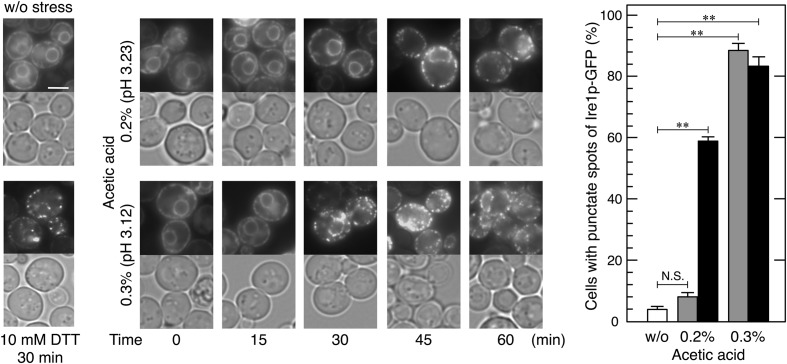
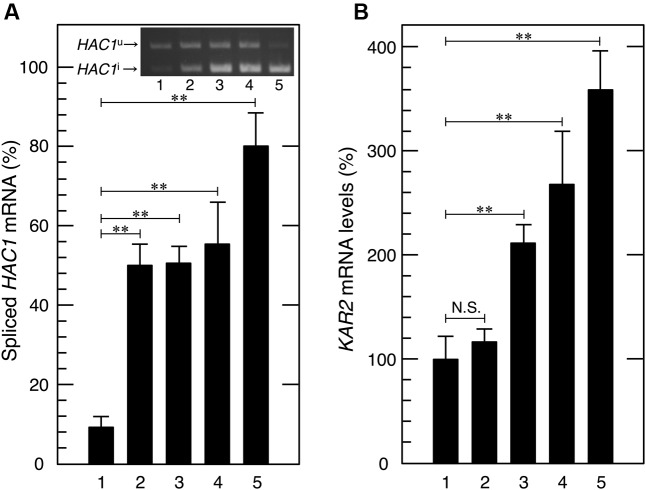
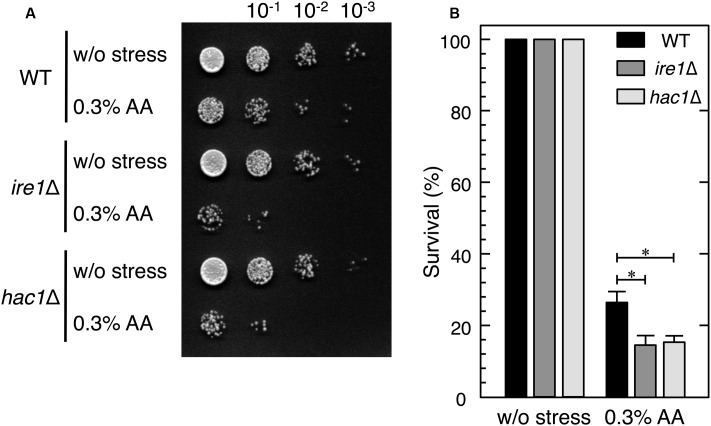
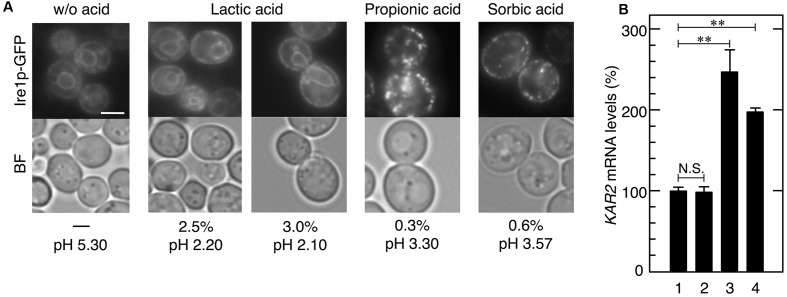
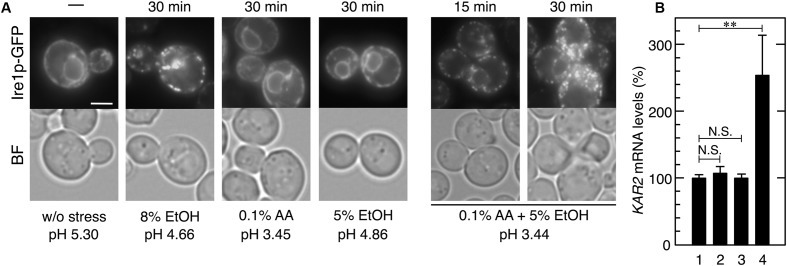
Since acetic acid inhibits the growth and fermentation ability of , it is one of the practical hindrances to the efficient production of bioethanol from a lignocellulosic biomass. Although extensive information is available on yeast response to acetic acid stress, the involvement of endoplasmic reticulum (ER) and unfolded protein response (UPR) has not been addressed. We herein demonstrated that acetic acid causes ER stress and induces the UPR. The accumulation of misfolded proteins in the ER and activation of Ire1p and Hac1p, an ER-stress sensor and ER stress-responsive transcription factor, respectively, were induced by a treatment with acetic acid stress (>0.2% v/v). Other monocarboxylic acids such as propionic acid and sorbic acid, but not lactic acid, also induced the UPR. Additionally, Δ and Δ cells were more sensitive to acetic acid than wild-type cells, indicating that activation of the Ire1p-Hac1p pathway is required for maximum tolerance to acetic acid. Furthermore, the combination of mild acetic acid stress (0.1% acetic acid) and mild ethanol stress (5% ethanol) induced the UPR, whereas neither mild ethanol stress nor mild acetic acid stress individually activated Ire1p, suggesting that ER stress is easily induced in yeast cells during the fermentation process of lignocellulosic hydrolysates. It was possible to avoid the induction of ER stress caused by acetic acid and the combined stress by adjusting extracellular pH.
由于乙酸会抑制[具体对象]的生长和发酵能力,它是从木质纤维素生物质高效生产生物乙醇的实际障碍之一。尽管关于酵母对乙酸胁迫的反应已有大量信息,但内质网(ER)和未折叠蛋白反应(UPR)的参与情况尚未得到探讨。我们在此证明,乙酸会引发内质网应激并诱导未折叠蛋白反应。用乙酸胁迫(>0.2% v/v)处理会诱导内质网中错误折叠蛋白的积累以及分别作为内质网应激传感器和内质网应激反应转录因子的Ire1p和Hac1p的激活。其他一元羧酸如丙酸和山梨酸,但不是乳酸,也会诱导未折叠蛋白反应。此外,Δ和Δ细胞对乙酸比野生型细胞更敏感,这表明激活Ire1p - Hac1p途径是对乙酸最大耐受性所必需的。此外,轻度乙酸胁迫(0.1%乙酸)和轻度乙醇胁迫(5%乙醇)的组合会诱导未折叠蛋白反应,而单独的轻度乙醇胁迫或轻度乙酸胁迫均未激活Ire1p,这表明在木质纤维素水解产物的发酵过程中,酵母细胞很容易诱导内质网应激。通过调节细胞外pH值有可能避免由乙酸和联合胁迫引起的内质网应激的诱导。