Devos Fien C, Pollaris Lore, Cremer Jonathan, Seys Sven, Hoshino Tomoaki, Ceuppens Jan, Talavera Karel, Nemery Benoit, Hoet Peter H M, Vanoirbeek Jeroen A J
Centre for Environment and Health, Department of Public Health and Primary Care, University of Leuven, Leuven, Belgium.
Laboratory of Clinical Immunology, Department of Microbiology and Immunology, University of Leuven, Leuven, Belgium.
PLoS One. 2017 Jul 13;12(7):e0180690. doi: 10.1371/journal.pone.0180690. eCollection 2017.
While the importance of the Th2 cytokine IL-13 as a central mediator of airway hyperreactivity (AHR) has been described in allergic protein-induced asthma, this has never been investigated in chemical-induced asthma.
We examined the importance of IL-13 in a mouse model of chemical-induced AHR, using toluene-2,4-diisocyanate (TDI).
In a first set-up, wild type (WT) and IL-13 knockout (KO) C57Bl/6 mice were dermally treated on days 1 and 8 with 1% TDI or vehicle (acetone/olive oil) on both ears. On day 15, mice received an intranasal instillation with 0.1% TDI or vehicle. In a second set-up, WT mice sensitized with 1% TDI or vehicle, received i.v. either anti-IL-13 or control antibody prior to the intranasal challenge.
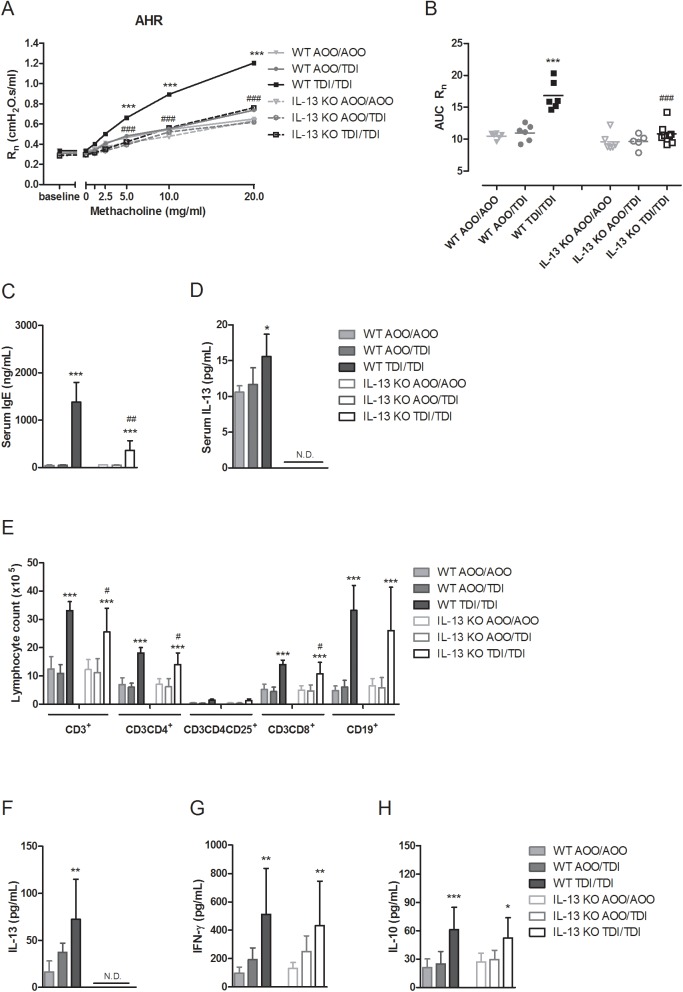
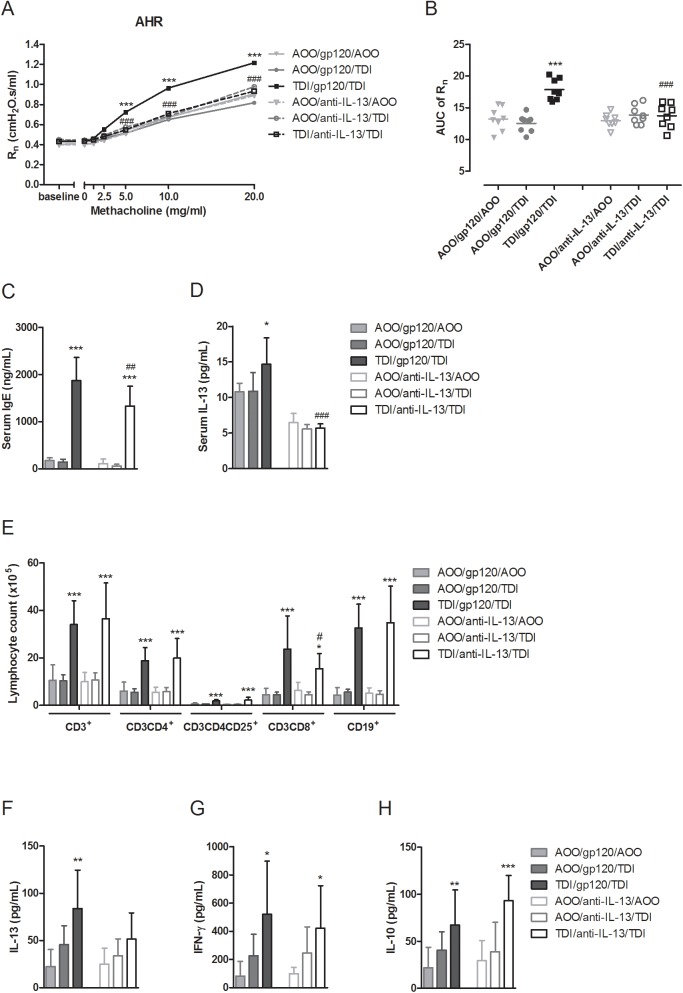
TDI-sensitized and TDI-challenged WT mice showed AHR to methacholine, in contrast to TDI-sensitized and TDI-challenged IL-13 KO mice, which also showed lower levels of total serum IgE. TDI-sensitized and TDI-challenged IL-13 KO mice had lower numbers of T-cells in the auricular lymph nodes. TDI-treated WT mice, receiving anti-IL-13, showed no AHR, in contrast to those receiving control antibody, despite increased levels of IgE. Anti-IL-13 treatment in TDI-treated WT mice resulted in lower levels of serum IL-13, but did not induce changes in T- and B-cell numbers, and in the cytokine production profile.
We conclude that IL-13 plays a critical role in the effector phase of chemical-induced, immune-mediated AHR. This implicates that anti-IL-13 treatment could have a beneficial effect in patients with this asthma phenotype.
虽然Th2细胞因子白细胞介素-13(IL-13)作为过敏性蛋白诱导哮喘中气道高反应性(AHR)的核心介质的重要性已得到描述,但在化学物质诱导的哮喘中从未对此进行过研究。
我们使用甲苯-2,4-二异氰酸酯(TDI),在化学物质诱导的AHR小鼠模型中研究了IL-13的重要性。
在第一种实验设置中,野生型(WT)和IL-13基因敲除(KO)的C57Bl/6小鼠在第1天和第8天,双耳均用1% TDI或赋形剂(丙酮/橄榄油)进行皮肤处理。在第15天,小鼠经鼻内滴注0.1% TDI或赋形剂。在第二种实验设置中,用1% TDI或赋形剂致敏的WT小鼠,在鼻内激发前静脉注射抗IL-13或对照抗体。
与TDI致敏和激发的IL-13 KO小鼠相比,TDI致敏和激发的WT小鼠对乙酰甲胆碱表现出AHR,IL-13 KO小鼠的总血清IgE水平也较低。TDI致敏和激发的IL-13 KO小鼠耳后淋巴结中的T细胞数量较少。与接受对照抗体的TDI处理的WT小鼠相比,接受抗IL-13的TDI处理的WT小鼠未表现出AHR,尽管IgE水平升高。TDI处理的WT小鼠接受抗IL-13治疗后,血清IL-13水平降低,但未引起T细胞和B细胞数量以及细胞因子产生谱的变化。
我们得出结论,IL-13在化学物质诱导的、免疫介导的AHR的效应阶段起关键作用。这意味着抗IL-13治疗可能对这种哮喘表型的患者有有益作用。