Suzuki Takeshi, Nunes Maria Andreia, España María Urizarna, Namin Hooman Hosseinzadeh, Jin Pengyu, Bensoussan Nicolas, Zhurov Vladimir, Rahman Tawhid, De Clercq Rebecca, Hilson Pierre, Grbic Vojislava, Grbic Miodrag
Department of Biology, The University of Western Ontario, London, Ontario, Canada.
Department of Plant Systems Biology, VIB, Ghent, Belgium.
PLoS One. 2017 Jul 12;12(7):e0180654. doi: 10.1371/journal.pone.0180654. eCollection 2017.
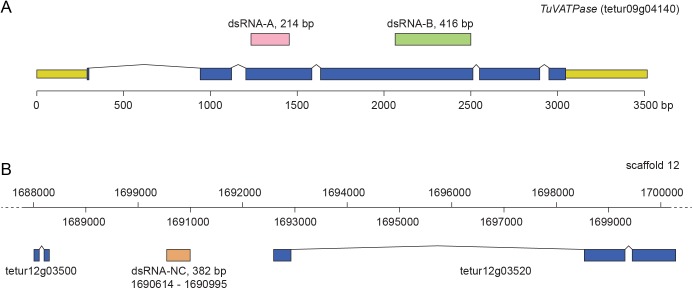
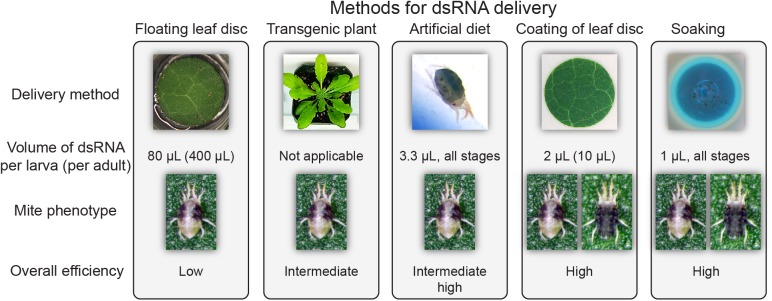
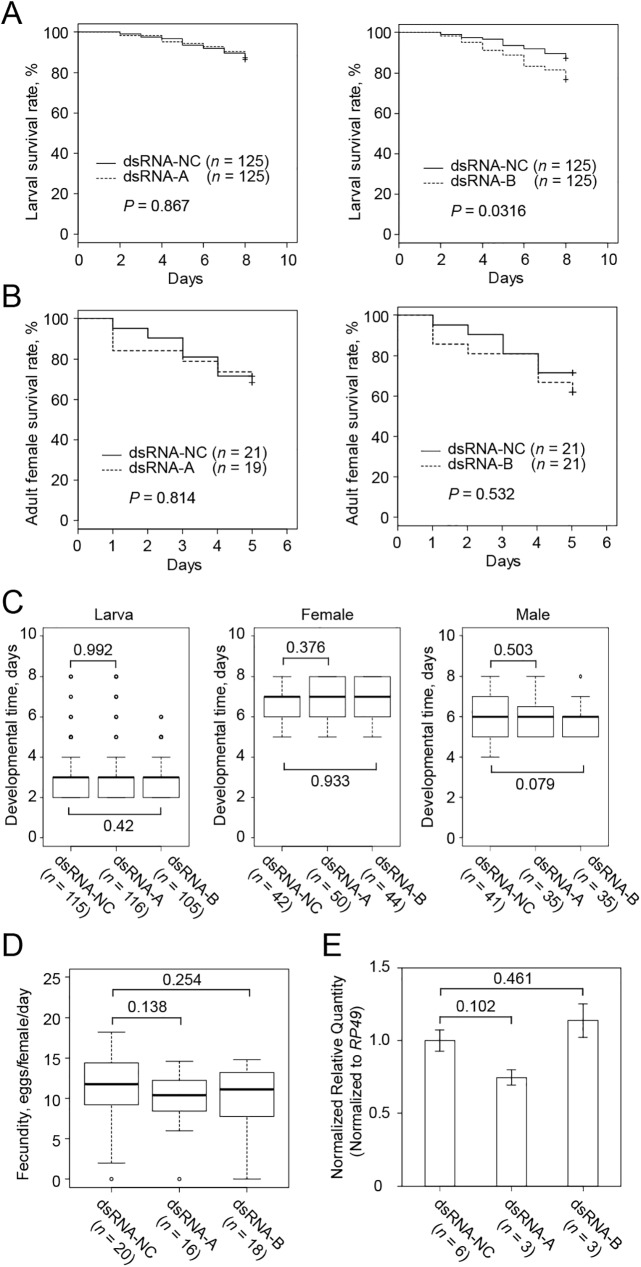
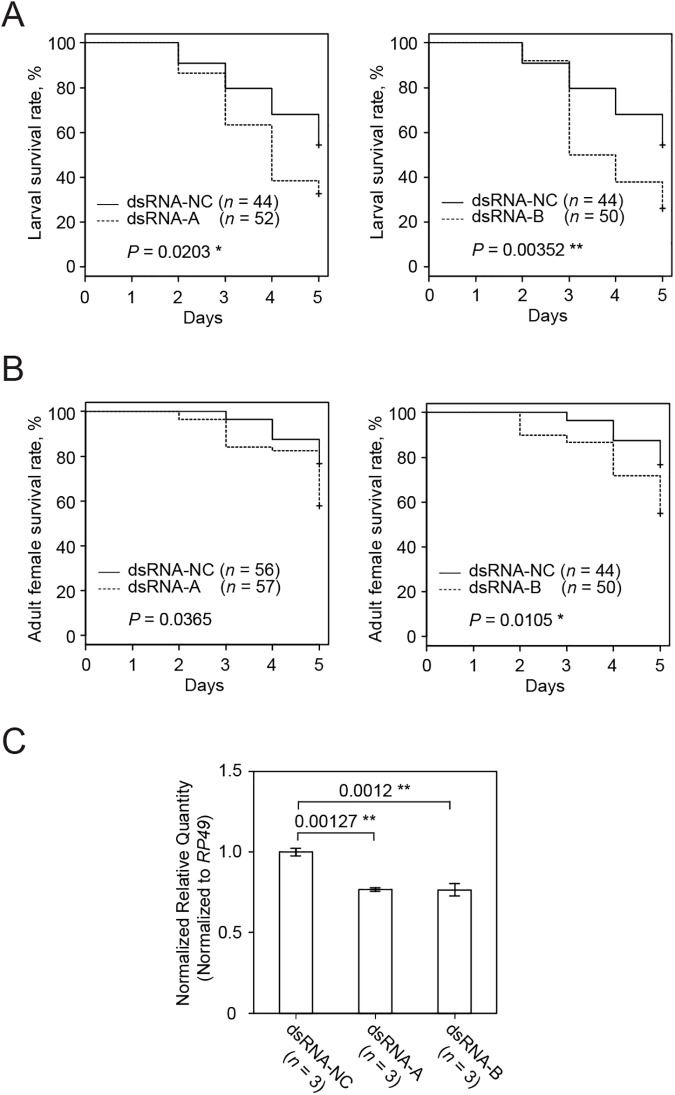
RNA interference (RNAi) can be used for the protection against agricultural pests through the silencing of genes required for pest fitness. To assess the potential of RNAi approaches in the two-spotted spider mite, Tetranychus urticae, we compared 5 methods for the delivery of double-stranded RNA (dsRNA). These methods include mite feeding on either (i) leaves floating on a dsRNA solution, (ii) dsRNA-expressing plants, (iii) artificial diet supplemented with dsRNA, or (iv) dsRNA-coated leaves, and (v) mite soaking in a dsRNA solution. In all cases, the gene targeted for method validation was the Vacuolar-type H+-ATPase (TuVATPase), encoding a constitutively expressed ATP-driven proton pump located in the membrane. Down-regulation of TuVATPase increased mortality and/or reduced fecundity in all methods, but with variable efficiency. The most efficient methods for dsRNA delivery were direct soaking of mites in the dsRNA solution and mite feeding on dsRNA-coated leaves that mimics dsRNA application as a sprayable pesticide. Both resulted in a dark-body phenotype not observed in mites treated with a control dsRNA. Although with lower efficiency, dsRNA designed for TuVATPase silencing and expressed in transgenic Arabidopsis plants impacted the fitness of mites feeding on these plants. RNAi may thus be a valuable strategy to control spider mite populations, either as a sprayable pesticide or through transgenic crops. This comparative methodological study focusing on the induction of RNAi-based gene silencing in T. urticae paves the way for reverse genetics approaches in this model chelicerate system and prepares large-scale systematic RNAi screens as a first step towards the development of specific RNA-based pesticides. Such alternative molecules may help control spider mites that cause significant damages to crops and ornamental plant species, as well as other chelicerates detrimental to agriculture and health.
RNA干扰(RNAi)可通过使害虫生存所需的基因沉默来用于防治农业害虫。为了评估RNAi方法在二斑叶螨(Tetranychus urticae)中的应用潜力,我们比较了5种双链RNA(dsRNA)递送方法。这些方法包括让螨虫取食以下物质:(i)漂浮在dsRNA溶液上的叶片;(ii)表达dsRNA的植物;(iii)添加了dsRNA的人工饲料;或(iv)包被有dsRNA的叶片,以及(v)将螨虫浸泡在dsRNA溶液中。在所有情况下,用于方法验证的靶基因都是液泡型H⁺-ATP酶(TuVATPase),它编码一种位于膜上的组成型表达的ATP驱动质子泵。在所有方法中,TuVATPase的下调均增加了死亡率和/或降低了繁殖力,但效率各不相同。最有效的dsRNA递送方法是将螨虫直接浸泡在dsRNA溶液中以及让螨虫取食包被有dsRNA的叶片,这模拟了作为可喷雾农药的dsRNA施用。两者均导致在对照dsRNA处理的螨虫中未观察到的黑体表型。尽管效率较低,但设计用于沉默TuVATPase并在转基因拟南芥植物中表达的dsRNA影响了取食这些植物的螨虫的适合度。因此,RNAi可能是一种控制叶螨种群的有价值策略,既可以作为可喷雾农药,也可以通过转基因作物来实现。这项侧重于在二斑叶螨中诱导基于RNAi的基因沉默的比较方法学研究,为这个模式螯肢动物系统中的反向遗传学方法铺平了道路,并为大规模系统RNAi筛选做了准备,这是朝着开发基于RNA的特异性农药迈出的第一步。这种替代分子可能有助于控制对农作物和观赏植物物种造成重大损害的叶螨,以及对农业和健康有害的其他螯肢动物。