Kim Sung Hee, Nepali Rajendra, Yoo Myung Hoon, Lee Kwang-Sun, Chung Jong Woo
Department of Otolaryngology, Asan Medical Center, University of Ulsan College of Medicine, Seoul, Korea.
Department of Otolaryngology-Head and Neck Surgery, Gandaki Medical College, Pokhara, Nepal.
J Audiol Otol. 2017 Jul;21(2):95-102. doi: 10.7874/jao.2017.21.2.95. Epub 2017 Jul 5.
The mutation of the gap junction protein beta 2 () gene is the predominant cause of autosomal recessive non-syndromic hearing loss. The purpose of this study was to evaluate the speech perception outcome after cochlear implantation according to the presence of a mutation.
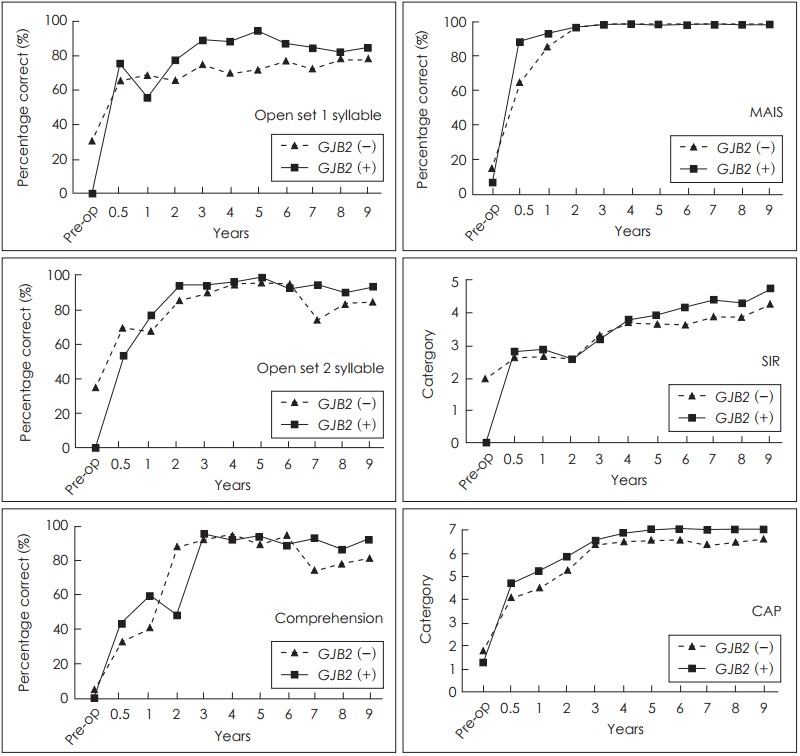
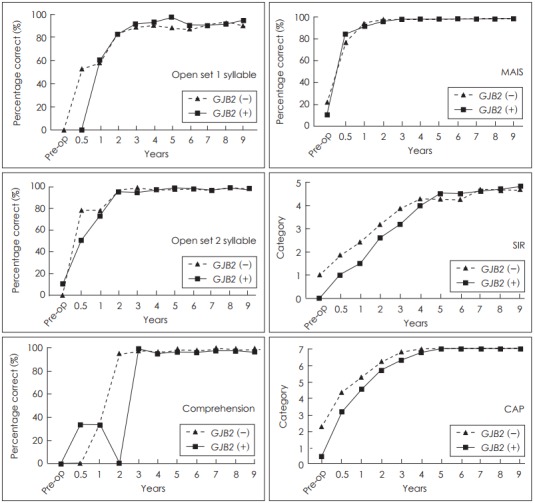
During the period from March 2004 to February 2005, 38 patients underwent cochlear implantation at Asan Medical Center. Genetic factors and speech perception were evaluated in all subjects, and the patients were grouped according to the presence of a mutation. The two groups were carefully matched according to the age at cochlear implantation. We analyzed four mutations in the gene: 35delG, 167delT, 235delC, and E114G. Speech perception outcomes were measured using the open set, 1 and 2 syllables, the comprehension test, the Meaningful Auditory Integration Scale, the categories of auditory performance, and the Speech Intelligibility Rating scores. The evaluations were performed before the operation, 6 and 12 months thereafter, and then annually up to nine years after cochlear implantation.
Fifteen patients had bi-allelic mutations (11 with E114G and 4 with 235delC), whereas the remaining 23 had wild type alleles. For the age-matched analysis, 14 patients were selected and divided into two groups of 7 subjects each: mutation and no mutation (i.e., deafness of unknown origin). Overall, all patients showed improvement of speech perception outcome after cochlear implantation. There was no difference in the improvement between patients with and without mutations at the 5-year and 9-year follow up. The pattern of improvement throughout the duration of the follow-up also showed no difference between the two groups.
Similar outcomes of speech perception are expected after cochlear implantation in pediatric patients with or without mutation.
缝隙连接蛋白β2()基因突变是常染色体隐性非综合征性听力损失的主要病因。本研究旨在根据是否存在突变评估人工耳蜗植入后的言语感知结果。
2004年3月至2005年2月期间,38例患者在峨山医疗中心接受了人工耳蜗植入。对所有受试者评估遗传因素和言语感知情况,并根据是否存在突变对患者进行分组。两组在人工耳蜗植入时的年龄方面进行了仔细匹配。我们分析了基因中的四种突变:35delG、167delT、235delC和E114G。使用开放式、1个和2个音节、理解测试、有意义听觉整合量表、听觉表现类别以及言语可懂度评分来测量言语感知结果。评估在手术前、术后6个月和12个月进行,然后在人工耳蜗植入后每年进行一次,直至9年。
15例患者有双等位基因突变(11例为E114G,4例为235delC),其余23例有野生型等位基因。对于年龄匹配分析,选择了14例患者并分为两组,每组7名受试者:突变组和无突变组(即不明原因耳聋组)。总体而言,所有患者人工耳蜗植入后言语感知结果均有改善。在5年和9年随访时,有突变和无突变患者之间的改善情况无差异。两组在整个随访期间的改善模式也无差异。
有或无突变的小儿患者人工耳蜗植入后预期言语感知结果相似。