Liu Hui, Chen Zhida, Zeng Wenrong, Xiong Yuanfei, Lin Yongzhi, Zhong Huacheng, Wu Jin
Department of Orthopaedics, The Affiliated Southeast Hospital of Xiamen University, Orthopaedic Center of People's Liberation Army, 363000, Zhangzhou, People's Republic of China.
Department of Medical Imaging, The Affiliated Southeast Hospital of Xiamen University, Orthopaedic Center of People's Liberation Army, 363000, Zhangzhou, People's Republic of China.
J Orthop Surg Res. 2017 Jul 14;12(1):111. doi: 10.1186/s13018-017-0610-3.
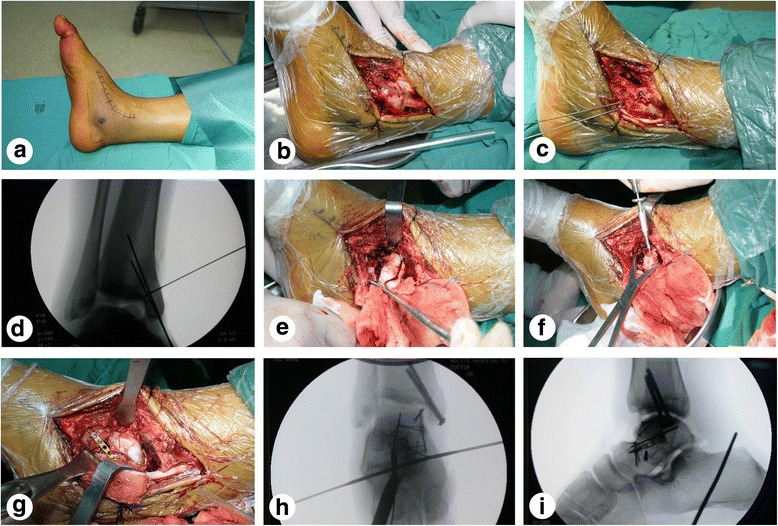
Fractures of the talar neck are relatively uncommon yet current interventions suffer from a high incidence of complications and poor functional outcomes. In the present study, we report a surgical treatment of Hawkins type III talar neck fracture through the approach of medial malleolar osteotomy and mini-plate for fixation and discuss the therapeutic effects after long-term follow-up.
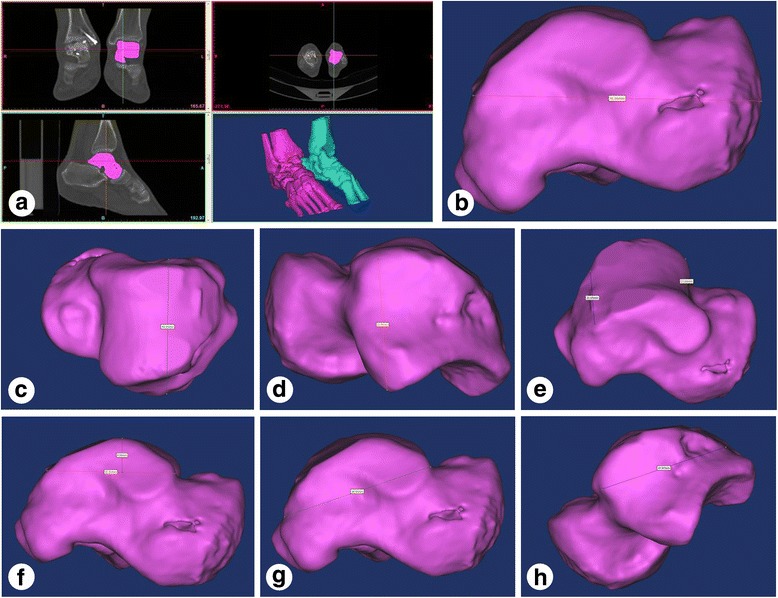
From January 2010 to January 2015, 21 patients with 22 fractures were treated using this approach within days of sustaining the injury. Clinical and radiographic data were collected during regular post-operative follow-ups. Health-related quality of life factors were evaluated using visual analogue scale (VAS). Functional outcomes were determined according the Hawkins score and the Ankle-Hind foot Scale of the American Orthopedic Foot and Ankle Society (AOFAS). Present of complications such as arthritis, avascular necrosis (AVN), and malunion were evaluated using radiographs and magnetic resonance imaging (MRI). Anatomical parameters of injured and corresponding uninjured talus were measured and compared using digital three-dimensional (3D) computer model.
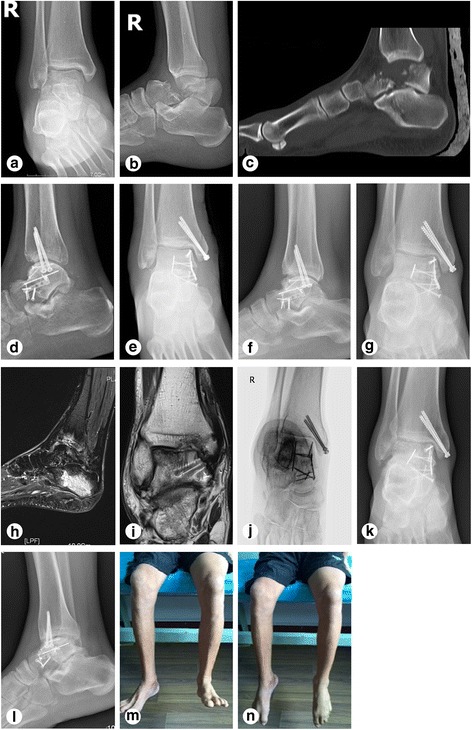
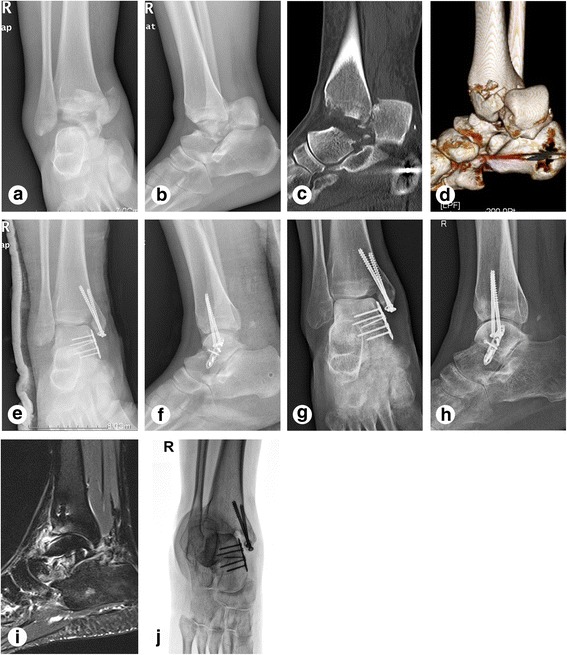
The mean duration of surgery was 65.6 ± 9.7 min. The average blood loss volume of the patients was 29.1 ± 5.7 ml. All the patients except 1 were followed up 18 to 41 months (average 29.6 months). The average VAS score for these patients was 3.2 ± 1.1, and the mean Hawkins score was 11.4 ± 3.4 at the final follow-up visit. The average AOFAS score was 72.8 ± 17.3. Nine patients outcomes were rated as "excellent", 4 as "good", 4 as "fair," and 4 as "poor". No malunion, screw loosening, plate breakage, or other internal fixation failures were found at final follow-up. Long-term complications included: 1 case of malunion, 5 cases of complete AVN, 8 cases of partial AVN, 13 cases of talocrural arthritis, 14 cases of subtalar arthritis, and 3 cases of talonavicular arthritis. Secondary surgery was performed in 4 cases. The relevant average anatomical data of injured and uninjured talus show no significant difference.
This surgical treatment we used here resulted in decreased soft tissue trauma, adequate exposure of talar neck, satisfactory performance of daily life activities, and quality of life following surgery and restoration of anatomy of injured talus. However, long-term complications such as arthritis and AVN are still commonly seen.
距骨颈骨折相对少见,但目前的治疗方法并发症发生率高且功能预后差。在本研究中,我们报告了一种通过内踝截骨和微型钢板固定治疗Hawkins III型距骨颈骨折的手术方法,并讨论了长期随访后的治疗效果。
2010年1月至2015年1月,21例(22处骨折)患者在受伤后数天内采用该方法治疗。在术后定期随访期间收集临床和影像学数据。使用视觉模拟量表(VAS)评估与健康相关的生活质量因素。根据Hawkins评分和美国矫形足踝协会(AOFAS)的踝-后足评分确定功能预后。使用X线片和磁共振成像(MRI)评估是否存在关节炎、缺血性坏死(AVN)和畸形愈合等并发症。使用数字三维(3D)计算机模型测量并比较受伤距骨和相应未受伤距骨的解剖参数。
平均手术时间为65.6±9.7分钟。患者平均失血量为29.1±5.7毫升。除1例患者外,所有患者均接受了18至41个月(平均29.6个月)的随访。这些患者的平均VAS评分为3.2±1.1,末次随访时平均Hawkins评分为11.4±3.4。平均AOFAS评分为72.8±17.3。9例患者的预后评为“优”,4例为“良”,4例为“中”,4例为“差”。末次随访时未发现畸形愈合、螺钉松动、钢板断裂或其他内固定失败情况。长期并发症包括:1例畸形愈合,5例完全性AVN,8例部分性AVN,13例踝关节关节炎,14例距下关节炎,3例距舟关节炎。4例患者接受了二次手术。受伤距骨和未受伤距骨的相关平均解剖数据无显著差异。
我们在此使用的这种手术治疗方法减少了软组织创伤,充分暴露了距骨颈,术后日常生活活动表现和生活质量令人满意,且恢复了受伤距骨的解剖结构。然而,关节炎和AVN等长期并发症仍然常见。