Barhanpurkar-Naik Amruta, Mhaske Suhas T, Pote Satish T, Singh Kanupriya, Wani Mohan R
National Centre for Cell Science, S. P. Pune University Campus, Pune, 411 007, India.
Stem Cell Res Ther. 2017 Jul 14;8(1):168. doi: 10.1186/s13287-017-0618-y.
Mesenchymal stem cells (MSCs) represent an important source for cell therapy in regenerative medicine. MSCs have shown promising results for repair of damaged tissues in various degenerative diseases in animal models and also in human clinical trials. However, little is known about the factors that could enhance the migration and tissue-specific engraftment of exogenously infused MSCs for successful regenerative cell therapy. Previously, we have reported that interleukin-3 (IL-3) prevents bone and cartilage damage in animal models of rheumatoid arthritis and osteoarthritis. Also, IL-3 promotes the differentiation of human MSCs into functional osteoblasts and increases their in-vivo bone regenerative potential in immunocompromised mice. However, the role of IL-3 in migration of MSCs is not yet known. In the present study, we investigated the role of IL-3 in migration of human MSCs under both in-vitro and in-vivo conditions.
MSCs isolated from human bone marrow, adipose and gingival tissues were used for in-vitro cell migration, motility and wound healing assays in the presence or absence of IL-3. The effect of IL-3 preconditioning on expression of chemokine receptors and integrins was examined by flow cytometry and real-time PCR. The in-vivo migration of IL-3-preconditioned MSCs was investigated using a subcutaneous matrigel-releasing stromal cell-derived factor-1 alpha (SDF-1α) model in immunocompromised mice.
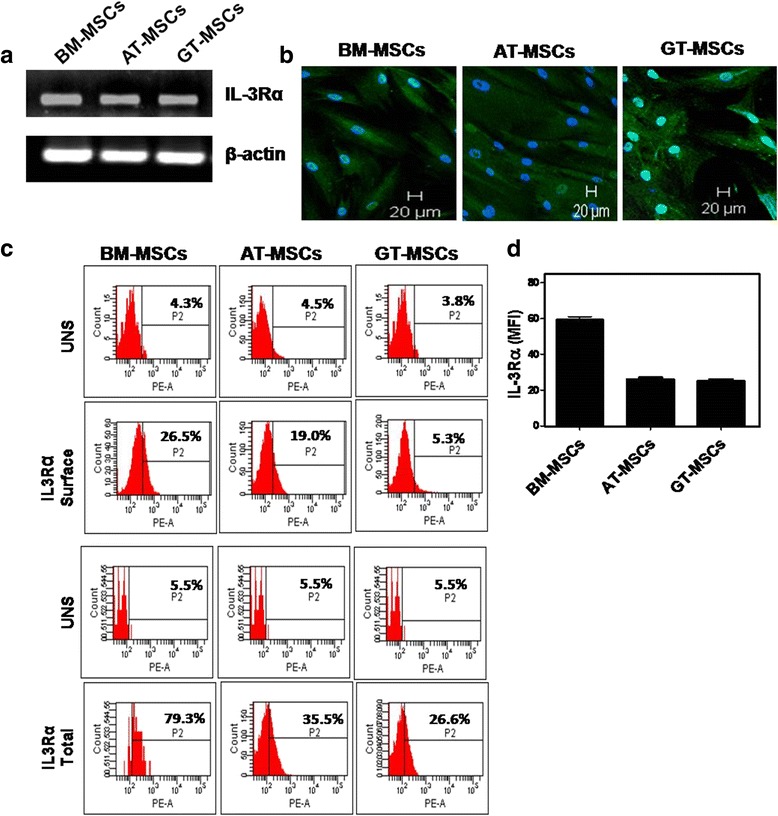
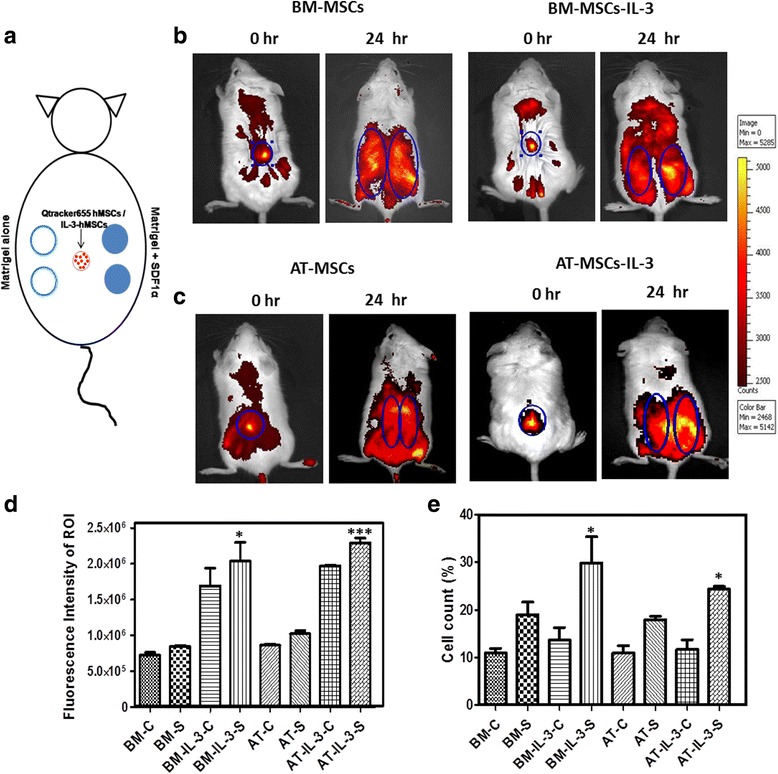
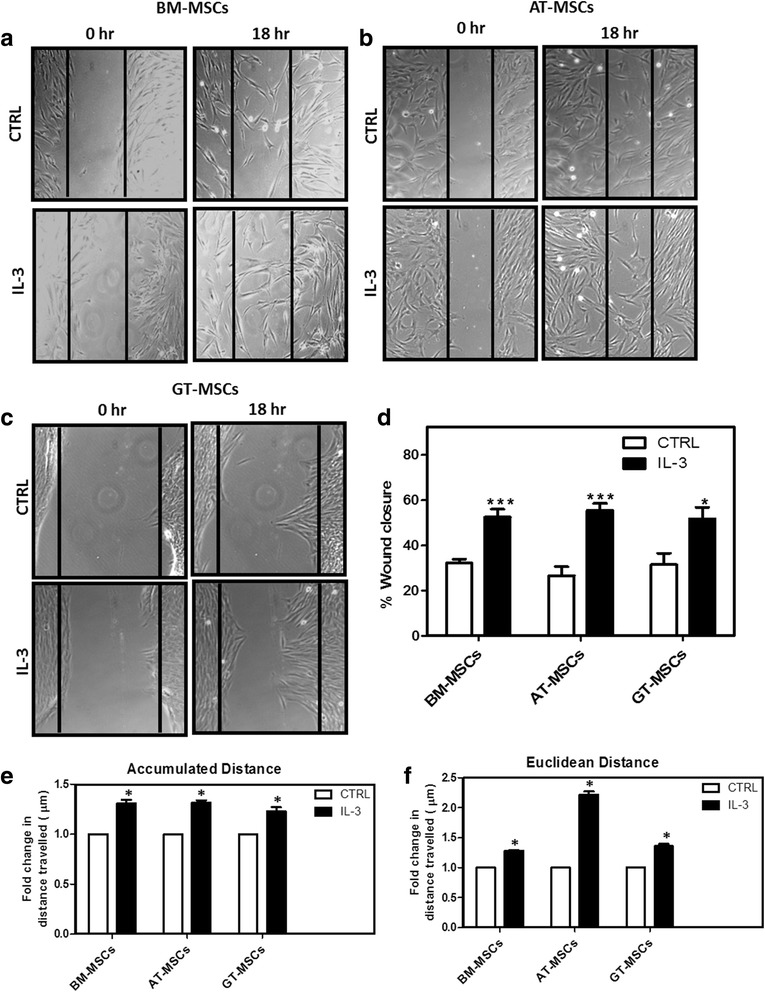
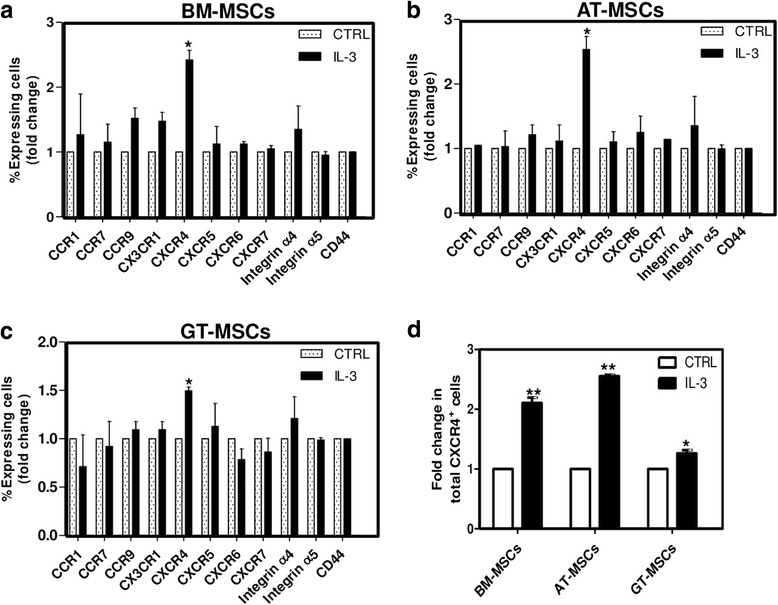
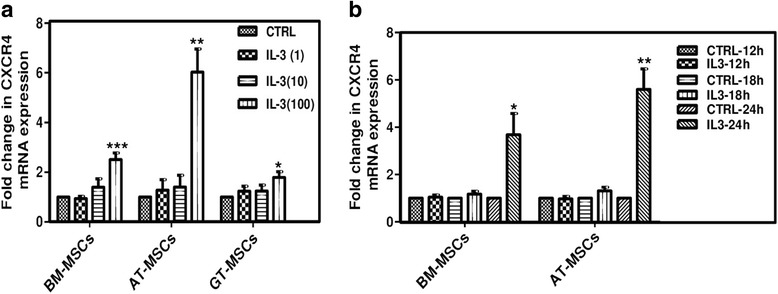
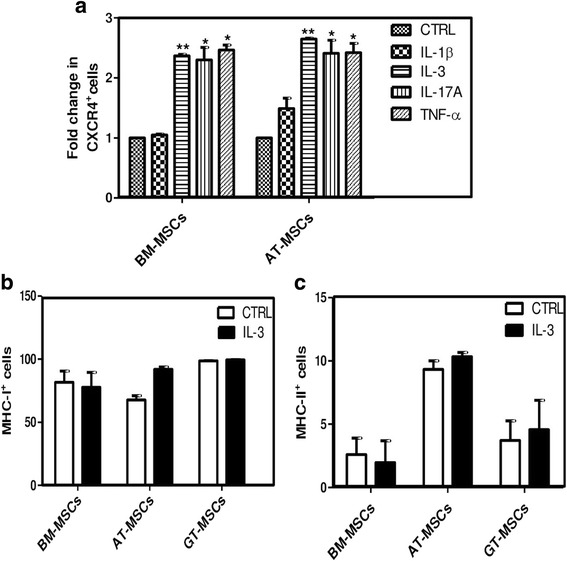
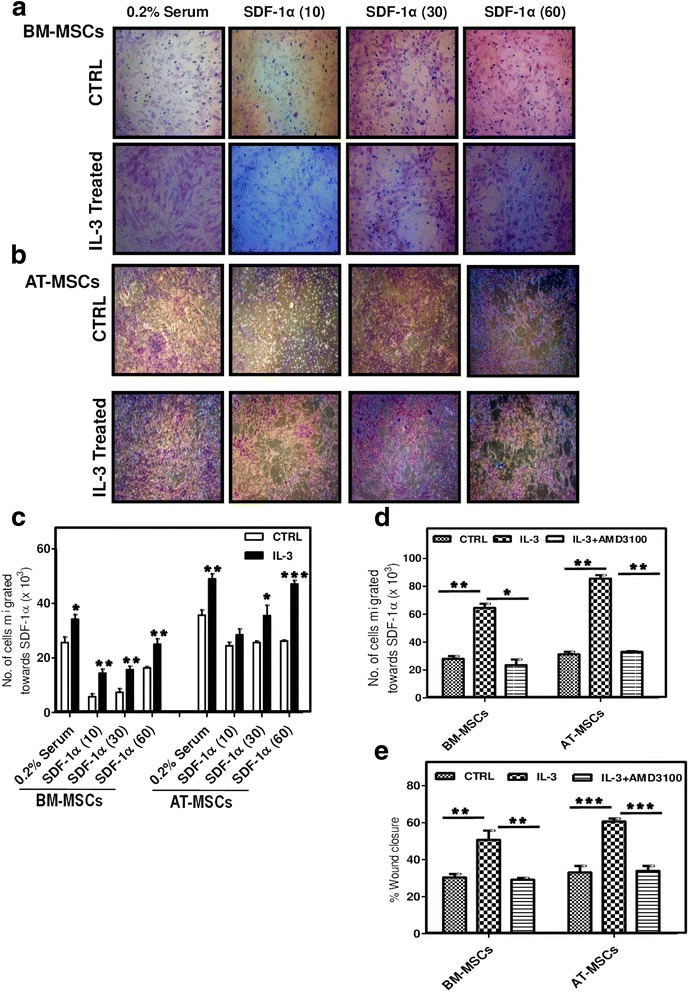
We observed that human MSCs isolated from all three sources express IL-3 receptor-α (IL-3Rα) both at gene and protein levels. IL-3 significantly enhances in-vitro migration, motility and wound healing abilities of MSCs. Moreover, IL-3 preconditioning upregulates expression of chemokine (C-X-C motif) receptor 4 (CXCR4) on MSCs, which leads to increased migration of cells towards SDF-1α. Furthermore, CXCR4 antagonist AMD3100 decreases the migration of IL-3-treated MSCs towards SDF-1α. Importantly, IL-3 also induces in-vivo migration of MSCs towards subcutaneously implanted matrigel-releasing-SDF-1α in immunocompromised mice.
The present study demonstrates for the first time that IL-3 has an important role in enhancing the migration of human MSCs through regulation of the CXCR4/SDF-1α axis. These findings suggest a potential role of IL-3 in improving the efficacy of MSCs in regenerative cell therapy.
间充质干细胞(MSCs)是再生医学中细胞治疗的重要来源。在动物模型和人类临床试验中,MSCs已显示出在修复各种退行性疾病中受损组织方面的良好效果。然而,对于能够增强外源性注入的MSCs迁移和组织特异性植入以实现成功的再生细胞治疗的因素,我们了解甚少。此前,我们报道白细胞介素-3(IL-3)可预防类风湿性关节炎和骨关节炎动物模型中的骨和软骨损伤。此外,IL-3可促进人MSCs向功能性成骨细胞分化,并增强其在免疫缺陷小鼠体内的骨再生潜力。然而,IL-3在MSCs迁移中的作用尚不清楚。在本研究中,我们研究了IL-3在体外和体内条件下人MSCs迁移中的作用。
从人骨髓、脂肪和牙龈组织中分离的MSCs用于在有或无IL-3存在的情况下进行体外细胞迁移、运动性和伤口愈合试验。通过流式细胞术和实时PCR检测IL-3预处理对趋化因子受体和整合素表达的影响。使用免疫缺陷小鼠皮下基质胶释放基质细胞衍生因子-1α(SDF-1α)模型研究IL-3预处理的MSCs的体内迁移。
我们观察到从所有三种来源分离的人MSCs在基因和蛋白质水平均表达IL-3受体-α(IL-3Rα)。IL-3显著增强MSCs的体外迁移、运动性和伤口愈合能力。此外,IL-3预处理上调了MSCs上趋化因子(C-X-C基序)受体4(CXCR4)的表达,这导致细胞向SDF-1α的迁移增加。此外,CXCR4拮抗剂AMD3100减少了IL-3处理的MSCs向SDF-1α的迁移。重要的是,IL-3还可诱导免疫缺陷小鼠体内的MSCs向皮下植入的基质胶释放-SDF-1α迁移。
本研究首次证明IL-3通过调节CXCR4/SDF-1α轴在增强人MSCs迁移中起重要作用。这些发现提示IL-3在提高MSCs在再生细胞治疗中的疗效方面具有潜在作用。