Department of Critical Care Medicine, Ruijin Hospital, Shanghai Jiaotong University School of Medicine, 197 Rui-Jin Er Road, Shanghai, 200025, China.
Department of Emergency Intensive Care Unit, Ruijin Hospital, Shanghai Jiaotong University School of Medicine, Shanghai, China.
Crit Care. 2017 Jul 14;21(1):186. doi: 10.1186/s13054-017-1781-3.
Acute pancreatitis (AP) is a life-threatening disease that requires early identification of patients at risk of developing infectious complications. Immunosuppression is an initial event that is key to AP pathogenesis. The programmed cell death 1 (PD-1) and programmed cell death ligand 1 (PD-L1) system is reported to mediate evasion of host immune surveillance in many diseases; however, the relationship between PD-1/PD-L1 expression and these parameters or infectious complications in AP has not been elucidated. This study was conducted to determine whether PD-1 and PD-L1 are upregulated and to reveal the relationship between PD-1/PD-L1 expression and the development of infectious complications in AP.
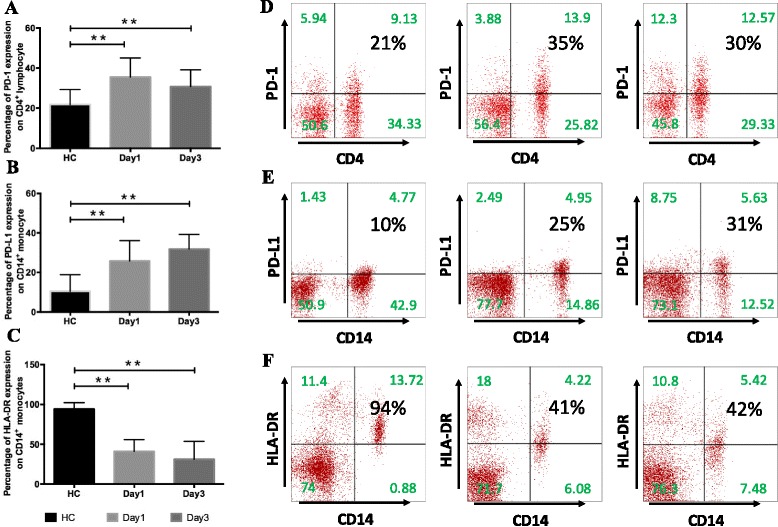
Sixty-three patients with AP and 32 sex- and age-matched healthy control subjects were prospectively enrolled. On days 1 and 3 after the onset of AP, we measured PD-1 expression in peripheral CD4 T cells and PD-L1 and human leukocyte antigen-DR (HLA-DR) expression in CD14 monocytes using flow cytometry. Plasma interleukin (IL)-10 levels were measured by enzyme-linked immunosorbent assay.
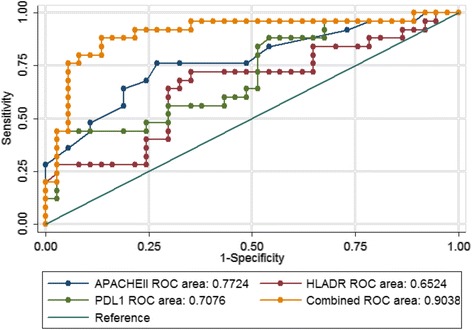
Compared with healthy volunteers, the percentages of PD-1-expressing CD4 lymphocytes and PD-L1-expressing CD14 monocytes were increased in patients with AP on days 1 and 3 after onset, especially those with infectious complications. Moreover, increased PD-1/PD-L1 expression was associated with increased occurrence of infectious complications, decreased circulating lymphocytes, and increased plasma IL-10 concentration. Multivariate regression analysis indicated that the increased percentage of PD-L1-expressing CD14 monocytes was an independent risk factor for infectious complications in AP. Area under the ROC curve analysis showed the combination of Acute Physiology and Chronic Health Evaluation II score and PD-L1 and HLA-DR expression in CD14 monocytes had high accuracy in predicting infectious complications in patients with AP.
The PD-1/PD-L1 system plays an essential role in the early immunosuppression of AP. PD-L1 expression in CD14 monocytes may be a new marker for predicting risk of infectious complications in patients with AP.
急性胰腺炎(AP)是一种危及生命的疾病,需要早期识别发生感染性并发症的风险患者。免疫抑制是 AP 发病机制的初始事件,也是关键事件。程序性细胞死亡 1(PD-1)和程序性细胞死亡配体 1(PD-L1)系统被报道在许多疾病中介导宿主免疫监视的逃逸;然而,PD-1/PD-L1 表达与 AP 中的这些参数或感染性并发症之间的关系尚未阐明。本研究旨在确定 PD-1 和 PD-L1 是否上调,并揭示 PD-1/PD-L1 表达与 AP 中感染性并发症的发展之间的关系。
前瞻性纳入 63 例 AP 患者和 32 名性别和年龄匹配的健康对照者。在 AP 发病后第 1 天和第 3 天,我们使用流式细胞术测量外周血 CD4 T 细胞中的 PD-1 表达和 CD14 单核细胞中的 PD-L1 和人类白细胞抗原-DR(HLA-DR)表达。通过酶联免疫吸附试验测量血浆白细胞介素(IL)-10 水平。
与健康志愿者相比,AP 患者在发病后第 1 天和第 3 天,PD-1 表达阳性的 CD4 淋巴细胞和 PD-L1 表达阳性的 CD14 单核细胞的百分比增加,尤其是那些发生感染性并发症的患者。此外,PD-1/PD-L1 表达增加与感染性并发症的发生增加、循环淋巴细胞减少和血浆 IL-10 浓度增加有关。多变量回归分析表明,CD14 单核细胞中 PD-L1 表达阳性的百分比增加是 AP 感染性并发症的独立危险因素。ROC 曲线分析显示,急性生理学和慢性健康评估 II 评分与 CD14 单核细胞中 PD-L1 和 HLA-DR 表达的组合对预测 AP 患者感染性并发症具有较高的准确性。
PD-1/PD-L1 系统在 AP 的早期免疫抑制中起重要作用。CD14 单核细胞中 PD-L1 的表达可能是预测 AP 患者感染性并发症风险的新标志物。