Matar Madonna J, Moghnieh Rima, Alothman Adel F, Althaqafi Abdulhakeem O, Alenazi Thamer H, Farahat Fayssal M, Corman Shelby, Solem Caitlyn T, Raghubir Nirvana, Macahilig Cynthia, Haider Seema, Stephens Jennifer M
Department of Infectious Diseases, Notre Dame des Secours University Hospital, Jbeil, Lebanon.
Department of Internal Medicine, Makassed General Hospital, Beirut, Lebanon.
Infect Drug Resist. 2017 Feb 3;10:43-48. doi: 10.2147/IDR.S97415. eCollection 2017.
To describe treatment patterns and medical resource use for methicillin-resistant (MRSA) complicated skin and soft tissue infections (cSSTI) in Saudi Arabia and Lebanon in terms of drug selection against the infecting pathogen as well as hospital resource utilization and clinical outcomes among patients with these infections.
This retrospective chart review study evaluated 2011-2012 data from five hospitals in Saudi Arabia and Lebanon. Patients were included if they had been discharged with a diagnosis of MRSA cSSTI, which was culture-proven or suspected based on clinical criteria. Hospital data were abstracted for a random sample of patients with each infection type to capture demographics, treatment patterns, hospital resource utilization, and clinical outcomes. Statistical analysis was descriptive.
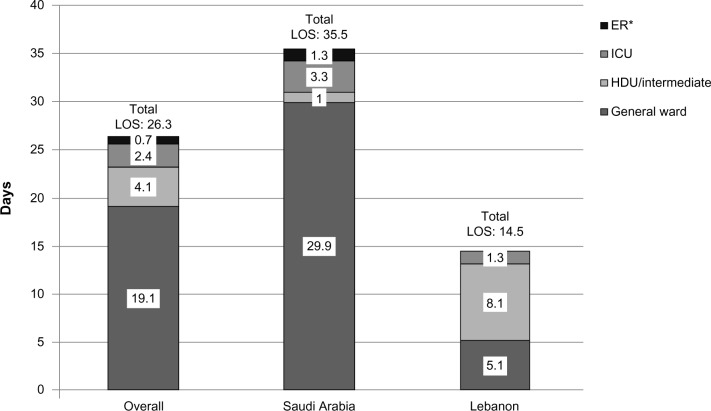
Data were abstracted from medical records of 87 patients with MRSA cSSTI; mean age 52.4±25.9 years and 61% male. Only 64% of patients received an MRSA active initial therapy, with 56% of first-line regimens containing older beta-lactams. The mean total length of stay was 26.3 days, with the majority (19.1 days) spent in general wards. Surgical procedures included incision and drainage (22% of patients), debridement (14%), and amputation (5%). Mechanical ventilation was required by 9% of patients, with a mean duration of 18 days per patient. Hemodialysis was required by four patients (5%), two of whom were reported to have moderate to severe renal disease on admission, for a mean of 5.5 days. Inpatient mortality was 8%. Thirty-nine percent were prescribed at least one antibiotic at discharge, with the most commonly prescribed discharge antibiotics being clindamycin (44%), ciprofloxacin (18%), trimethoprim/sulfamethoxazole (12%), and linezolid (9%).
This Middle Eastern real-world study of resource use and treatment patterns in MRSA cSSTI indicates that management of this condition could be further optimized in terms of drug selection and resource utilization.
从针对感染病原体的药物选择、医院资源利用以及这些感染患者的临床结局方面,描述沙特阿拉伯和黎巴嫩耐甲氧西林金黄色葡萄球菌(MRSA)复杂性皮肤和软组织感染(cSSTI)的治疗模式和医疗资源使用情况。
这项回顾性病历审查研究评估了沙特阿拉伯和黎巴嫩五家医院2011 - 2012年的数据。如果患者出院诊断为MRSA cSSTI(经培养证实或根据临床标准怀疑),则纳入研究。从每种感染类型的患者随机样本中提取医院数据,以获取人口统计学信息、治疗模式、医院资源利用情况和临床结局。统计分析为描述性分析。
从87例MRSA cSSTI患者的病历中提取数据;平均年龄52.4±25.9岁,男性占61%。只有64%的患者接受了针对MRSA的初始有效治疗,56%的一线治疗方案包含较老的β - 内酰胺类药物。平均总住院时间为26.3天,大部分时间(19.1天)在普通病房度过。外科手术包括切开引流(22%的患者)、清创术(14%)和截肢术(5%)。9%的患者需要机械通气,每位患者的平均通气时间为18天。4例患者(5%)需要血液透析,其中2例入院时报告有中度至重度肾病,平均透析时间为5.5天。住院死亡率为8%。39%的患者出院时至少开具了一种抗生素,最常开具的出院抗生素为克林霉素(44%)、环丙沙星(18%)、甲氧苄啶/磺胺甲恶唑(12%)和利奈唑胺(9%)。
这项中东地区关于MRSA cSSTI资源使用和治疗模式的真实世界研究表明,在药物选择和资源利用方面,这种疾病的管理可以进一步优化。