Lee Hae In, Park Byung Rim, Chun Sang Woo
Department of Dental Hygiene, Gwangyang Health Science University, Gwangyang 57764, Korea.
Department of Physiology, College of Medicine, Wonkwang University, Iksan 54538, Korea.
Korean J Physiol Pharmacol. 2017 Jul;21(4):371-376. doi: 10.4196/kjpp.2017.21.4.371. Epub 2017 Jun 26.
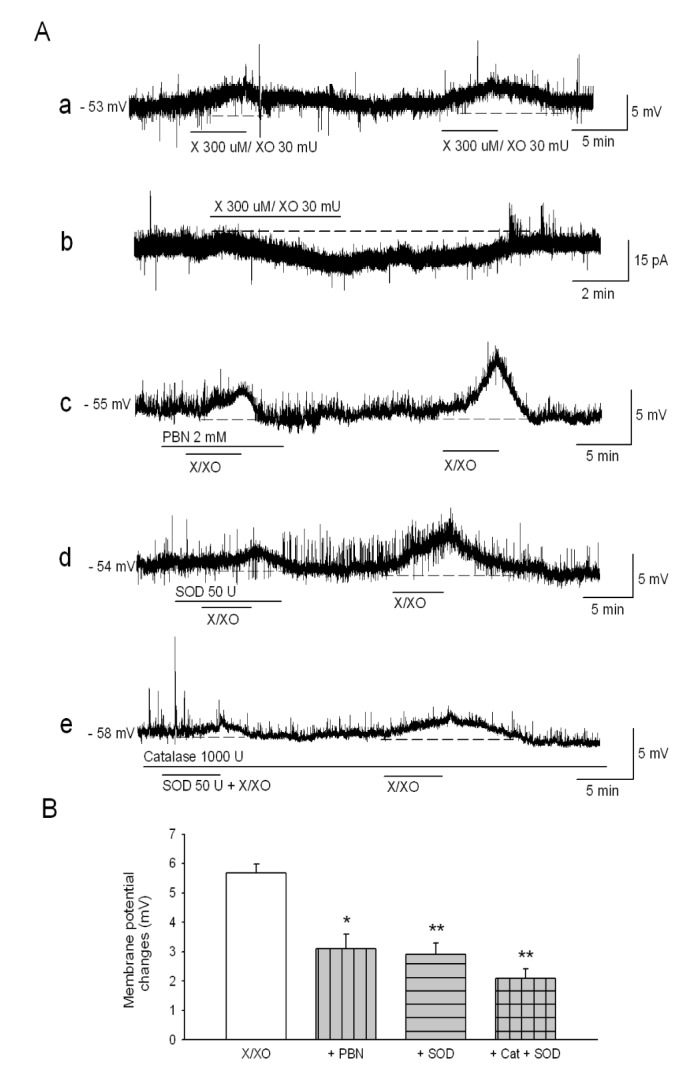
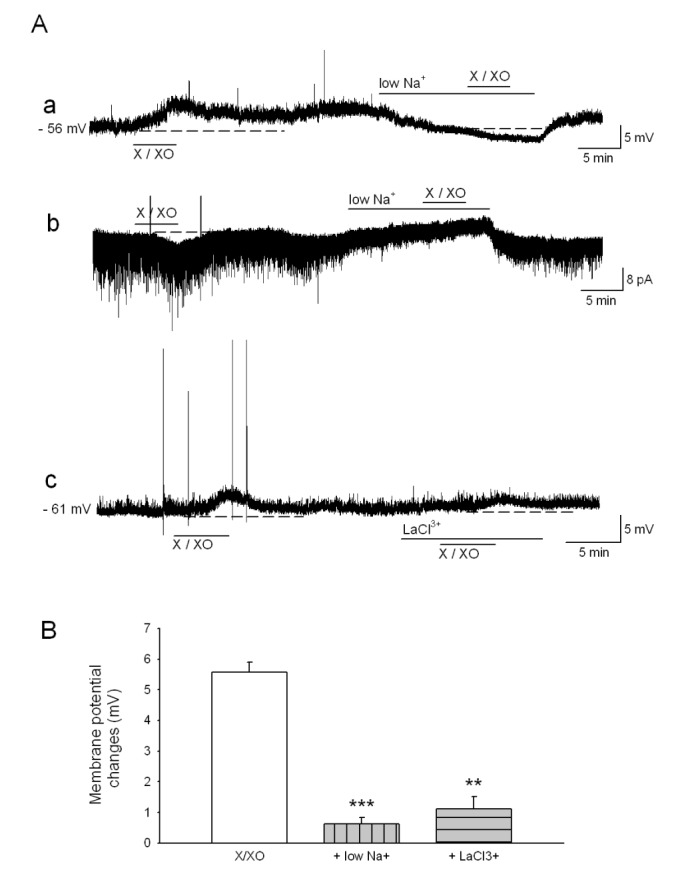
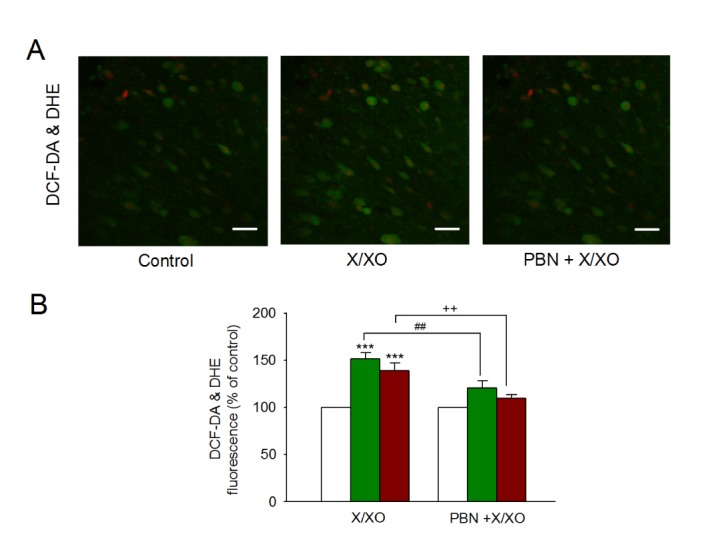
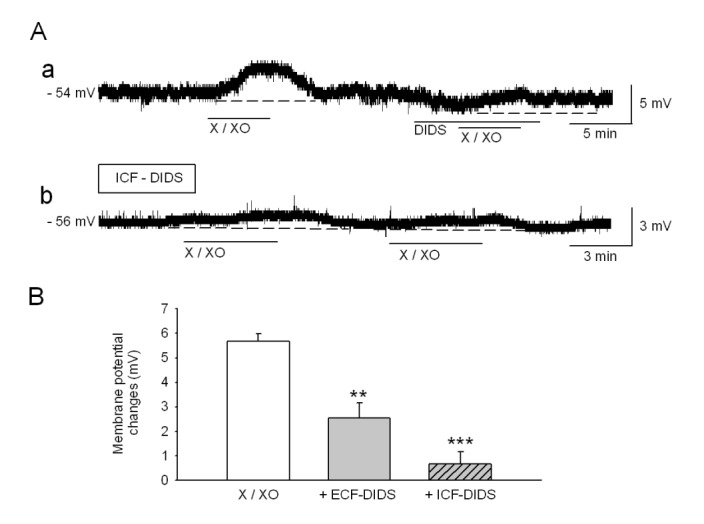
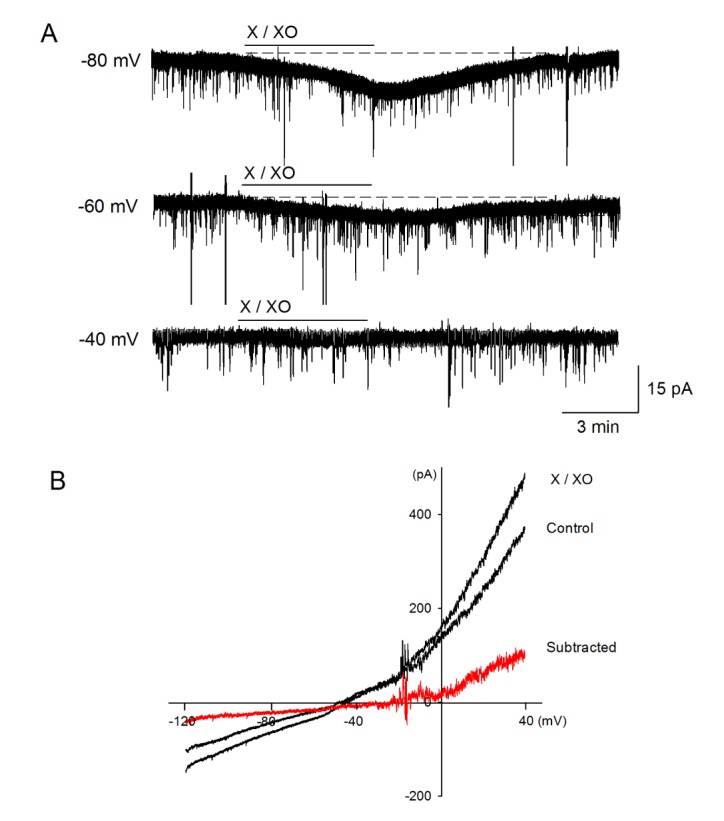
The caudal subnucleus of the spinal trigeminal nucleus (medullary dorsal horn; MDH) receives direct inputs from small diameter primary afferent fibers that predominantly transmit nociceptive information in the orofacial region. Recent studies indicate that reactive oxygen species (ROS) is involved in persistent pain, primarily through spinal mechanisms. In this study, we aimed to investigate the role of xanthine/xanthine oxidase (X/XO) system, a known generator of superoxide anion (O), on membrane excitability in the rat MDH neurons. For this, we used patch clamp recording and confocal imaging. An application of X/XO (300 µM/30 mU) induced membrane depolarization and inward currents. When slices were pretreated with ROS scavengers, such as phenyl N-tert-butylnitrone (PBN), superoxide dismutase (SOD), and catalase, X/XO-induced responses decreased. Fluorescence intensity in the DCF-DA and DHE-loaded MDH cells increased on the application of X/XO. An anion channel blocker, 4,4-diisothiocyanatostilbene-2,2-disulfonic acid (DIDS), significantly decreased X/XO-induced depolarization. X/XO elicited an inward current associated with a linear current-voltage relationship that reversed near -40 mV. X/XO-induced depolarization reduced in the presence of La, a nonselective cation channel (NSCC) blocker, and by lowering the external sodium concentration, indicating that membrane depolarization and inward current are induced by influx of Na ions. In conclusion, X/XO-induced ROS modulate the membrane excitability of MDH neurons, which was related to the activation of NSCC.
三叉神经脊束核尾侧亚核(延髓背角;MDH)接收来自小直径初级传入纤维的直接输入,这些纤维主要在口面部区域传递伤害性信息。最近的研究表明,活性氧(ROS)主要通过脊髓机制参与持续性疼痛。在本研究中,我们旨在探讨黄嘌呤/黄嘌呤氧化酶(X/XO)系统(一种已知的超氧阴离子(O)生成器)对大鼠MDH神经元膜兴奋性的作用。为此,我们使用了膜片钳记录和共聚焦成像。应用X/XO(300 μM/30 mU)可诱导膜去极化和内向电流。当切片用ROS清除剂如苯基N-叔丁基硝酮(PBN)、超氧化物歧化酶(SOD)和过氧化氢酶预处理时,X/XO诱导的反应减弱。在应用X/XO时,DCF-DA和DHE加载的MDH细胞中的荧光强度增加。阴离子通道阻滞剂4,4-二异硫氰酸根合芪-2,2-二磺酸(DIDS)显著降低了X/XO诱导的去极化。X/XO引发了一种与线性电流-电压关系相关的内向电流,该电流在接近-40 mV时反转。在非选择性阳离子通道(NSCC)阻滞剂La存在下以及通过降低细胞外钠浓度,X/XO诱导的去极化减弱,表明膜去极化和内向电流是由Na离子内流引起的。总之,X/XO诱导的ROS调节MDH神经元的膜兴奋性,这与NSCC的激活有关。