Walther Andreas, Philipp Michel, Lozza Niclà, Ehlert Ulrike
Clinical Psychology and Psychotherapy, University of ZurichZurich, Switzerland.
University Research Priority Program-Dynamics of Healthy Aging, University of ZurichZurich, Switzerland.
Front Psychol. 2017 Jun 29;8:1075. doi: 10.3389/fpsyg.2017.01075. eCollection 2017.
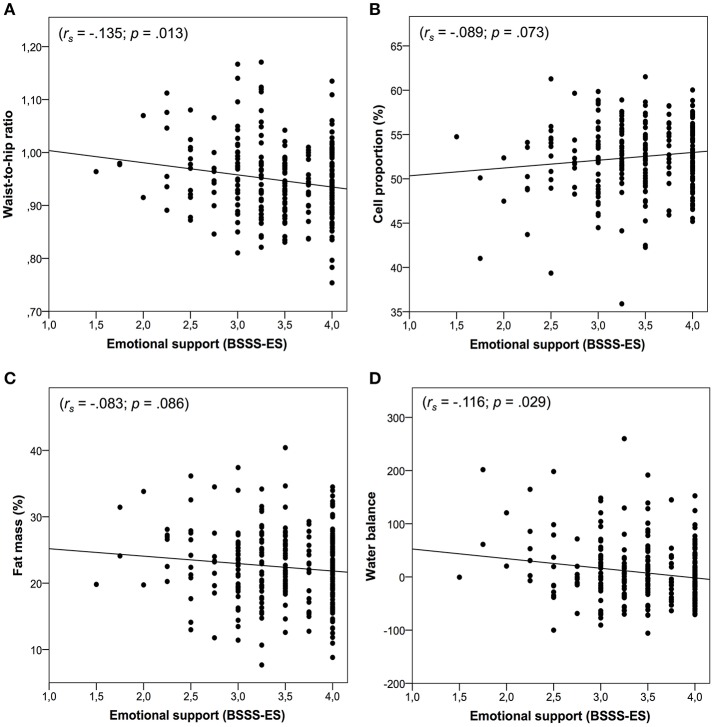
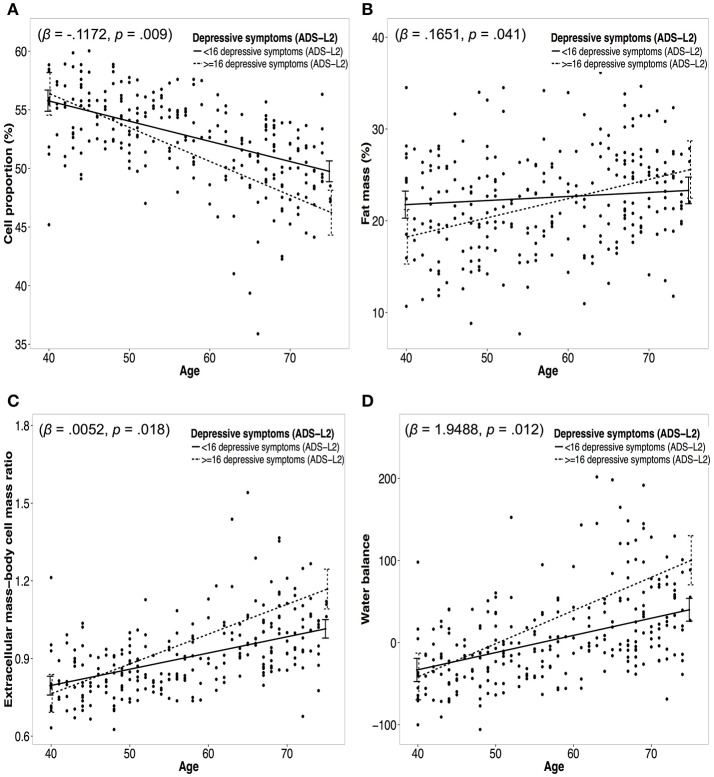
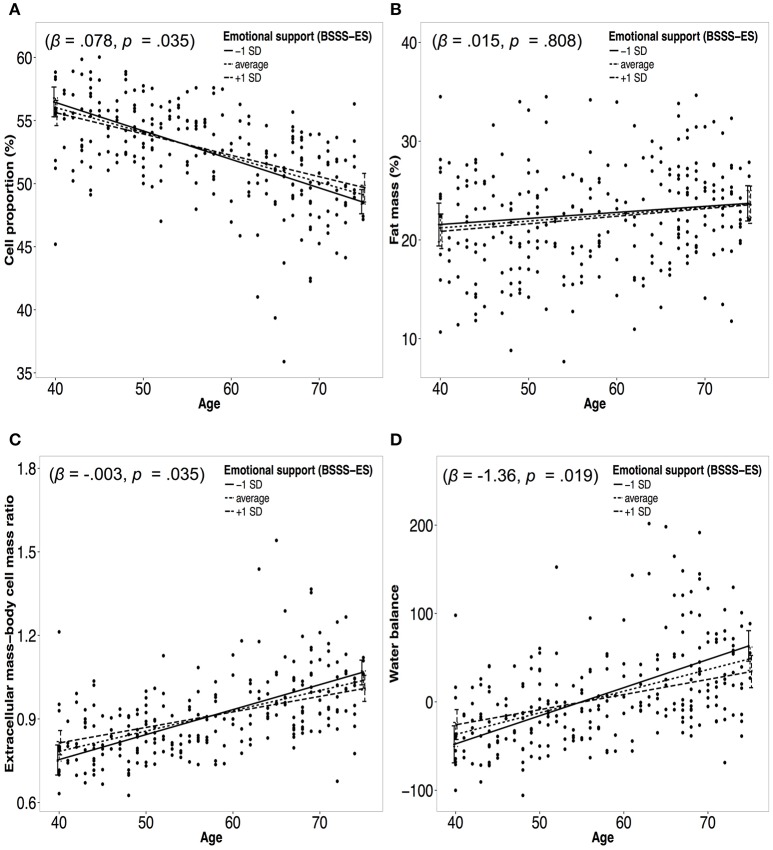
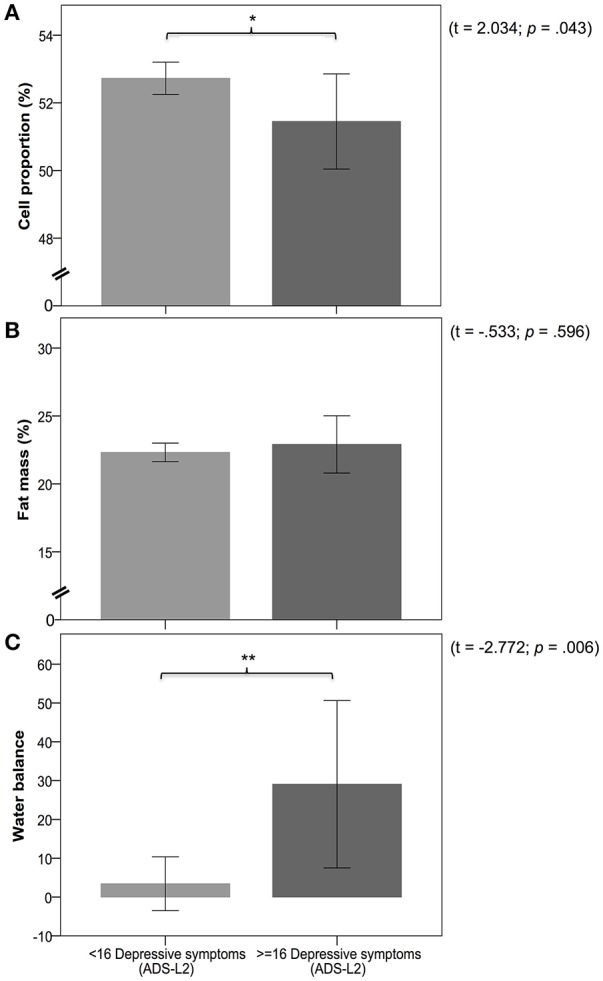
More depressive symptoms and low emotional support have been related to worse body composition. Body composition significantly deteriorates in aging men. Therefore, we aimed to examine whether high emotional support and low depressive symptoms are associated with better body composition and a decelerated age-related deterioration of body composition in aging men. A cross-sectional analysis including 269 self-reporting healthy men aged between 40 and 75 years living in the German-speaking part of Switzerland was conducted. Participants completed questionnaires on emotional support and depressive symptoms. The depression screening instrument was used to form a group with low ( = 225) and moderate ( = 44) depressive symptoms. Body mass index (BMI) and waist-to-hip ratio (WHR) were measured, and cell proportion (CP), fat mass (FM), and water balance (WB) were obtained using bioelectrical impedance analysis. Age-related associations emerged for WHR, CP, FM, and WB, but not for BMI. Emotional support was negatively associated with BMI, WHR, and WB, and only trend-wise with CP and FM. Group comparisons revealed that more depressive symptoms were associated with lower levels of CP and higher levels of WB. Both emotional support and depressive symptoms were significant moderators of the association between age and specific measures of body composition such as CP, FM, and WB. However, after correction for multiple testing for moderation analyses only the moderation effects of depressive symptoms on the association between age and WB and CP remained significant. Low depressive symptoms were associated with a better body composition as well as a decelerated decline in body composition and the role of emotional support acting as a buffer against age-related deterioration of body composition merits further investigation.
更多的抑郁症状和较低的情感支持与更差的身体成分有关。老年男性的身体成分会显著恶化。因此,我们旨在研究高情感支持和低抑郁症状是否与老年男性更好的身体成分以及与年龄相关的身体成分恶化减缓有关。我们进行了一项横断面分析,纳入了269名居住在瑞士德语区、年龄在40至75岁之间的自我报告健康男性。参与者完成了关于情感支持和抑郁症状的问卷调查。使用抑郁筛查工具将参与者分为抑郁症状低(=225)和中度(=44)的两组。测量了体重指数(BMI)和腰臀比(WHR),并使用生物电阻抗分析获得了细胞比例(CP)、脂肪量(FM)和水平衡(WB)。年龄与WHR、CP、FM和WB之间存在相关性,但与BMI无关。情感支持与BMI、WHR和WB呈负相关,与CP和FM仅呈趋势性相关。组间比较显示,更多的抑郁症状与较低的CP水平和较高的WB水平相关。情感支持和抑郁症状都是年龄与身体成分特定指标(如CP、FM和WB)之间关联的显著调节因素。然而,在对调节分析进行多重检验校正后,只有抑郁症状对年龄与WB和CP之间关联的调节作用仍然显著。低抑郁症状与更好的身体成分以及身体成分下降减缓有关,情感支持作为防止身体成分与年龄相关恶化的缓冲作用值得进一步研究。