Kuzmanovic Bojana, Rigoux Lionel
Translational Neurocircuitry Group, Max Planck Institute for Metabolism ResearchCologne, Germany.
Translational Neuromodeling Unit, Institute for Biomedical Engineering, University of Zurich and ETH ZurichZurich, Switzerland.
Front Psychol. 2017 Jun 29;8:1087. doi: 10.3389/fpsyg.2017.01087. eCollection 2017.
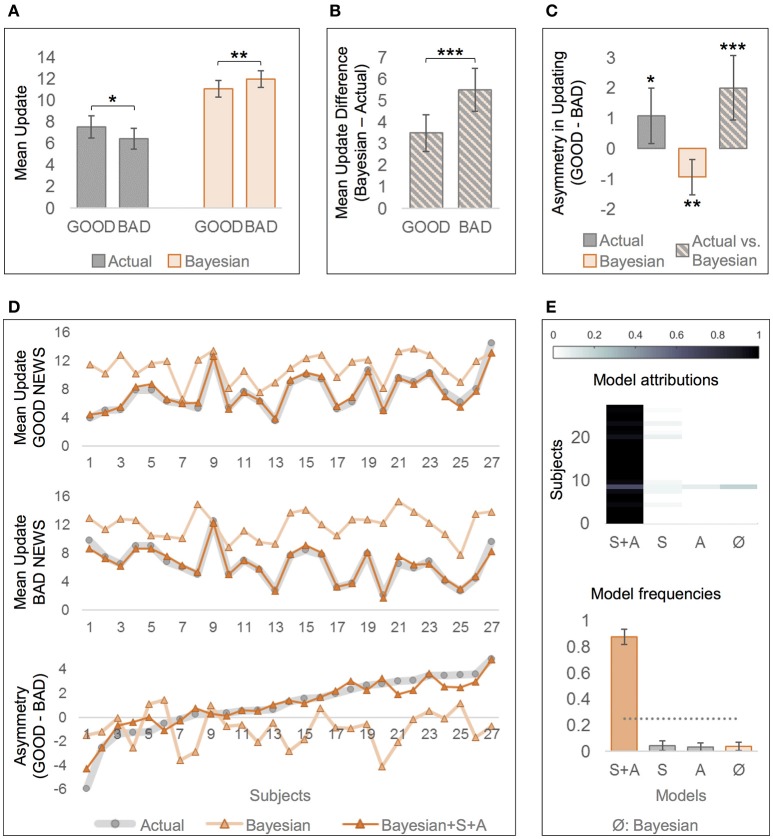
People tend to update beliefs about their future outcomes in a valence-dependent way: they are likely to incorporate good news and to neglect bad news. However, belief formation is a complex process which depends not only on motivational factors such as the desire for favorable conclusions, but also on multiple cognitive variables such as prior beliefs, knowledge about personal vulnerabilities and resources, and the size of the probabilities and estimation errors. Thus, we applied computational modeling in order to test for valence-induced biases in updating while formally controlling for relevant cognitive factors. We compared biased and unbiased Bayesian models of belief updating, and specified alternative models based on reinforcement learning. The experiment consisted of 80 trials with 80 different adverse future life events. In each trial, participants estimated the base rate of one of these events and estimated their own risk of experiencing the event before and after being confronted with the actual base rate. Belief updates corresponded to the difference between the two self-risk estimates. Valence-dependent updating was assessed by comparing trials with good news (better-than-expected base rates) with trials with bad news (worse-than-expected base rates). After receiving bad relative to good news, participants' updates were smaller and deviated more strongly from rational Bayesian predictions, indicating a valence-induced bias. Model comparison revealed that the biased (i.e., optimistic) Bayesian model of belief updating better accounted for data than the unbiased (i.e., rational) Bayesian model, confirming that the valence of the new information influenced the amount of updating. Moreover, alternative computational modeling based on reinforcement learning demonstrated higher learning rates for good than for bad news, as well as a moderating role of personal knowledge. Finally, in this specific experimental context, the approach based on reinforcement learning was superior to the Bayesian approach. The computational validation of valence-dependent belief updating represents a novel support for a genuine optimism bias in human belief formation. Moreover, the precise control of relevant cognitive variables justifies the conclusion that the motivation to adopt the most favorable self-referential conclusions biases human judgments.
他们很可能纳入好消息而忽视坏消息。然而,信念形成是一个复杂的过程,它不仅取决于诸如对有利结论的渴望等动机因素,还取决于多个认知变量,如先前的信念、关于个人弱点和资源的知识,以及概率大小和估计误差。因此,我们应用计算模型来测试在正式控制相关认知因素的同时,效价引发的更新偏差。我们比较了信念更新的有偏差和无偏差贝叶斯模型,并基于强化学习指定了替代模型。该实验由80次试验组成,涉及80种不同的未来不良生活事件。在每次试验中,参与者估计其中一个事件的基础概率,并在面对实际基础概率之前和之后估计自己经历该事件的风险。信念更新对应于两次自我风险估计之间的差异。通过比较有好消息(优于预期的基础概率)的试验和有坏消息(低于预期的基础概率)的试验来评估效价依赖更新。在收到坏消息相对于好消息后,参与者的更新更小,并且与理性贝叶斯预测的偏差更大,表明存在效价引发的偏差。模型比较表明,信念更新的有偏差(即乐观)贝叶斯模型比无偏差(即理性)贝叶斯模型能更好地解释数据,证实了新信息的效价影响更新量。此外,基于强化学习的替代计算模型表明,好消息的学习率高于坏消息,并且个人知识起到了调节作用。最后,在这个特定的实验背景下,基于强化学习的方法优于贝叶斯方法。效价依赖信念更新的计算验证为人类信念形成中真正的乐观偏差提供了新的支持。此外,对相关认知变量的精确控制证明了这样的结论:采用最有利的自我参照结论的动机使人类判断产生偏差。