Song Jeong Eun, Kim Do Young
Jeong Eun Song, Do Young Kim, Department of Internal Medicine, Yonsei University College of Medicine, Seoul 120-752, South Korea.
World J Hepatol. 2017 Jun 28;9(18):808-814. doi: 10.4254/wjh.v9.i18.808.
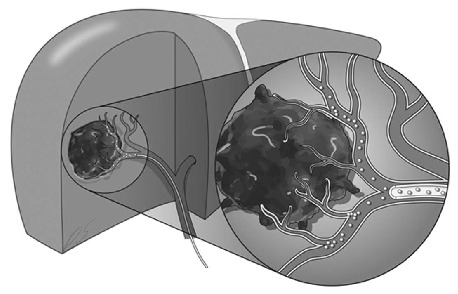
Transarterial chemoembolization (TACE) is the current standard of therapy for patients with intermediate-stage hepatocellular carcinoma (HCC) according to the Barcelona Clinic Liver Cancer classification. The concept of conventional TACE (cTACE) is the selective obstruction of tumor-feeding artery by injection of chemotherapeutic agents, leading to ischemic necrosis of the target tumor cytotoxic and ischemic effects. Drug-eluting beads (DEBs) have been imposed as novel drug-delivering agents for TACE, which allows for higher concentrations of drugs within the target tumor and lower systemic concentrations compared with cTACE. Despite the theoretical advantages of DEB-TACE, it is still controversial in clinical practice as to whether DEB-TACE is superior to cTACE in regard to overall survival and treatment response. In this review article, we summarize the clinical efficacy and safety of DEB-TACE for patients with intermediate or advanced stage HCC in comparison with cTACE.
根据巴塞罗那临床肝癌分类,经动脉化疗栓塞术(TACE)是中期肝细胞癌(HCC)患者当前的标准治疗方法。传统TACE(cTACE)的概念是通过注射化疗药物选择性阻塞肿瘤供血动脉,导致靶肿瘤发生缺血性坏死,产生细胞毒性和缺血效应。药物洗脱微球(DEB)已被用作TACE的新型给药载体,与cTACE相比,它可使靶肿瘤内药物浓度更高而全身浓度更低。尽管DEB-TACE具有理论优势,但在临床实践中,DEB-TACE在总生存期和治疗反应方面是否优于cTACE仍存在争议。在这篇综述文章中,我们总结了与cTACE相比,DEB-TACE治疗中晚期HCC患者的临床疗效和安全性。