Hiromoto Takeshi, Meilleur Flora, Shimizu Rumi, Shibazaki Chie, Adachi Motoyasu, Tamada Taro, Kuroki Ryota
Quantum Beam Science Center, Japan Atomic Energy Agency, Tokai, Ibaraki, 319-1195, Japan.
Neutron Sciences Directorate, Oak Ridge National Laboratory, Oak Ridge, Tennessee, 37831.
Protein Sci. 2017 Oct;26(10):1953-1963. doi: 10.1002/pro.3230. Epub 2017 Jul 25.
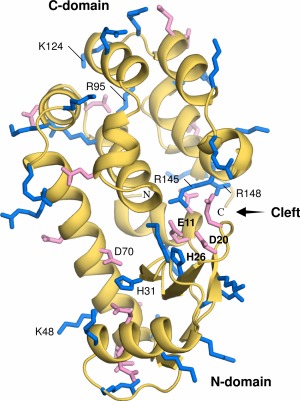
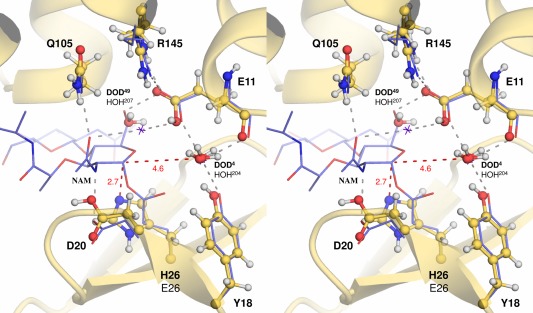
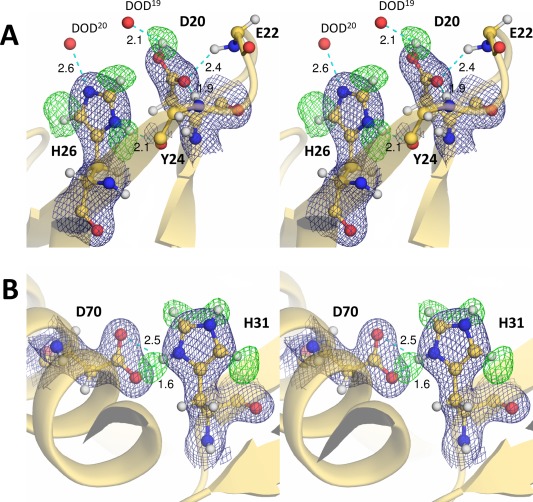
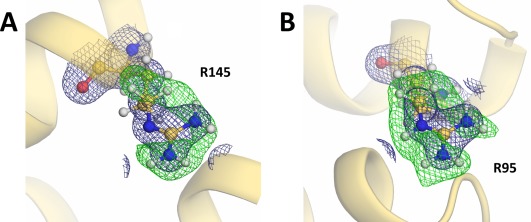
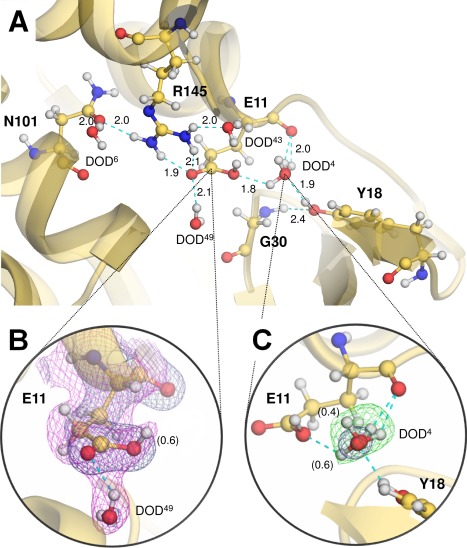
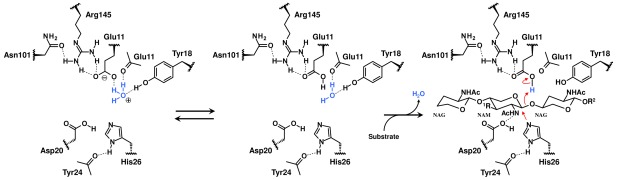
T4 phage lysozyme is an inverting glycoside hydrolase that degrades the murein of bacterial cell walls by cleaving the β-1,4-glycosidic bond. The substitution of the catalytic Thr26 residue to a histidine converts the wild type from an inverting to a retaining enzyme, which implies that the original general acid Glu11 can also act as an acid/base catalyst in the hydrolysis. Here, we have determined the neutron structure of the perdeuterated T26H mutant to clarify the protonation states of Glu11 and the substituted His26, which are key in the retaining reaction. The 2.09-Å resolution structure shows that the imidazole group of His26 is in its singly protonated form in the active site, suggesting that the deprotonated Nɛ2 atom of His26 can attack the anomeric carbon of bound substrate as a nucleophile. The carboxyl group of Glu11 is partially protonated and interacts with the unusual neutral state of the guanidine moiety of Arg145, as well as two heavy water molecules. Considering that one of the water-binding sites has the potential to be occupied by a hydronium ion, the bulk solvent could be the source for the protonation of Glu11. The respective protonation states of Glu11 and His26 are consistent with the bond lengths determined by an unrestrained refinement of the high-resolution X-ray structure of T26H at 1.04-Å resolution. The detail structural information, including the coordinates of the deuterium atoms in the active site, provides insight into the distinctively different catalytic activities of the mutant and wild type enzymes.
T4噬菌体溶菌酶是一种转化糖苷水解酶,通过切割β-1,4-糖苷键来降解细菌细胞壁的胞壁质。将催化性的苏氨酸26残基替换为组氨酸,可使野生型酶从转化型变为保留型酶,这意味着原来的一般酸谷氨酸11在水解过程中也可作为酸碱催化剂。在此,我们测定了全氘代T26H突变体的中子结构,以阐明谷氨酸11和取代的组氨酸26的质子化状态,这两者在保留反应中起关键作用。分辨率为2.09 Å的结构表明,组氨酸26的咪唑基团在活性位点处于单质子化形式,这表明组氨酸26去质子化的Nɛ2原子可作为亲核试剂攻击结合底物的异头碳。谷氨酸11的羧基部分质子化,并与精氨酸145胍基部分的异常中性状态以及两个重水分子相互作用。考虑到其中一个水结合位点有可能被水合氢离子占据,大量溶剂可能是谷氨酸11质子化的来源。谷氨酸11和组氨酸26各自的质子化状态与分辨率为1.04 Å的T26H高分辨率X射线结构无约束精修所确定的键长一致。详细的结构信息,包括活性位点中氘原子的坐标,为深入了解突变体和野生型酶截然不同的催化活性提供了依据。