Messerlian Carmen, Martinez Rosie M, Hauser Russ, Baccarelli Andrea A
Department of Environmental Health, Harvard T.H. Chan School of Public Health, Boston, Massachusetts 02115, USA.
Department of Environmental Health, Harvard T.H. Chan School of Public Health, Boston, Massachusetts 02115, USA; and at the Laboratory of Precision Environmental Biosciences, Department of Environmental Health Sciences, Columbia Mailman School of Public Health, New York, New York 10032, USA.
Nat Rev Endocrinol. 2017 Dec;13(12):740-748. doi: 10.1038/nrendo.2017.81. Epub 2017 Jul 14.
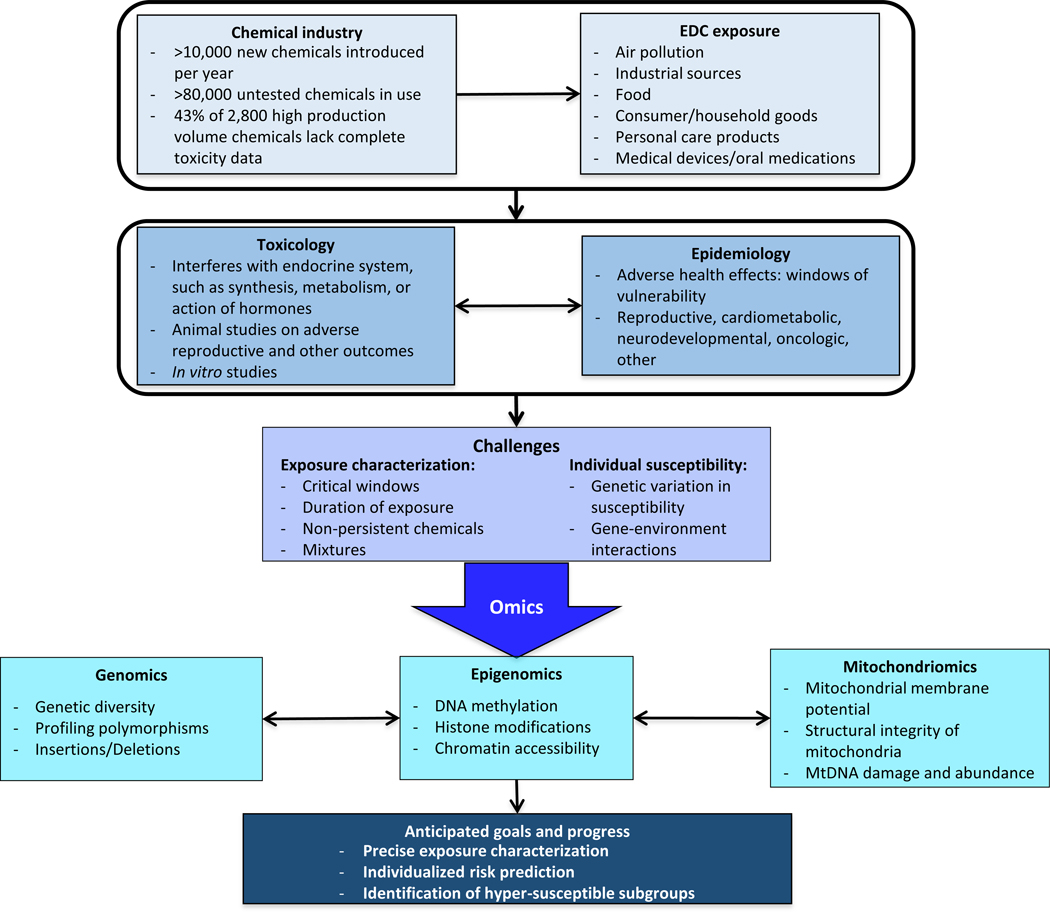
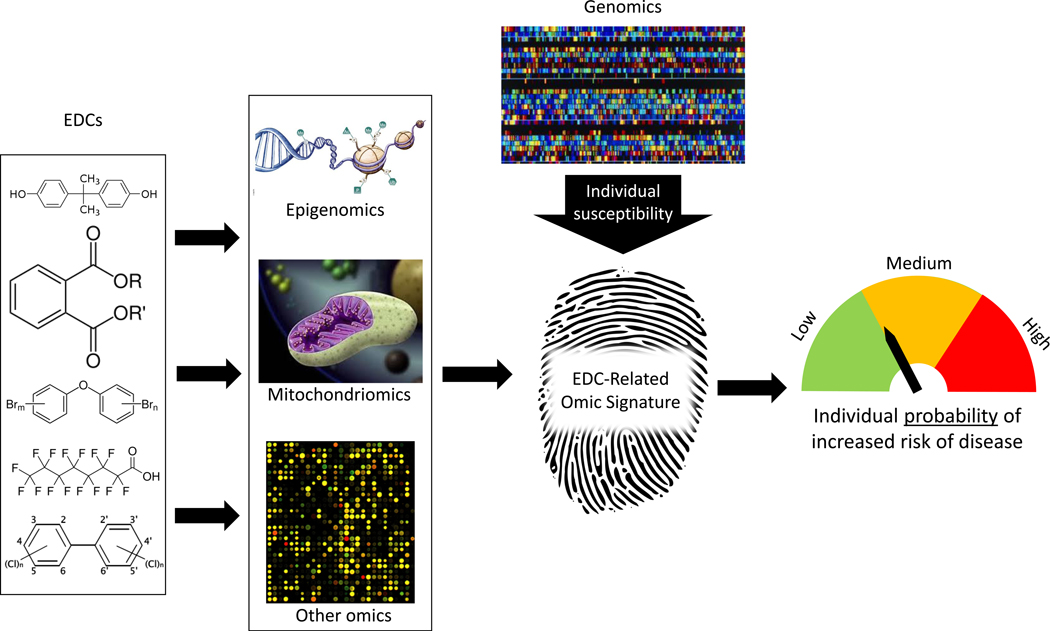
The emerging field of omics - large-scale data-rich biological measurements of the genome - provides new opportunities to advance and strengthen research into endocrine-disrupting chemicals (EDCs). Although some EDCs have been associated with adverse health effects in humans, our understanding of their impact remains incomplete. Progress in the field has been primarily limited by our inability to adequately estimate and characterize exposure and identify sensitive and measurable outcomes during windows of vulnerability. Evolving omics technologies in genomics, epigenomics and mitochondriomics have the potential to generate data that enhance exposure assessment to include the exposome - the totality of the lifetime exposure burden - and provide biology-based estimates of individual risks. Applying omics technologies to expand our knowledge of individual risk and susceptibility will augment biological data in the prediction of variability and response to disease, thereby further advancing EDC research. Together, refined exposure characterization and enhanced disease-risk prediction will help to bridge crucial gaps in EDC research and create opportunities to move the field towards a new vision - precision public health.
组学这一新兴领域——对基因组进行大规模、富含数据的生物学测量——为推进和加强对内分泌干扰化学物质(EDCs)的研究提供了新机遇。尽管一些EDCs已被证实与人类不良健康影响相关,但我们对其影响的理解仍不完整。该领域的进展主要受限于我们无法充分估计和描述暴露情况,以及在易损期识别敏感且可测量的结果。基因组学、表观基因组学和线粒体组学中不断发展的组学技术有潜力生成数据,从而加强暴露评估,将其扩展至暴露组——一生暴露负担的总和,并提供基于生物学的个体风险估计。应用组学技术来扩展我们对个体风险和易感性的认识,将增加生物学数据,用于预测变异性和对疾病的反应,从而进一步推动EDC研究。总之,精细化的暴露特征描述和增强的疾病风险预测将有助于弥合EDC研究中的关键差距,并创造机会推动该领域迈向新愿景——精准公共卫生。