National and Kapodistrian University of Athens, School of Medicine, Athens, Greece.
University of Ottawa Heart Institute, Ottawa, Ontario, Canada.
Eur J Heart Fail. 2017 Jul;19(7):950-957. doi: 10.1002/ejhf.895.
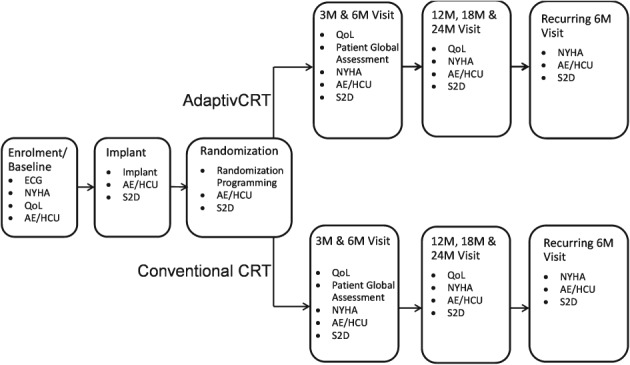
The AdaptResponse trial is designed to test the hypothesis that preferential adaptive left ventricular-only pacing with the AdaptivCRT algorithm reduces the incidence of the combined endpoint of all-cause mortality and intervention for heart failure (HF) decompensation, compared with conventional cardiac resynchronization therapy (CRT), among patients with a CRT indication, left bundle branch block (LBBB) and normal atrioventricular (AV) conduction. The AdaptResponse study is a prospective, randomized, controlled, single-blinded, multicentre, clinical trial (ClinicalTrials.gov Identifier: NCT02205359), conducted at up to 200 centres worldwide. Following enrolment and baseline assessment, eligible subjects will be implanted with a CRT system containing the AdaptivCRT algorithm, and randomized in a 1:1 fashion to either a treatment ('AdaptivCRT') or control ('Conventional CRT') group. The study is designed to observe a primary endpoint in 1100 patients ('event-driven') and approximately 3000 patients will be randomized. The primary endpoint is the composite of all-cause mortality and intervention for HF decompensation; secondary endpoints include all-cause mortality, intervention for HF decompensation, clinical composite score (CCS) at 6 months, atrial fibrillation, quality of life measured by the Kansas City Cardiomyopathy Questionnaire (KCCQ), health outcome measured by the EQ-5D instrument, all-cause readmission after a HF admission, and cost-effectiveness. The AdaptResponse clinical trial is powered to assess clinical endpoints and is expected to provide definitive evidence on the incremental utility of AdaptivCRT-enhanced CRT systems.
适应性反应试验旨在检验这样一个假设,即与传统心脏再同步治疗(CRT)相比,带有适应性 CRT 算法的左心室优先适应性起搏能降低 CRT 适应证、左束支传导阻滞(LBBB)和正常房室(AV)传导患者的全因死亡率和心力衰竭(HF)失代偿干预的联合终点发生率。适应性反应研究是一项前瞻性、随机、对照、单盲、多中心临床试验(ClinicalTrials.gov 标识符:NCT02205359),在全球多达 200 个中心进行。在入组和基线评估后,符合条件的受试者将植入包含适应性 CRT 算法的 CRT 系统,并以 1:1 的比例随机分为治疗组(“适应性 CRT”)或对照组(“常规 CRT”)。该研究旨在观察 1100 例患者的主要终点(“事件驱动”),大约 3000 例患者将被随机分组。主要终点是全因死亡率和 HF 失代偿干预的复合终点;次要终点包括全因死亡率、HF 失代偿干预、6 个月时的临床综合评分(CCS)、心房颤动、堪萨斯城心肌病问卷(KCCQ)测量的生活质量、EQ-5D 仪器测量的健康结果、HF 入院后全因再入院率和成本效益。适应性反应临床试验的目的是评估临床终点,并有望提供关于适应性 CRT 增强型 CRT 系统增量效用的明确证据。