Research Department Cell and Gene Therapy, Department of Stem Cell Transplantation, University Medical Center Hamburg-Eppendorf, Hamburg, Germany.
Present Adress: University Medical Center Hamburg-Eppendorf, Pediatric Hematology and Oncology & Research Institute Children's Cancer Center Hamburg, Martinistr. 52, 20246, Hamburg, Germany.
Mol Cancer. 2017 Jul 14;16(1):120. doi: 10.1186/s12943-017-0668-x.
Clonal competition in cancer describes the process in which the progeny of a cell clone supersedes or succumbs to other competing clones due to differences in their functional characteristics, mostly based on subsequently acquired mutations. Even though the patterns of those mutations are well explored in many tumors, the dynamical process of clonal selection is underexposed.
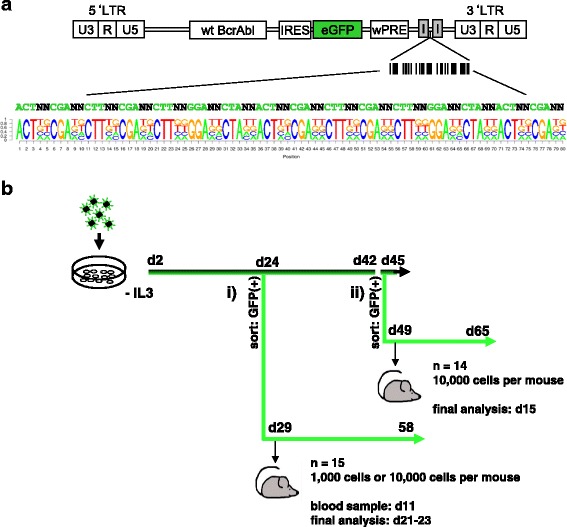
We studied the dynamics of clonal competition in a BcrAbl-induced leukemia using a γ-retroviral vector library encoding the oncogene in conjunction with genetic barcodes. To this end, we studied the growth dynamics of transduced cells on the clonal level both in vitro and in vivo in transplanted mice.
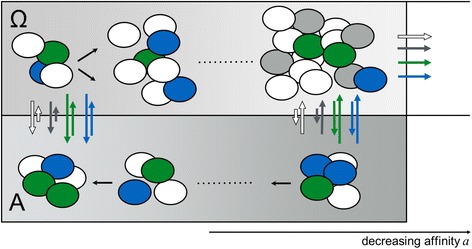
While we detected moderate changes in clonal abundancies in vitro, we observed monoclonal leukemias in 6/30 mice after transplantation, which intriguingly were caused by only two different BcrAbl clones. To analyze the success of these clones, we applied a mathematical model of hematopoietic tissue maintenance, which indicated that a differential engraftment capacity of these two dominant clones provides a possible explanation of our observations. These findings were further supported by additional transplantation experiments and increased BcrAbl transcript levels in both clones.
Our findings show that clonal competition is not an absolute process based on mutations, but highly dependent on selection mechanisms in a given environmental context.
癌症中的克隆竞争描述了这样一个过程,即由于功能特征的差异,细胞克隆的后代取代或屈服于其他竞争克隆,而这些差异主要基于随后获得的突变。尽管许多肿瘤中对这些突变模式进行了很好的探索,但克隆选择的动态过程却知之甚少。
我们使用一种γ逆转录病毒载体文库,该文库将致癌基因与遗传条码一起编码,研究了 BcrAbl 诱导的白血病中的克隆竞争动态。为此,我们在体外和移植小鼠体内的体内水平上研究了转导细胞的克隆生长动态。
虽然我们在体外检测到克隆丰度的适度变化,但在移植后 6/30 只小鼠中观察到单克隆白血病,这令人好奇的是,这些白血病仅由两种不同的 BcrAbl 克隆引起。为了分析这些克隆的成功,我们应用了造血组织维持的数学模型,该模型表明这两个主要克隆的不同植入能力提供了我们观察结果的可能解释。这些发现进一步得到了额外的移植实验和两个克隆中 BcrAbl 转录本水平升高的支持。
我们的发现表明,克隆竞争不是基于突变的绝对过程,而是高度依赖于特定环境背景下的选择机制。