Liao Xiaoyan, Wang Kui, Lin Kai, Chan Raymond C K, Zhang Xiaoyuan
Department of Psychology, School of Public Health, Southern Medical UniversityGuangzhou, China.
Nanfang Hospital, Southern Medical UniversityGuangzhou, China.
Front Psychol. 2017 Jun 30;8:1110. doi: 10.3389/fpsyg.2017.01110. eCollection 2017.
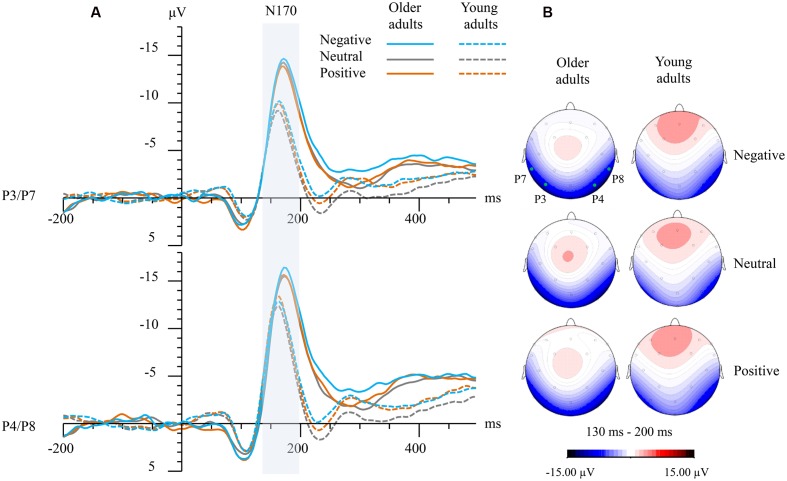
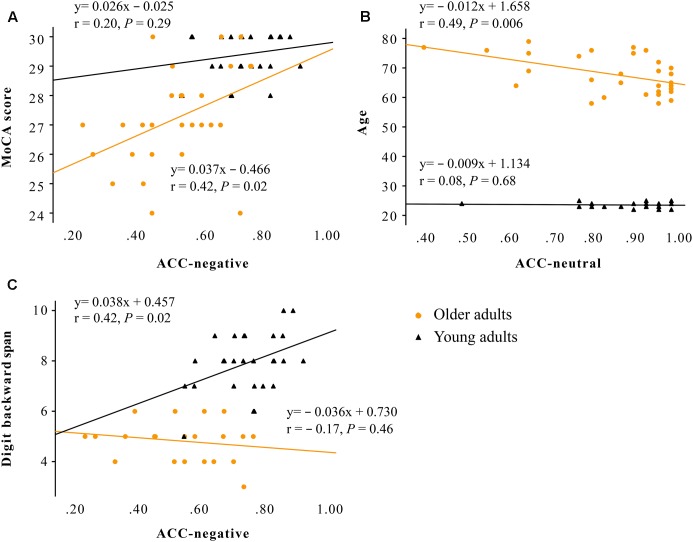
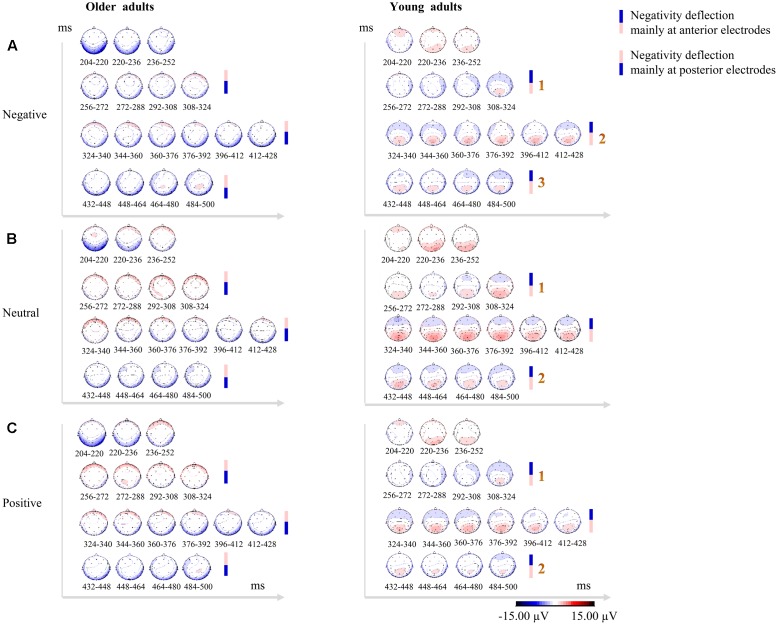
This study used event-related potentials (ERPs) to investigate the effects of age on neural temporal dynamics of processing task-relevant facial expressions and their relationship to cognitive functions. Negative (sad, afraid, angry, and disgusted), positive (happy), and neutral faces were presented to 30 older and 31 young participants who performed a facial emotion categorization task. Behavioral and ERP indices of facial emotion processing were analyzed. An enhanced N170 for negative faces, in addition to intact right-hemispheric N170 for positive faces, was observed in older adults relative to their younger counterparts. Moreover, older adults demonstrated an attenuated within-group N170 laterality effect for neutral faces, while younger adults showed the opposite pattern. Furthermore, older adults exhibited sustained temporo-occipital negativity deflection over the time range of 200-500 ms post-stimulus, while young adults showed posterior positivity and subsequent emotion-specific frontal negativity deflections. In older adults, decreased accuracy for labeling negative faces was positively correlated with Montreal Cognitive Assessment Scores, and accuracy for labeling neutral faces was negatively correlated with age. These findings suggest that older people may exert more effort in structural encoding for negative faces and there are different response patterns for the categorization of different facial emotions. Cognitive functioning may be related to facial emotion categorization deficits observed in older adults. This may not be attributable to positivity effects: it may represent a selective deficit for the processing of negative facial expressions in older adults.
本研究采用事件相关电位(ERP)来探究年龄对处理与任务相关面部表情的神经时间动态的影响,以及其与认知功能的关系。向30名老年人和31名年轻人呈现负面(悲伤、恐惧、愤怒和厌恶)、正面(快乐)和中性面孔,让他们执行面部情绪分类任务。分析面部情绪处理的行为和ERP指标。相对于年轻人,老年人中观察到负面面孔的N170增强,正面面孔的右半球N170完整。此外,老年人中中性面孔的组内N170偏侧化效应减弱,而年轻人表现出相反的模式。此外,老年人在刺激后200 - 500毫秒的时间范围内表现出持续的颞枕部负向偏转,而年轻人则表现出后部正向和随后的情绪特异性额叶负向偏转。在老年人中,负面面孔标注准确性的降低与蒙特利尔认知评估得分呈正相关,中性面孔标注准确性与年龄呈负相关。这些发现表明,老年人可能在负面面孔的结构编码上付出更多努力,并且在不同面部情绪分类上存在不同的反应模式。认知功能可能与老年人中观察到的面部情绪分类缺陷有关。这可能不归因于积极效应:它可能代表老年人处理负面面部表情的选择性缺陷。