Duan Wei-Na, Xia Zhong-Yuan, Liu Min, Sun Qian, Lei Shao-Qing, Wu Xiao-Jing, Meng Qing-Tao, Leng Yan
Department of Anesthesiology, Renmin Hospital of Wuhan University, Wuhan, Hubei 430060, P.R. China.
Mol Med Rep. 2017 Sep;16(3):2668-2674. doi: 10.3892/mmr.2017.6941. Epub 2017 Jul 6.
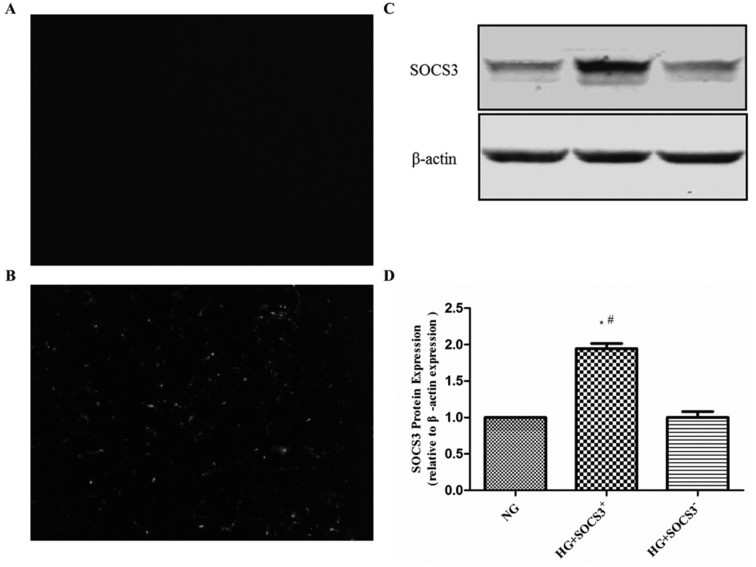
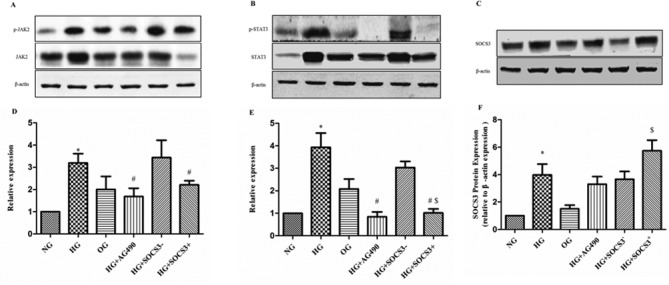
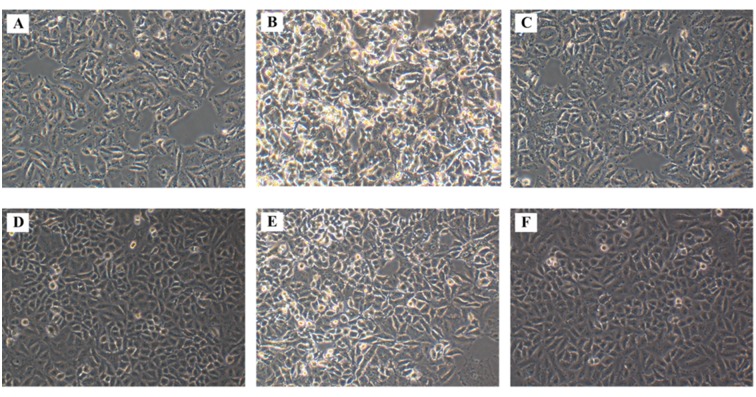
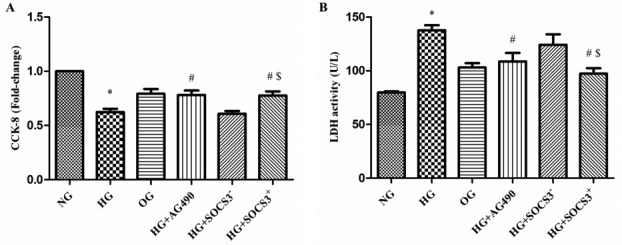
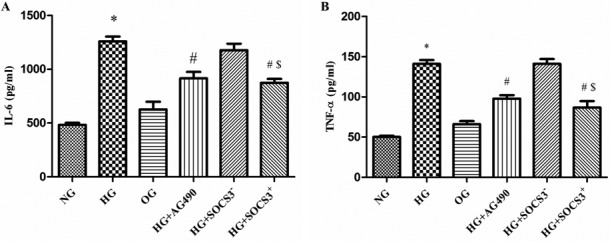
Previous studies have suggested that the Janus kinase (JAK)/signal transducers and activators of transcription (STAT) pathway is involved in hyperglycemia‑induced lung injury. The present study aimed to investigate the roles of suppressor of cytokine signaling3 (SOCS3) in the regulation of JAK2/STAT3 activation following high glucose (HG) treatment in A549 human pulmonary epithelial cells. Cell viability was evaluated using Cell Counting Kit-8 and lactate dehydrogenase assays. HG‑induced inflammatory injury in A549 cells was assessed through the evaluation of interleukin‑6 (IL‑6) and tumor necrosis factor‑α (TNF‑α) levels using ELISA. The protein expression levels of SOCS3, JAK2, STAT3, phosphorylated (p)‑JAK2 and p‑STAT3 were determined using western blot analysis. Cellular viability was significantly decreased, whereas IL‑6 and TNF‑α levels were significantly increased, following HG stimulation of A549 cells. In addition, the protein levels of SOCS3, p‑JAK2 and p‑STAT3 were significantly increased in HG‑treated cells. Treatment with the JAK2/STAT3 inhibitor tyrphostin AG490, or SOCS3 overexpression, appeared to prevent the HG‑induced alterations in protein expression. Furthermore, cellular viability was enhanced, whereas the levels of proinflammatory cytokines were suppressed. These finding suggested the involvement of the SOCS3/JAK2/STAT3 signaling pathway in HG‑induced responses in lung cells. Therefore, it may be hypothesized that the inhibition of the JAK2/STAT3 pathway through SOCS3 overexpression may prevent hyperglycemia‑induced lung injury, and may have therapeutic potential for the treatment of patients with diabetic lung injury.
先前的研究表明,Janus激酶(JAK)/信号转导子和转录激活子(STAT)通路参与了高血糖诱导的肺损伤。本研究旨在探讨细胞因子信号转导抑制因子3(SOCS3)在高糖(HG)处理A549人肺上皮细胞后对JAK2/STAT3激活的调节作用。使用细胞计数试剂盒-8和乳酸脱氢酶检测法评估细胞活力。通过酶联免疫吸附测定法(ELISA)评估白细胞介素-6(IL-6)和肿瘤坏死因子-α(TNF-α)水平,以评估HG诱导的A549细胞炎症损伤。使用蛋白质印迹分析测定SOCS3、JAK2、STAT3、磷酸化(p)-JAK2和p-STAT3的蛋白表达水平。HG刺激A549细胞后,细胞活力显著降低,而IL-6和TNF-α水平显著升高。此外,HG处理的细胞中SOCS3、p-JAK2和p-STAT3的蛋白水平显著升高。用JAK2/STAT3抑制剂 tyrphostin AG490处理或SOCS3过表达似乎可防止HG诱导的蛋白表达改变。此外,细胞活力增强,而促炎细胞因子水平受到抑制。这些发现表明SOCS3/JAK2/STAT3信号通路参与了HG诱导的肺细胞反应。因此,可以推测通过SOCS3过表达抑制JAK2/STAT3通路可能预防高血糖诱导的肺损伤,并且可能对糖尿病肺损伤患者具有治疗潜力。