
汉黄芩素通过抑制 TLR4 介导的 JAK/STAT/AIM2 信号通路上调 SOCS3 减轻糖尿病肾病损伤。
Wogonin upregulates SOCS3 to alleviate the injury in Diabetic Nephropathy by inhibiting TLR4-mediated JAK/STAT/AIM2 signaling pathway.
机构信息
Nephropathy Department, DongGuan Tungwah Hospital, Dongcheng, East Road No. 1, DongGuan, 523015, Guangdong, China.
Dongguan Key Laboratory of Precise Prevention & Treatment of Chronic Kidney Disease and Complications, DongGuan, 523015, Guangdong, China.
出版信息
Mol Med. 2024 Jun 6;30(1):78. doi: 10.1186/s10020-024-00845-4.
BACKGROUND
Diabetic nephropathy (DN) is a life-threatening renal disease and needs urgent therapies. Wogonin is renoprotective in DN. This study aimed to explore the mechanism of how wogonin regulated high glucose (HG)-induced renal cell injury.
METHODS
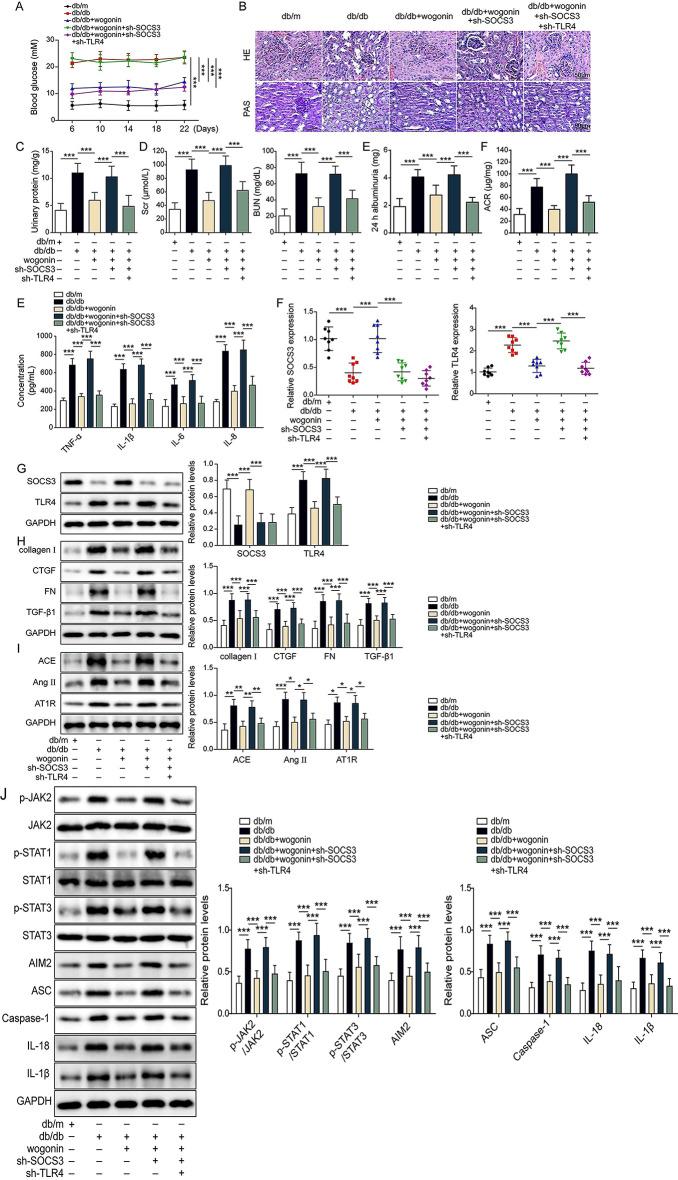
Diabetic mice (db/db), control db/m mice, and normal glucose (NG)- or HG-treated human tubule epithelial cells (HK-2) were used to evaluate the levels of suppressor of cytokine signaling 3 (SOCS3), Toll-like receptor 4 (TLR4), inflammation and fibrosis. Lentivirus was used to regulate SOCS3 and TLR4 expressions. After oral gavage of wogonin (10 mg/kg) or vehicle in db/db mice, histological morphologies, blood glucose, urinary protein, serum creatinine values (Scr), blood urea nitrogen (BUN), superoxide dismutase (SOD), glutathione (GSH), and reactive oxygen species (ROS) were assessed. RT-qPCR and Western blot evaluated inflammation and fibrosis-related molecules.
RESULTS
HG exposure induced high blood glucose, severe renal injuries, high serumal Src and BUN, low SOD and GSH, and increased ROS. HG downregulated SOCS3 but upregulated TLR4 and JAK/STAT, fibrosis, and inflammasome-related proteins. Wogonin alleviated HG-induced renal injuries by decreasing cytokines, ROS, Src, and MDA and increasing SOD and GSH. Meanwhile, wogonin upregulated SOCS3 and downregulated TLR4 under HG conditions. Wogonin-induced SOCS3 overexpression directly decreased TLR4 levels and attenuated JAK/STAT signaling pathway-related inflammation and fibrosis, but SOCS3 knockdown significantly antagonized the protective effects of wogonin. However, TLR4 knockdown diminished SOCS3 knockdown-induced renal injuries.
CONCLUSION
Wogonin attenuates renal inflammation and fibrosis by upregulating SOCS3 to inhibit TLR4 and JAK/STAT pathway.
背景
糖尿病肾病(DN)是一种危及生命的肾脏疾病,需要紧急治疗。汉黄芩素对 DN 具有肾保护作用。本研究旨在探讨汉黄芩素调节高糖(HG)诱导的肾细胞损伤的机制。
方法
使用糖尿病小鼠(db/db)、对照 db/m 小鼠和正常葡萄糖(NG)或 HG 处理的人肾小管上皮细胞(HK-2)来评估细胞因子信号转导抑制因子 3(SOCS3)、Toll 样受体 4(TLR4)、炎症和纤维化水平。使用慢病毒调节 SOCS3 和 TLR4 的表达。在 db/db 小鼠中口服给予汉黄芩素(10 mg/kg)或载体后,评估组织学形态、血糖、尿蛋白、血清肌酐值(Scr)、血尿素氮(BUN)、超氧化物歧化酶(SOD)、谷胱甘肽(GSH)和活性氧(ROS)。RT-qPCR 和 Western blot 评估炎症和纤维化相关分子。
结果
HG 暴露导致高血糖、严重的肾脏损伤、血清 Src 和 BUN 升高、SOD 和 GSH 降低以及 ROS 增加。HG 下调 SOCS3 但上调 TLR4 和 JAK/STAT、纤维化和炎症小体相关蛋白。汉黄芩素通过降低细胞因子、ROS、Src 和 MDA 以及增加 SOD 和 GSH 来减轻 HG 诱导的肾损伤。同时,汉黄芩素在 HG 条件下上调 SOCS3 并下调 TLR4。汉黄芩素诱导的 SOCS3 过表达直接降低 TLR4 水平并减弱 JAK/STAT 信号通路相关的炎症和纤维化,但 SOCS3 敲低显著拮抗了汉黄芩素的保护作用。然而,TLR4 敲低减轻了 SOCS3 敲低诱导的肾脏损伤。
结论
汉黄芩素通过上调 SOCS3 抑制 TLR4 和 JAK/STAT 通路来减轻肾脏炎症和纤维化。


 Zotero 插件