Department of Anesthesiology, The Affiliated Hospital of Stomatology, Chongqing Medical University, Chongqing, China.
Mol Pain. 2017 Jan-Dec;13:1744806917723789. doi: 10.1177/1744806917723789.
Modulation of N-methyl-D-aspartate receptor subunits NR1 and NR2 through phosphorylation mediates opioid-induced hyperalgesia, and activations of protein kinase C and extracellular signal-regulated kinase 1/2 potentiate while activation of calcium/calmodulin-dependent protein kinase II inhibits opioid-induced hyperalgesia. However, the mechanism of opioid-induced hyperalgesia development and in particular the potential interplay between N-methyl-D-aspartate receptors and protein kinase C or calcium/calmodulin-dependent protein kinase II or extracellular signal-regulated kinase 1/2 in the development of remifentanil-induced hyperalgesia is unclear.
Remifentanil (1 µg ċ kg−1 ċ min−1) was given intravenously over 60 min in rats, followed by the infusion of either vehicle solution or the respective inhibitors of protein kinase C (chelerythrine), extracellular signal-regulated kinase II (KN93), or extracellular signal-regulated kinase 1/2 (PD98059). Thereafter, the pain behaviors were evaluated by the paw withdrawal mechanical threshold and paw withdrawal thermal latency. In in vitro studies, fetal spinal cord dorsal horn neurons were primary cultured in the presence of 4 nM remifentanil for 60 min, and then the remifentanil was washed out and replaced immediately by culturing in the absence or presence of chelerythrine, KN93 or PD98059, respectively for up to 8 h. The expressions of N-methyl-D-aspartate receptors subunits and their phosphorylation (NR1, NR2B, p-NR1, p-NR2B) were analyzed by Western blotting after the completion of treatments. Functional changes of N-methyl-D-aspartate receptors were evaluated by electrophysiologic recordings of N-methyl-D-aspartate currents.
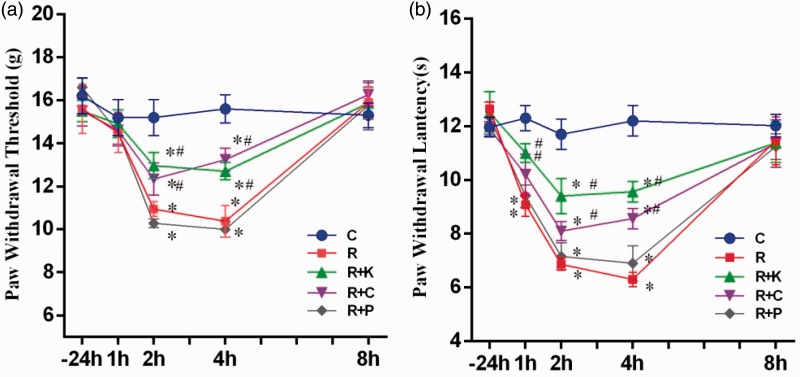
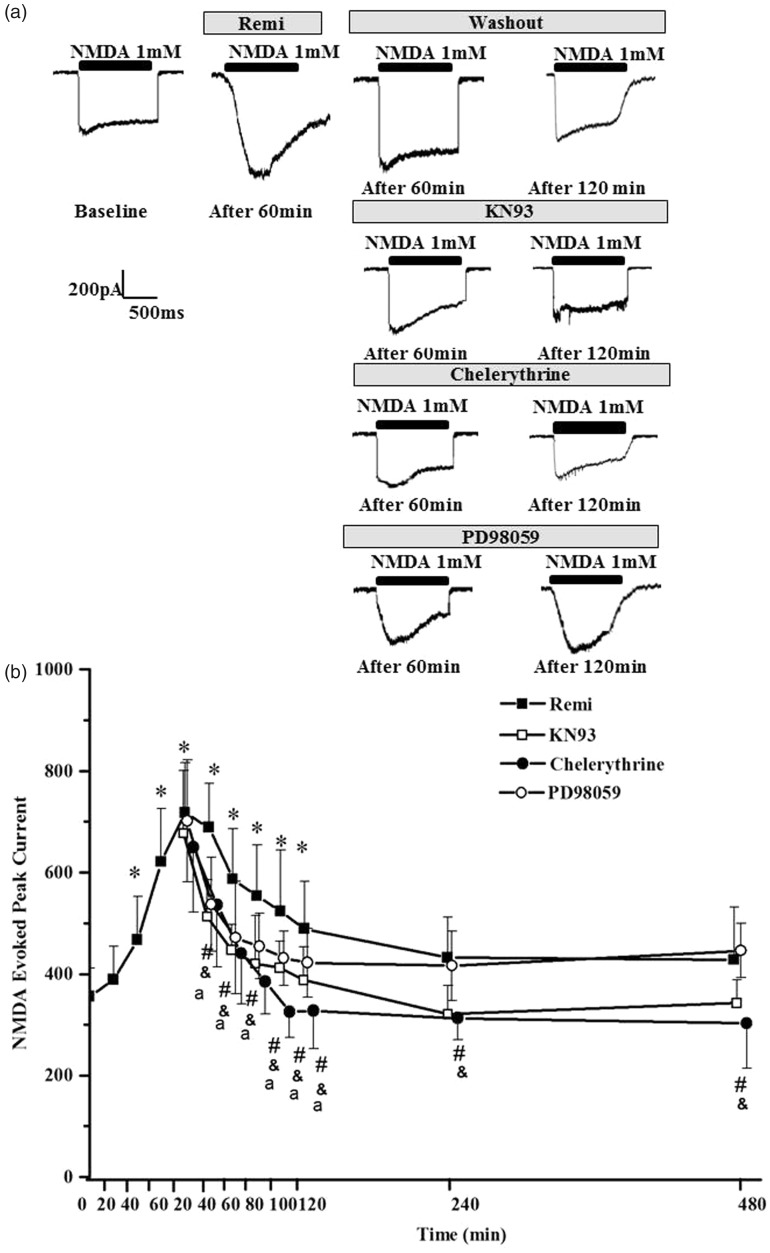
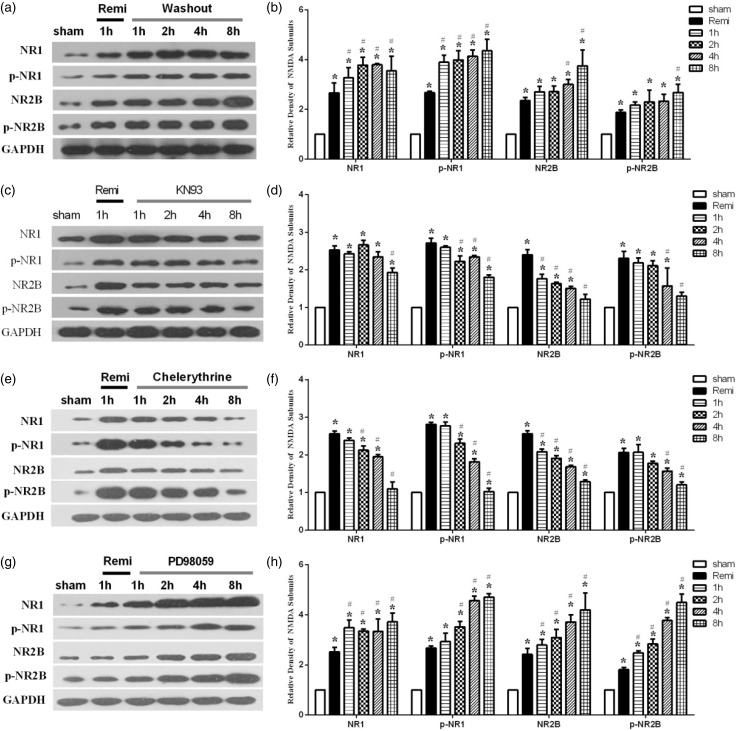
Remifentanil induced significant thermal and mechanical hyperalgesia, which were significantly attenuated by Chelerythrine or KN93 but not PD98059. The expressions of NR1, NR2B, p-NR1, and p-NR2B were increased significantly and progressively over time after remifentanil administration, and these increases were all significantly attenuated by either chelerythrine or KN93 but not PD98059. Intriguingly, N-methyl-D-aspartate receptor functional enhancement induced by remifentanil was attenuated by Chelerythrine, KN93, and PD98059.
It is concluded that the enhancements in function and quantity of N-methyl-D-aspartate receptor via phosphorylation of its subunits through protein kinase C and calcium/calmodulin-dependent protein kinase II activation may represent the major mechanism whereby remifentanil induced hyperalgesia.
通过磷酸化调节 N-甲基-D-天冬氨酸受体亚单位 NR1 和 NR2 介导阿片类药物引起的痛觉过敏,而蛋白激酶 C 和细胞外信号调节激酶 1/2 的激活增强,而钙/钙调蛋白依赖性蛋白激酶 II 的激活则抑制阿片类药物引起的痛觉过敏。然而,阿片类药物引起的痛觉过敏发展的机制,特别是 N-甲基-D-天冬氨酸受体与蛋白激酶 C 或钙/钙调蛋白依赖性蛋白激酶 II 或细胞外信号调节激酶 1/2 之间在瑞芬太尼引起的痛觉过敏发展中的潜在相互作用尚不清楚。
在大鼠中静脉输注瑞芬太尼(1μg·kg−1·min−1)60 分钟,然后输注蛋白激酶 C(石杉碱甲)、细胞外信号调节激酶 2(KN93)或细胞外信号调节激酶 1/2(PD98059)的相应抑制剂。此后,通过足底撤回机械阈值和足底撤回热潜伏期评估疼痛行为。在体外研究中,在存在 4 nM 瑞芬太尼的情况下对胎鼠脊髓背角神经元进行原代培养 60 分钟,然后立即冲洗瑞芬太尼,并分别用无或有石杉碱甲、KN93 或 PD98059 培养,最长 8 小时。Western 印迹分析治疗完成后 N-甲基-D-天冬氨酸受体亚单位及其磷酸化(NR1、NR2B、p-NR1、p-NR2B)的表达。通过 N-甲基-D-天冬氨酸电流的电生理记录评估 N-甲基-D-天冬氨酸受体的功能变化。
瑞芬太尼诱导明显的热痛觉过敏和机械痛觉过敏,石杉碱甲或 KN93 显著减轻,但 PD98059 不减轻。瑞芬太尼给药后,NR1、NR2B、p-NR1 和 p-NR2B 的表达均显著且逐渐增加,石杉碱甲或 KN93 可显著减弱这些增加,但 PD98059 不能减弱。有趣的是,瑞芬太尼诱导的 N-甲基-D-天冬氨酸受体功能增强被石杉碱甲、KN93 和 PD98059 减弱。
综上所述,通过蛋白激酶 C 和钙/钙调蛋白依赖性蛋白激酶 II 激活使 N-甲基-D-天冬氨酸受体亚单位磷酸化,从而增强其功能和数量,可能是瑞芬太尼引起痛觉过敏的主要机制。