Moyo Nathifa, Borthwick Nicola J, Wee Edmund G, Capucci Silvia, Crook Alison, Dorrell Lucy, Hanke Tomáš
The Jenner Institute, Nuffield Department of Medicine, University of Oxford, Oxford, United Kingdom.
Department of Pharmacy and Biotechnology, University of Bologna, Bologna, Italy.
PLoS One. 2017 Jul 18;12(7):e0181382. doi: 10.1371/journal.pone.0181382. eCollection 2017.
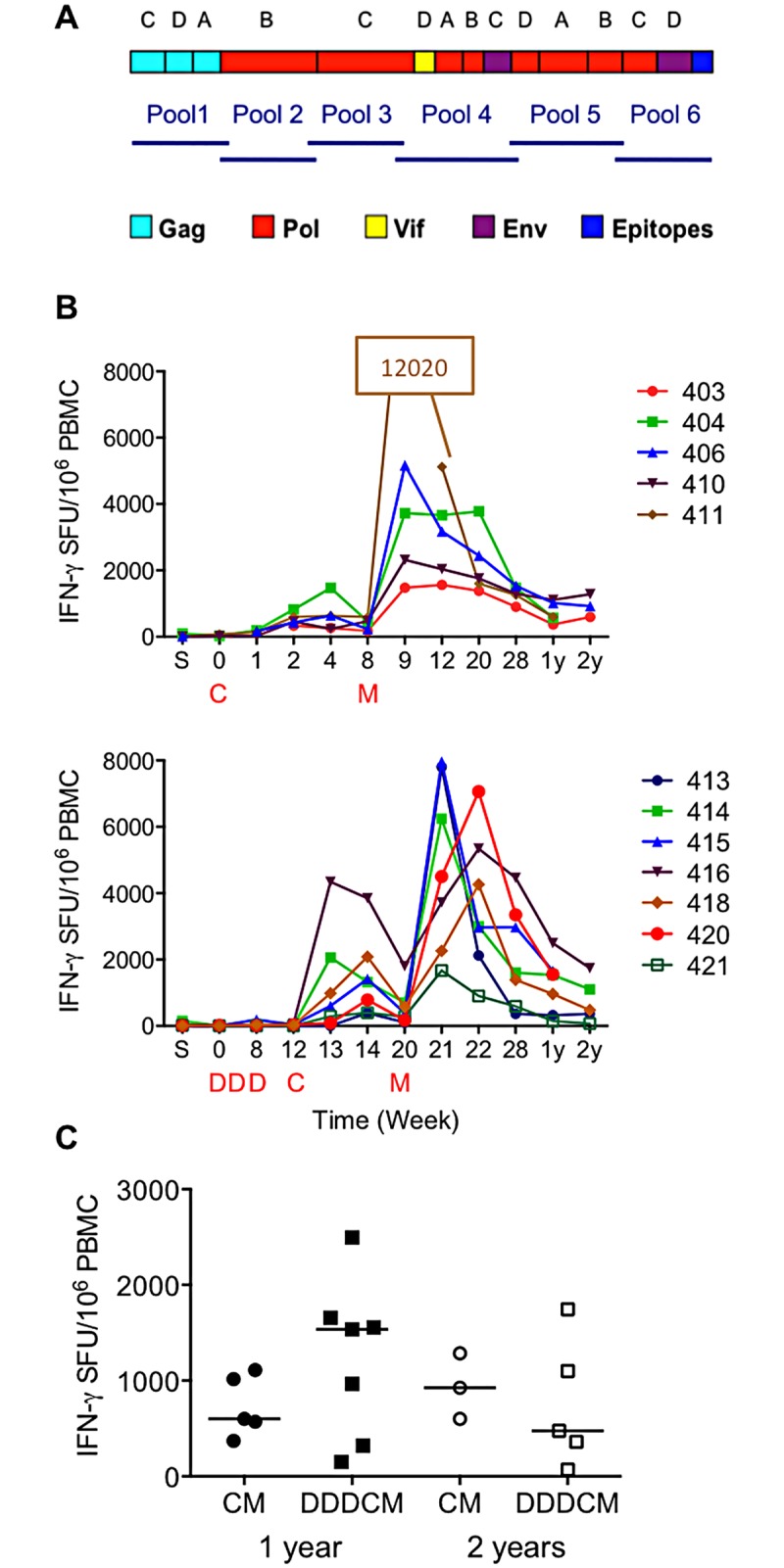
Durability of vaccine-elicited immune responses is one of the key determinants for vaccine success. Our aim is to develop a vaccination strategy against the human immunodeficiency virus type 1 (HIV-1), which induces protective and durable CD8+ T-cell responses. The central theorem of our approach is to focus T cells on highly conserved regions of the HIV-1 proteome and this is achieved through the use of the first-generation conserved vaccine immunogen HIVconsv. This immunogen vectored by plasmid DNA, simian adenovirus and poxvirus MVA was tested in healthy, HIV-1-negative adults in UK and induced high magnitudes of HIVconsv-specific plurifunctional CD8+ T cells capable of in vitro HIV-1 inhibition. Here, we assessed the durability of these responses.
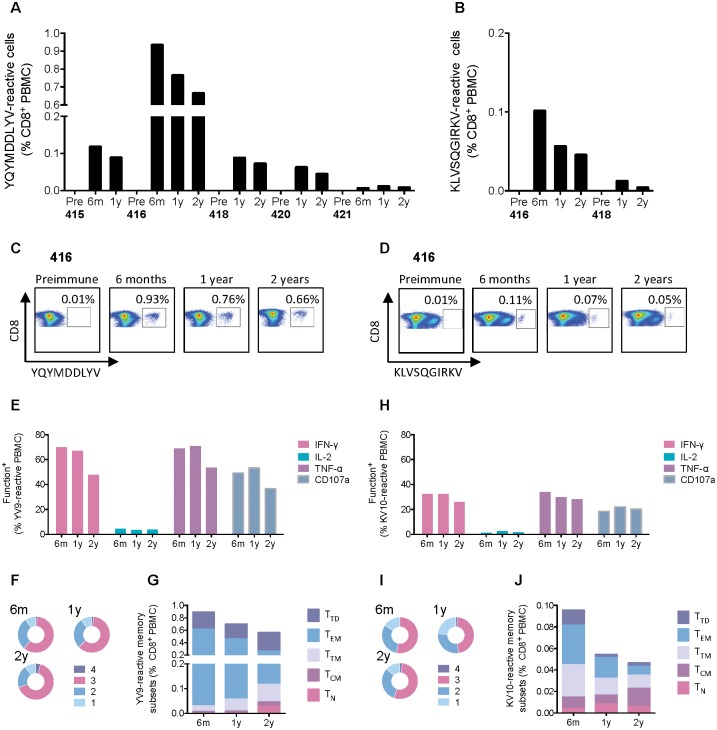
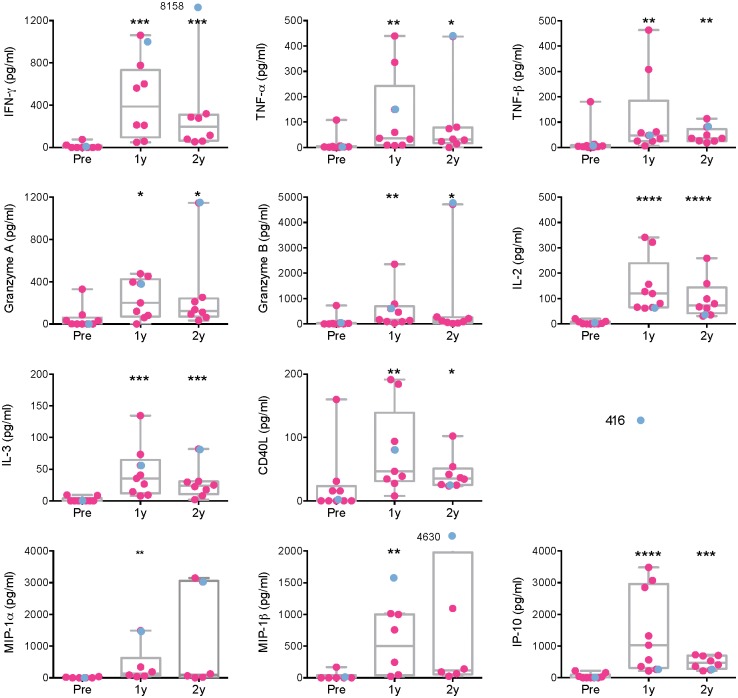
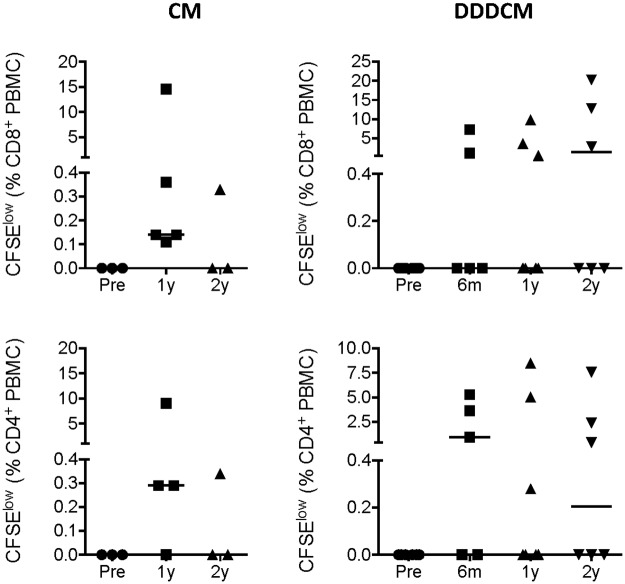
Vaccine recipients in trial HIV-CORE 002 were invited to provide a blood sample at 1 and 2 years after vaccination. Their PBMCs were tested in IFN-γ ELISPOT, 25-analyte Luminex, CFSE proliferation and intracellular cytokine staining assays, the last enhanced by HLA-peptide dextramer analysis.
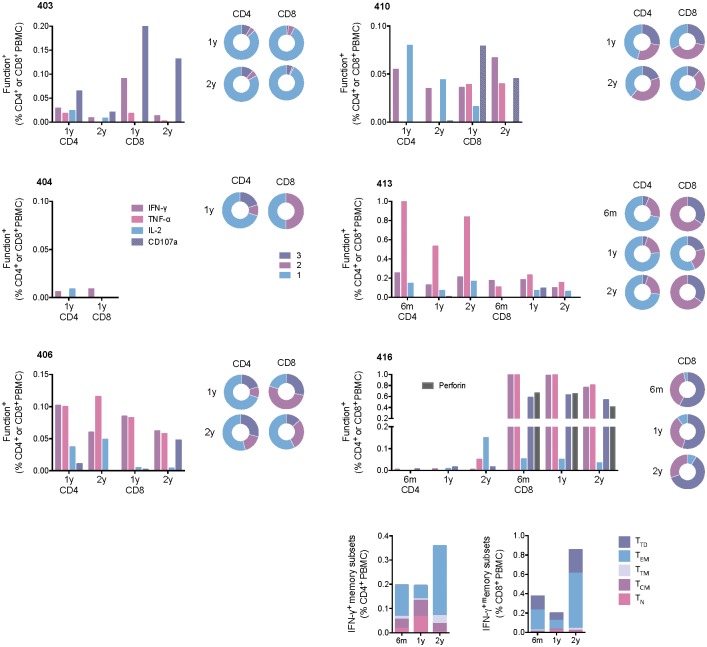
12/12 (1 year) and 8/8 (2 years) returning subjects had median (range) of 990 (150-2495) and 763 (70-1745) IFN-γ SFU/106 PBMC specific for HIVconsv, respectively, and recognized 5 (1-6) out of 6 peptide pools at 2 years. Over one-half of the HIVconsv-specific cells expressed at least 3 functions IFN-γ, TNF-α and CD107a, and were capable of proliferation. Among dextramer-reactive cells, naïve, transitional, effector and terminally differentiated memory subsets were similarly represented.
First generation HIVconsv vaccine induced human T cells, which were plurifunctional and persisted for at least 2 years.
ClinicalTrials.gov NCT01151319.
疫苗诱导的免疫反应的持久性是疫苗成功的关键决定因素之一。我们的目标是开发一种针对1型人类免疫缺陷病毒(HIV-1)的疫苗接种策略,该策略可诱导具有保护性和持久性的CD8 + T细胞反应。我们方法的核心原理是将T细胞聚焦于HIV-1蛋白质组的高度保守区域,这是通过使用第一代保守疫苗免疫原HIVconsv实现的。这种由质粒DNA、猿猴腺病毒和痘苗病毒MVA作为载体的免疫原在英国健康的HIV-1阴性成年人中进行了测试,并诱导出了能够在体外抑制HIV-1的高数量的HIVconsv特异性多功能CD8 + T细胞。在此,我们评估了这些反应的持久性。
HIV-CORE 002试验中的疫苗接种者被邀请在接种后1年和2年提供血样。他们的外周血单核细胞(PBMC)在干扰素-γ酶联免疫斑点试验(IFN-γ ELISPOT)、25分析物Luminex试验、羧基荧光素二醋酸盐琥珀酰亚胺酯(CFSE)增殖试验和细胞内细胞因子染色试验中进行检测,最后一项试验通过HLA肽多聚体分析得到增强。
12名(1年)和8名(2年)回访受试者中,HIVconsv特异性干扰素-γ斑点形成单位/10⁶ PBMC的中位数(范围)分别为990(150 - 2495)和763(70 - 1745),并且在2年时识别出6个肽库中的5个(1 - 6个)。超过一半的HIVconsv特异性细胞表达至少三种功能——干扰素-γ、肿瘤坏死因子-α和CD107a,并且能够增殖。在多聚体反应性细胞中,初始、过渡、效应和终末分化记忆亚群的比例相似。
第一代HIVconsv疫苗诱导产生的人类T细胞具有多功能性且至少持续了2年。
ClinicalTrials.gov NCT01151319。