Seif Saada A, Kohi Thecla W, Moshiro Candida S
Department of Nursing Management, School of Nursing, Muhimbili University of Health and Allied Sciences, P.O. Box 65001, Dar es Salaam, Tanzania.
Department of Nursing Management, School of Nursing, Muhimbili University of Health and Allied Sciences, P. O. Box, 65001, Dar es Salaam, Tanzania.
BMC Public Health. 2017 Jul 18;18(1):31. doi: 10.1186/s12889-017-4591-2.
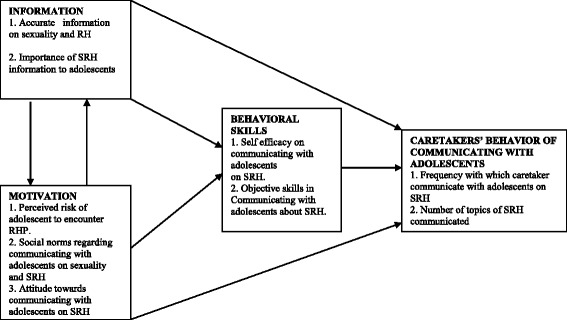
Caretakers/parents/caregivers/guardians play important roles in improving Sexual and Reproductive Health (SRH) of adolescents. Caretaker-adolescent sexual communication suggested to influence young people's sexual behaviours. Despite this significance, the communication is believed to be low in Unguja due to the increase of risky sexual behaviours among adolescents. This study assessed the pattern of such communication using IMB model as a framework.
This is a cross-sectional study targeted caretakers of adolescents aged 15-19. One thousand caretakers of adolescents were interviewed using structured questionnaire. Comparison between male and female caretakers on discussing different SRH topics to both sexes of adolescents was made. The mean-score difference of overall communication was examined using Univariate analysis of variance (ANOVA). Bivariate correlation and simple path analysis via regression was conducted to determine the association of IMB variables in relation to communication practice.
This study finds 40.7% of caretakers had ever communicated with their adolescents on SRH matters and 9.2% reported to have had communicated in the past 30 days. The weighted topic measure revealed only 26.5% of caretakers communicated with their adolescents. Both caretakers communicated more with their female adolescents. The communication was more common between same sex and between caretakers and their biological adolescents (p < 0.000). Both male and female caretakers mostly discussed sexual abstinence to female adolescents while to male adolescents, HIV/STIs was mostly discussed by female caretakers and pregnancy by male caretakers. The least discussed topics to both sexes are safer sex and other contraceptives use. The bivariate correlations suggested that IMB constructs were inter-related and associated with communication practice.
Caretakers-adolescents communication on SRH in Unguja is low and it is not comprehensive. Caretakers fail to communicate with their adolescents on sensitive issues but do so on less sensitive ones. The pattern of communication found to vary across gender of caretaker and that of adolescent and depends on the nature of relationship between caretaker and adolescent. There is gender differences in selecting SRH topics of discussion. Interventions programmes have to include strategies that enhance caretaker's information, motivation and skills so as to improve SRH communication between caretakers and adolescent.
照顾者/父母/照料者/监护人在改善青少年性与生殖健康(SRH)方面发挥着重要作用。照顾者与青少年之间的性沟通被认为会影响年轻人的性行为。尽管具有这一重要性,但由于青少年中危险性行为的增加,在奔巴岛,这种沟通被认为程度较低。本研究以信息 - 动机 - 行为技巧(IMB)模型为框架评估了这种沟通模式。
这是一项针对15 - 19岁青少年照顾者的横断面研究。使用结构化问卷对1000名青少年照顾者进行了访谈。比较了男性和女性照顾者与青少年两性讨论不同SRH主题的情况。使用单因素方差分析(ANOVA)检验总体沟通的平均得分差异。通过回归进行双变量相关性分析和简单路径分析,以确定IMB变量与沟通实践之间的关联。
本研究发现40.7%的照顾者曾与他们的青少年就SRH问题进行过沟通,9.2%报告在过去30天内进行过沟通。加权主题测量显示只有26.5%的照顾者与他们的青少年进行了沟通。两类照顾者都与他们的女性青少年沟通更多。这种沟通在同性之间以及照顾者与他们的亲生青少年之间更为常见(p < 0.000)。男性和女性照顾者大多向女性青少年讨论性禁欲,而对于男性青少年,女性照顾者大多讨论艾滋病毒/性传播感染,男性照顾者大多讨论怀孕。对两性最少讨论的主题是安全性行为和其他避孕方法的使用。双变量相关性分析表明IMB结构相互关联且与沟通实践相关。
在奔巴岛,照顾者与青少年之间关于SRH的沟通程度较低且不全面。照顾者未能就敏感问题与他们的青少年进行沟通,但在不太敏感的问题上会这样做。发现沟通模式因照顾者和青少年的性别而异,并取决于照顾者与青少年之间关系的性质。在选择SRH讨论主题方面存在性别差异。干预项目必须包括增强照顾者的信息、动机和技能的策略,以改善照顾者与青少年之间的SRH沟通。