
阿糖胞苷通过靶向PI3K/Akt/mTOR通路对高级别胶质瘤软脑膜转移的抗胶质瘤作用
Antiglioma effects of cytarabine on leptomeningeal metastasis of high-grade glioma by targeting the PI3K/Akt/mTOR pathway.
作者信息
Zhao Kai-Hong, Zhang Can, Bai Yue, Li Yan, Kang Xun, Chen Jian-Xin, Yao Kun, Jiang Tao, Zhong Xiao-Song, Li Wen-Bin
机构信息
Department of Glioma.
Clinical Center of Gene And Cell Engineering, Beijing Shijitan Hospital.
出版信息
Drug Des Devel Ther. 2017 Jun 26;11:1905-1915. doi: 10.2147/DDDT.S135711. eCollection 2017.
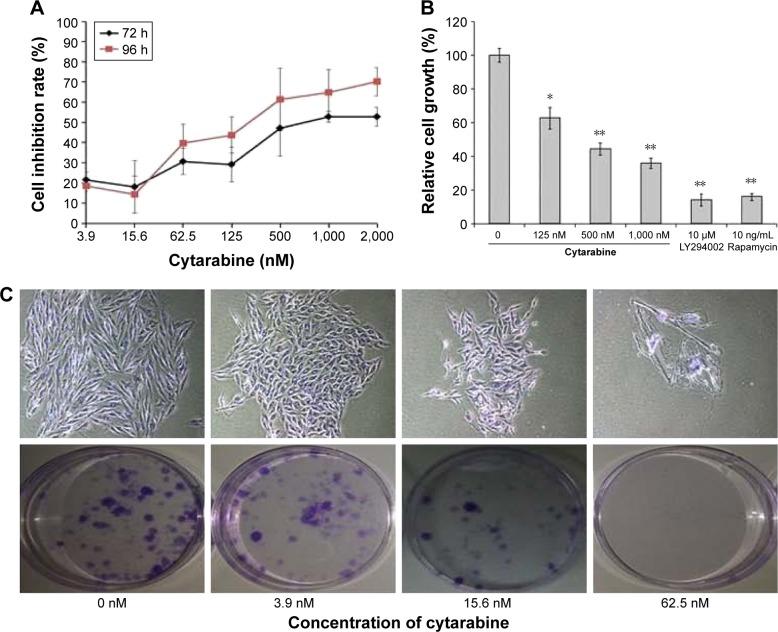
Leptomeningeal metastasis (LM) of high-grade glioma is a highly lethal disease requiring new effective therapeutic measures. For both de novo or relapsed glioma with LM, intrathecal cytarabine chemotherapy is not frequently used for first-line and relapse protocols. We encountered a clinical case demonstrating effective application of cytarabine in high-grade glioma with LM, prompting us to explore the effects of cytarabine on malignant glioma and molecular mechanisms of such effects through in vivo and in vitro experiments. The U87 cell line was selected to represent human glioma for studies. Cell viability was measured by MTT assay, plate colony formation assay, and trypan-blue dye exclusion test. Apoptosis was assessed by flow cytometry. Protein expression levels were detected by Western blot assay and immunohistochemistry. mRNA expression was examined by quantitative real-time reverse transcription polymerase chain reaction. Cytarabine inhibited tumor growth during the in vivo experiment. The present study confirmed that cytarabine inhibits proliferation and promotes apoptosis of U87 cells, and molecular analysis of this effect showed that cytarabine significantly reduces expression of phosphatidylinositol 3-kinase/serine/threonine kinase also known as the protein kinase B/mechanistic target of rapamycin (PI3K/Akt/mTOR) pathway, Ki-67, BCL2, and 4-1BB, and upregulates Bax and cleaved caspase-3. Our findings indicated that intrathecal administration of cytarabine manifests potential in prophylaxis and treatment of malignant glioma with LM. Effective medications for high-grade glioma with LM should contain cytarabine.
高级别胶质瘤的软脑膜转移(LM)是一种高致死性疾病,需要新的有效治疗措施。对于初发或复发的伴有LM的胶质瘤,鞘内注射阿糖胞苷化疗在一线治疗和复发治疗方案中并不常用。我们遇到了一个临床病例,显示阿糖胞苷在伴有LM的高级别胶质瘤中应用有效,这促使我们通过体内和体外实验探索阿糖胞苷对恶性胶质瘤的作用及其分子机制。选择U87细胞系代表人类胶质瘤进行研究。通过MTT法、平板集落形成试验和台盼蓝拒染试验检测细胞活力。通过流式细胞术评估细胞凋亡。通过蛋白质印迹分析和免疫组织化学检测蛋白质表达水平。通过定量实时逆转录聚合酶链反应检测mRNA表达。在体内实验中,阿糖胞苷抑制肿瘤生长。本研究证实阿糖胞苷抑制U87细胞增殖并促进其凋亡,对这种作用的分子分析表明,阿糖胞苷显著降低磷脂酰肌醇3激酶/丝氨酸/苏氨酸激酶(也称为蛋白激酶B/雷帕霉素机制性靶标,PI3K/Akt/mTOR)通路、Ki-67、BCL2和4-1BB的表达,并上调Bax和裂解的半胱天冬酶-3。我们的研究结果表明,鞘内注射阿糖胞苷在预防和治疗伴有LM的恶性胶质瘤方面具有潜力。治疗伴有LM的高级别胶质瘤的有效药物应包含阿糖胞苷。




 Zotero 插件