Tien Shelly H, Crabtree Juliet N, Gray Heather L, Peterson Erik J
Division of Maternal-Fetal Medicine, Department of Obstetrics, Gynecology, and Women's Health, University of Minnesota, Minneapolis, Minnesota, United States of America.
Center for Immunology and Division of Rheumatic and Autoimmune Diseases, Department of Medicine, University of Minnesota, Minneapolis, Minnesota, United States of America.
PLoS One. 2017 Jul 19;12(7):e0181338. doi: 10.1371/journal.pone.0181338. eCollection 2017.
Influenza infection is a significant cause of respiratory morbidity among pregnant women. Seasonal influenza vaccination engages innate immune receptors to promote protective immunity. A coding polymorphism (R620W) in PTPN22 imparts elevated risk for human infection and autoimmune disease, predisposes to diminished innate immune responses, and associates with reduced immunization responses. We sought to quantify the effects of PTPN22-R620W on humoral and cell-mediated immune responses to the inactivated influenza vaccine among healthy pregnant women.
Immune responses were measured in healthy pregnant R620W carrier (n = 17) and non-carrier (n = 33) women receiving the 2013 quadrivalent inactivated influenza vaccine (Fluzone). Hemagglutination inhibition assays were performed to quantify neutralizing antibodies; functional influenza-reactive CD4 T cells were quantified by flow cytometry, and influenza-specific CD8 T cells were enumerated with MHC Class I tetramers. Antibody seroconversion data were evaluated by Chi-square analysis, and the Mann-Whitney or Wilcoxon signed-rank tests were applied to T cell response data.
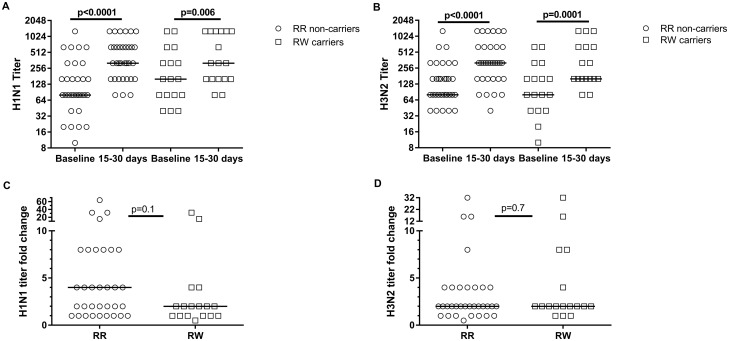
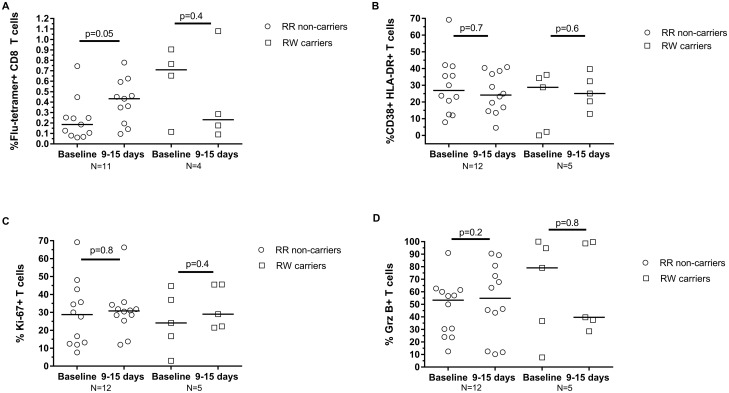
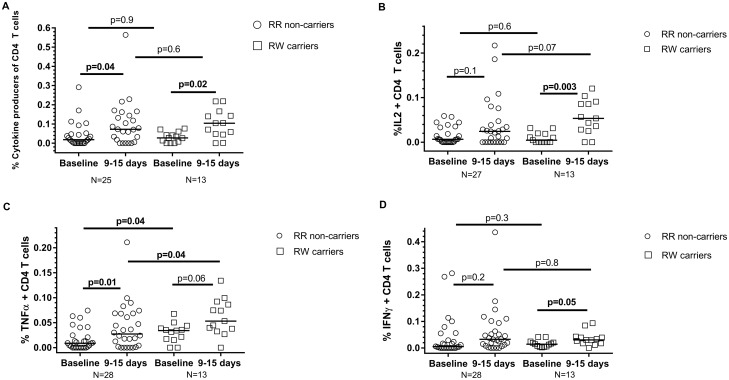
PTPN22 R620W carrier (n = 17) and non-carrier (n = 33) groups did not differ in age, parity, BMI, gestational age at time of vaccine, or history of prior influenza vaccination. After Fluzone exposure, 51.5% of non-carriers met criteria for antibody seroconversion to H1N1 influenza, compared with 23.5% of R620W carriers (p = 0.06). Influenza-reactive CD4 T cells showed modest increase at days 9-15 after vaccination in both R620W carriers and non-carriers (p = 0.02 and p = 0.04, respectively). However, there was no difference in overall response between the two groups (p = 0.6). The vaccine did not result in significant induction of influenza-specific CD8 T cells in either group.
There was no significant difference among healthy pregnant R620W carriers and non-carriers in H1N1 antibody seroconversion rates after influenza vaccination. Studies of larger cohorts will be needed to define the effect of PTPN22 risk allele carriage on antibody and T cell responses to influenza vaccination during pregnancy.
流感感染是孕妇呼吸道发病的重要原因。季节性流感疫苗接种可激活先天免疫受体以促进保护性免疫。蛋白酪氨酸磷酸酶非受体型22(PTPN22)中的一个编码多态性(R620W)会增加人类感染和自身免疫性疾病的风险,导致先天免疫反应减弱,并与免疫接种反应降低相关。我们试图量化PTPN22 - R620W对健康孕妇接种灭活流感疫苗后体液免疫和细胞介导免疫反应的影响。
在接种2013年四价灭活流感疫苗(Fluzone)的健康孕妇R620W携带者(n = 17)和非携带者(n = 33)中测量免疫反应。进行血凝抑制试验以量化中和抗体;通过流式细胞术对功能性流感反应性CD4 T细胞进行量化,并用MHC I类四聚体对流感特异性CD8 T细胞进行计数。抗体血清转化数据通过卡方分析进行评估,T细胞反应数据应用Mann - Whitney或Wilcoxon符号秩检验。
PTPN22 R620W携带者(n = 17)和非携带者(n = 33)组在年龄、产次、体重指数、接种疫苗时的孕周或既往流感疫苗接种史方面没有差异。接种Fluzone后,51.5%的非携带者达到H1N1流感抗体血清转化标准,而R620W携带者为23.5%(p = 0.06)。在接种疫苗后的第9 - 15天,R620W携带者和非携带者中的流感反应性CD4 T细胞均有适度增加(分别为p = 0.02和p = 0.04)。然而,两组之间的总体反应没有差异(p = 0.6)。该疫苗在两组中均未导致流感特异性CD8 T细胞的显著诱导。
流感疫苗接种后,健康孕妇R620W携带者和非携带者之间H1N1抗体血清转化率没有显著差异。需要对更大队列进行研究,以确定携带PTPN22风险等位基因对孕期流感疫苗接种后抗体和T细胞反应的影响。