Department of Chemical Engineering, Massachusetts Institute of Technology, Cambridge, MA, 02139, USA.
Koch Institute for Integrative Cancer Research, Massachusetts Institute of Technology, Cambridge, MA, 02139, USA.
Sci Rep. 2017 Jul 19;7(1):5831. doi: 10.1038/s41598-017-05889-7.
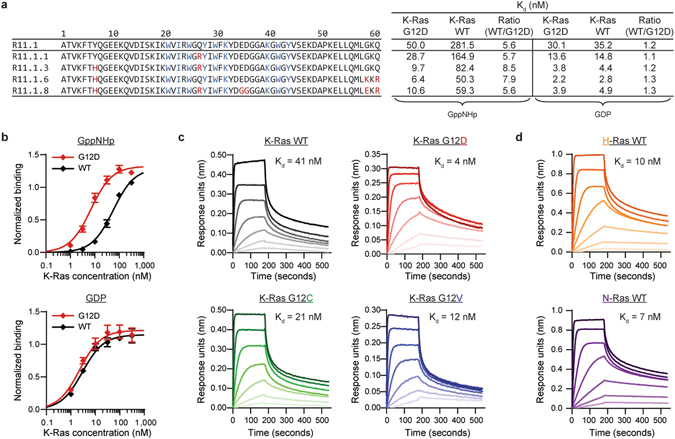
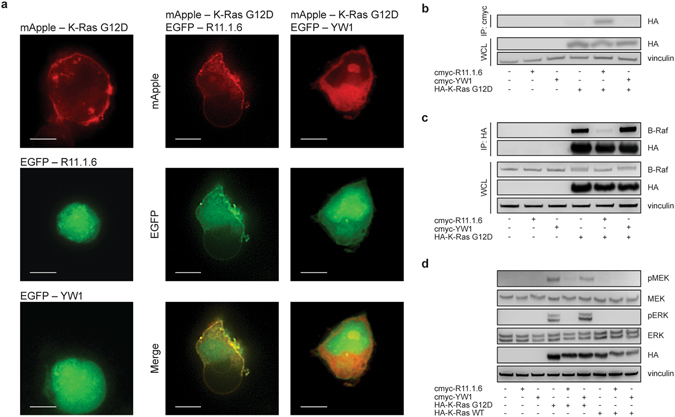
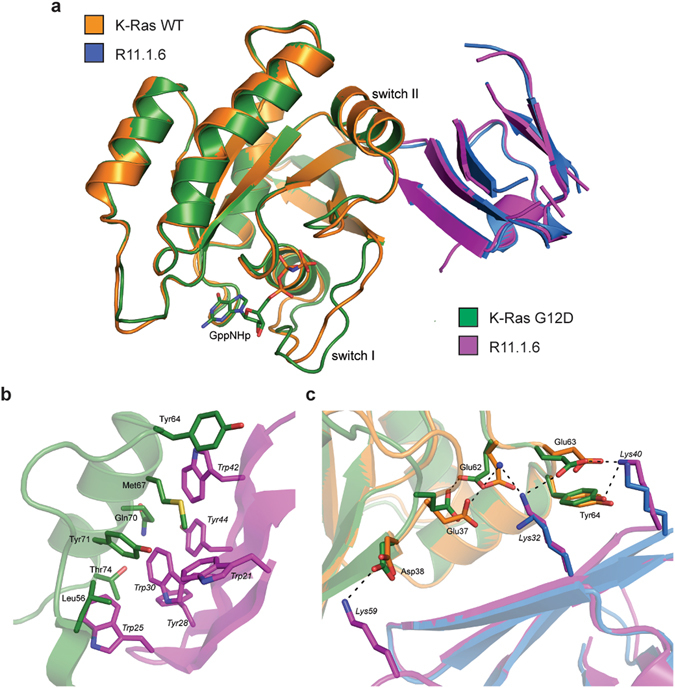
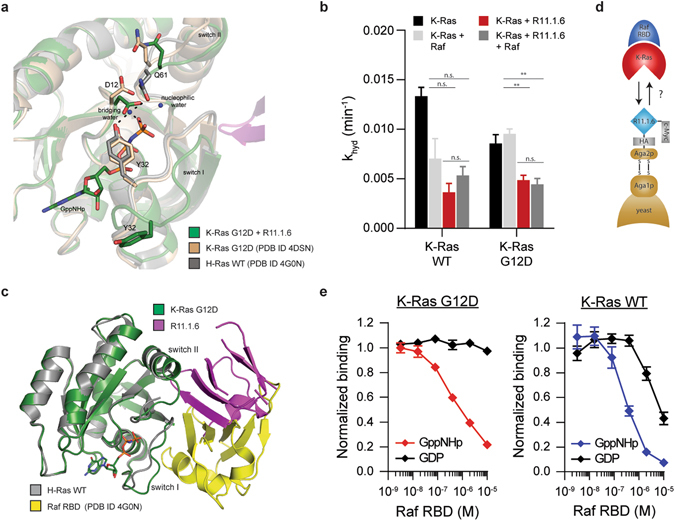
Ras is at the hub of signal transduction pathways controlling cell proliferation and survival. Its mutants, present in about 30% of human cancers, are major drivers of oncogenesis and render tumors unresponsive to standard therapies. Here we report the engineering of a protein scaffold for preferential binding to K-Ras G12D. This is the first reported inhibitor to achieve nanomolar affinity while exhibiting specificity for mutant over wild type (WT) K-Ras. Crystal structures of the protein R11.1.6 in complex with K-Ras WT and K-Ras G12D offer insight into the structural basis for specificity, highlighting differences in the switch I conformation as the major defining element in the higher affinity interaction. R11.1.6 directly blocks interaction with Raf and reduces signaling through the Raf/MEK/ERK pathway. Our results support greater consideration of the state of switch I and provide a novel tool to study Ras biology. Most importantly, this work makes an unprecedented contribution to Ras research in inhibitor development strategy by revealing details of a targetable binding surface. Unlike the polar interfaces found for Ras/effector interactions, the K-Ras/R11.1.6 complex reveals an extensive hydrophobic interface that can serve as a template to advance the development of high affinity, non-covalent inhibitors of K-Ras oncogenic mutants.
Ras 位于控制细胞增殖和存活的信号转导途径的中心。其突变体存在于约 30%的人类癌症中,是致癌的主要驱动因素,并使肿瘤对标准疗法不敏感。在这里,我们报告了一种蛋白质支架的工程设计,该支架可优先与 K-Ras G12D 结合。这是第一个报道的纳米级亲和力抑制剂,同时表现出对突变型(WT)K-Ras 的特异性。蛋白质 R11.1.6 与 K-Ras WT 和 K-Ras G12D 复合物的晶体结构提供了特异性结构基础的见解,突出了开关 I 构象的差异是更高亲和力相互作用的主要定义元素。R11.1.6 直接阻断与 Raf 的相互作用,并降低通过 Raf/MEK/ERK 途径的信号转导。我们的结果支持在开关 I 状态方面进行更多考虑,并提供了一种研究 Ras 生物学的新工具。最重要的是,这项工作通过揭示可靶向结合表面的细节,为 Ras 抑制剂开发策略的研究做出了前所未有的贡献。与 Ras/效应物相互作用中发现的极性界面不同,K-Ras/R11.1.6 复合物揭示了一个广泛的疏水界面,可作为推进高亲和力、非共价抑制剂开发的模板K-Ras 致癌突变体。