Division of Neuroscience and Experimental Psychology, The University of Manchester, Manchester M13 9PL, UK.
Cognitive and Behavioral Neuroscience Unit, D'Or Institute for Research and Education (IDOR), 22280-080 Rio de Janeiro, RJ, Brazil.
Eur Psychiatry. 2017 Sep;45:59-64. doi: 10.1016/j.eurpsy.2017.06.011. Epub 2017 Jul 10.
There is contradictory evidence regarding negative memory biases in major depressive disorder (MDD) and whether these persist into remission, which would suggest their role as vulnerability traits rather than correlates of mood state. Early life stress (ELS), common in patients with psychiatric disorders, has independently been associated with memory biases, and confounds MDD versus control group comparisons. Furthermore, in most studies negative biases could have resulted from executive impairments rather than memory difficulties per se.
To investigate whether memory biases are relevant to MDD vulnerability and how they are influenced by ELS, we developed an associative recognition memory task for temporo-spatial contexts of social actions with low executive demands, which were matched across conditions (self-blame, other-blame, self-praise, other-praise). We included fifty-three medication-free remitted MDD (25 with ELS, 28 without) and 24 healthy control (HC) participants without ELS.
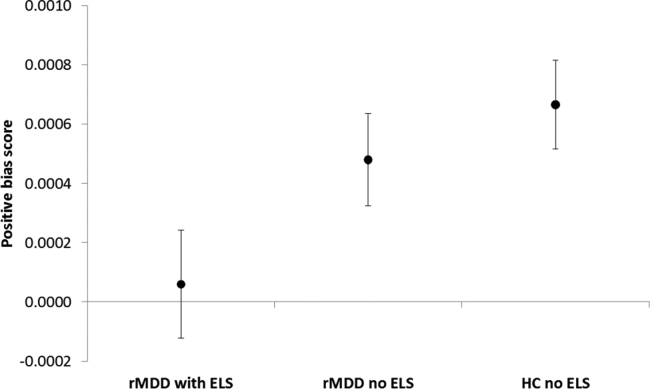
Only MDD patients with ELS showed a reduced bias (accuracy/speed ratio) towards memory for positive vs. negative materials when compared with MDD without ELS and with HC participants; attenuated positive biases correlated with number of past major depressive episodes, but not current symptoms. There were no biases towards self-blaming or self-praising memories.
This demonstrates that reduced positive biases in associative memory were specific to MDD patients with ELS rather than a general feature of MDD, and were associated with lifetime recurrence risk which may reflect a scarring effect. If replicated, our results would call for stratifying MDD patients by history of ELS when assessing and treating emotional memories.
关于重度抑郁症(MDD)患者是否存在消极记忆偏差,以及这些偏差是否会持续到缓解期,目前存在相互矛盾的证据。如果持续存在,这表明它们是易感性特征,而不是情绪状态的相关因素。在患有精神疾病的患者中常见的早期生活压力(ELS)也与记忆偏差独立相关,并使 MDD 与对照组的比较产生混淆。此外,在大多数研究中,消极偏差可能是由于执行功能障碍引起的,而不是记忆本身的问题。
为了研究记忆偏差是否与 MDD 的易感性有关,以及 ELS 如何影响它们,我们开发了一种社交行为时空背景的联想识别记忆任务,该任务对执行功能的要求较低,并且在各个条件下(自责、他责、自夸、他夸)都是匹配的。我们纳入了 53 名未服用药物的缓解期 MDD(25 名有 ELS,28 名无 ELS)和 24 名无 ELS 的健康对照组(HC)参与者。
只有患有 ELS 的 MDD 患者与无 ELS 的 MDD 患者和 HC 参与者相比,对积极与消极材料的记忆表现出较低的偏差(准确性/速度比);减弱的积极偏差与过去的重度抑郁发作次数相关,但与当前症状无关。对于自责或自夸的记忆没有偏差。
这表明,在联想记忆中,ELS 相关的 MDD 患者的积极偏差减少是特定的,而不是 MDD 的一般特征,并且与终生复发风险相关,这可能反映了一种疤痕效应。如果得到证实,我们的研究结果将呼吁在评估和治疗情绪记忆时,根据 ELS 病史对 MDD 患者进行分层。