Centre for Affective Disorders, Institute of Psychiatry, Psychology & Neuroscience, King's College London, United Kingdom.
Cognitive and Behavioral Neuroscience Unit, Neuroinformatics Workgroup, D'Or Institute for Research and Education (IDOR), Rio de Janeiro, Brazil.
Neuroimage Clin. 2019;24:101992. doi: 10.1016/j.nicl.2019.101992. Epub 2019 Aug 25.
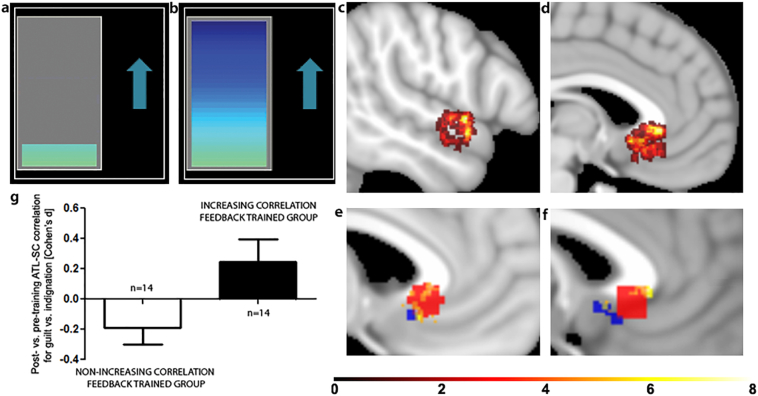
Previously, using fMRI, we demonstrated lower connectivity between right anterior superior temporal (ATL) and anterior subgenual cingulate (SCC) regions while patients with major depressive disorder (MDD) experience guilt. This neural signature was detected despite symptomatic remission which suggested a putative role in vulnerability. This randomised controlled double-blind parallel group clinical trial investigated whether patients with MDD are able to voluntarily modulate this neural signature. To this end, we developed a fMRI neurofeedback software (FRIEND), which measures ATL-SCC coupling and displays its levels in real time. Twenty-eight patients with remitted MDD were randomised to two groups, each receiving one session of fMRI neurofeedback whilst retrieving guilt and indignation/anger-related autobiographical memories. They were instructed to feel the emotion whilst trying to increase the level of a thermometer-like display on a screen. Active intervention group: The thermometer levels increased with increasing levels of ATL-SCC correlations in the guilt condition. Control intervention group: The thermometer levels decreased when correlation levels deviated from the previous baseline level in the guilt condition, thus reinforcing stable correlations. Both groups also received feedback during the indignation condition reinforcing stable correlations. We confirmed our predictions that patients in the active intervention group were indeed able to increase levels of ATL-SCC correlations for guilt vs. indignation and their self-esteem after training compared to before training and that this differed significantly from the control intervention group. These data provide proof-of-concept for a novel treatment target for MDD patients and are in keeping with the hypothesis that ATL-SCC connectivity plays a key role in self-worth. https://clinicaltrials.gov/ct2/show/results/NCT01920490.
此前,我们使用 fMRI 发现,在患有重度抑郁症(MDD)的患者经历内疚时,右侧前颞上(ATL)和前扣带下(SCC)区域之间的连接降低。尽管症状缓解,但这种神经特征仍然存在,这表明它可能在易感性中发挥作用。这项随机对照双盲平行组临床试验研究了 MDD 患者是否能够主动调节这种神经特征。为此,我们开发了一种 fMRI 神经反馈软件(FRIEND),该软件可以测量 ATL-SCC 耦合并实时显示其水平。将 28 名缓解期 MDD 患者随机分为两组,每组接受一次 fMRI 神经反馈,同时回忆内疚和愤怒/愤怒相关的自传体记忆。他们被指示在尝试增加屏幕上温度计式显示器的水平时感受情绪。主动干预组:在内疚条件下,随着 ATL-SCC 相关性的增加,温度计水平升高。对照组:在内疚条件下,当相关性偏离先前基线水平时,温度计水平下降,从而增强了稳定的相关性。两组在愤怒条件下也收到反馈,增强了稳定的相关性。我们证实了我们的预测,即与对照组相比,主动干预组的患者在训练后确实能够增加内疚时的 ATL-SCC 相关性水平及其自尊,与训练前相比,这有显著差异。这些数据为 MDD 患者的新型治疗靶点提供了概念验证,并且与 ATL-SCC 连接在自我价值中起关键作用的假设一致。https://clinicaltrials.gov/ct2/show/results/NCT01920490。