Veroniki Areti Angeliki, Rios Patricia, Cogo Elise, Straus Sharon E, Finkelstein Yaron, Kealey Ryan, Reynen Emily, Soobiah Charlene, Thavorn Kednapa, Hutton Brian, Hemmelgarn Brenda R, Yazdi Fatemeh, D'Souza Jennifer, MacDonald Heather, Tricco Andrea C
Li Ka Shing Knowledge Institute,St. Michael's Hospital, Toronto, Canada.
Department of Medicine, University of Toronto, 27 King's College Circle, Toronto, Canada.
BMJ Open. 2017 Jul 20;7(7):e017248. doi: 10.1136/bmjopen-2017-017248.
Compare the safety of antiepileptic drugs (AEDs) on neurodevelopment of infants/children exposed in utero or during breast feeding.
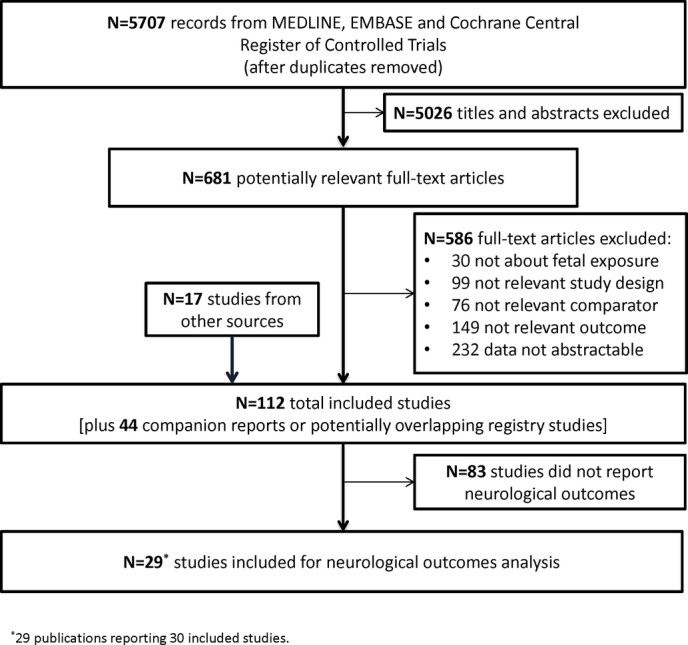
Systematic review and Bayesian random-effects network meta-analysis (NMA). MEDLINE, EMBASE and the Cochrane Central Register of Controlled Trials were searched until 27 April 2017. Screening, data abstraction and quality appraisal were completed in duplicate by independent reviewers.
29 cohort studies including 5100 infants/children.
Monotherapy and polytherapy AEDs including first-generation (carbamazepine, clobazam, clonazepam, ethosuximide, phenobarbital, phenytoin, primidone, valproate) and newer-generation (gabapentin, lamotrigine, levetiracetam, oxcarbazepine, topiramate, vigabatrin) AEDs. Epileptic women who did not receive AEDs during pregnancy or breast feeding served as the control group.
Cognitive developmental delay and autism/dyspraxia were primary outcomes. Attention-deficit hyperactivity disorder, language delay, neonatal seizures, psychomotor developmental delay and social impairment were secondary outcomes.
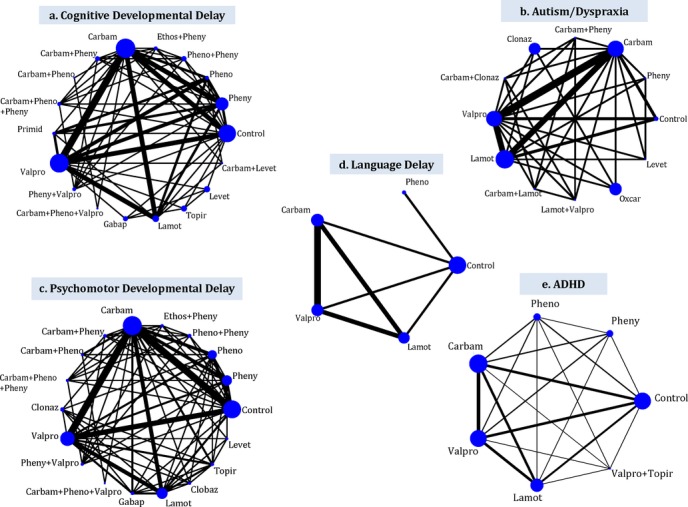
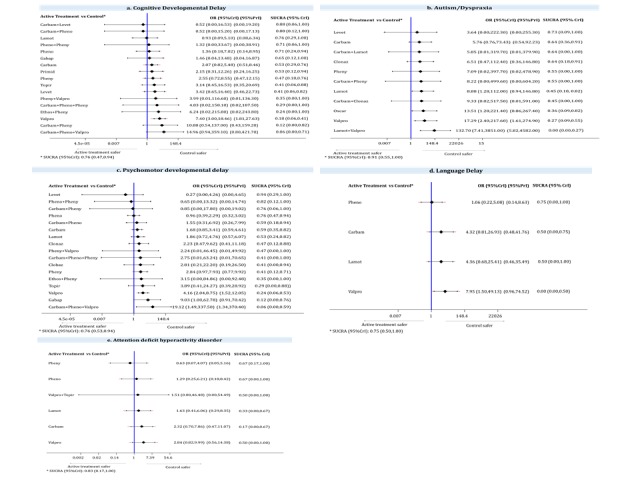
The NMA on cognitive developmental delay (11 cohort studies, 933 children, 18 treatments) suggested that among all AEDs only valproate was statistically significantly associated with more children experiencing cognitive developmental delay compared with control (OR=7.40, 95% credible interval (CrI) 3.00 to 18.46). The NMA on autism (5 cohort studies, 2551 children, 12 treatments) suggested that oxcarbazepine (OR 13.51, CrI 1.28 to 221.40), valproate (OR 17.29, 95% CrI 2.40 to 217.60), lamotrigine (OR 8.88, CrI 1.28 to 112.00) and lamotrigine+valproate (OR 132.70, CrI 7.41 to 3851.00) were associated with significantly greater odds of developing autism compared with control. The NMA on psychomotor developmental delay (11 cohort studies, 1145 children, 18 treatments) found that valproate (OR 4.16, CrI 2.04 to 8.75) and carbamazepine+phenobarbital+valproate (OR 19.12, CrI 1.49 to 337.50) were associated with significantly greater odds of psychomotor delay compared with control.
Valproate alone or combined with another AED is associated with the greatest odds of adverse neurodevelopmental outcomes compared with control. Oxcarbazepine and lamotrigine were associated with increased occurrence of autism. Counselling is advised for women considering pregnancy to tailor the safest regimen.
PROSPERO database (CRD42014008925).
比较抗癫痫药物(AEDs)对子宫内或母乳喂养期间暴露的婴儿/儿童神经发育的安全性。
系统评价和贝叶斯随机效应网络荟萃分析(NMA)。检索MEDLINE、EMBASE和Cochrane对照试验中央注册库直至2017年4月27日。筛选、数据提取和质量评估由独立评审员重复完成。
29项队列研究,包括5100名婴儿/儿童。
单药治疗和联合治疗的AEDs,包括第一代(卡马西平、氯巴占、氯硝西泮、乙琥胺、苯巴比妥、苯妥英、扑米酮、丙戊酸盐)和新一代(加巴喷丁、拉莫三嗪、左乙拉西坦、奥卡西平、托吡酯、氨己烯酸)AEDs。孕期或母乳喂养期间未接受AEDs的癫痫女性作为对照组。
认知发育迟缓及自闭症/运动障碍为主要结局。注意力缺陷多动障碍、语言发育迟缓、新生儿惊厥、精神运动发育迟缓及社交障碍为次要结局。
关于认知发育迟缓的NMA(11项队列研究,933名儿童,18种治疗方法)表明,在所有AEDs中,与对照组相比,仅丙戊酸盐在统计学上与更多儿童出现认知发育迟缓显著相关(比值比[OR]=7.40,95%可信区间[CrI]3.00至18.46)。关于自闭症的NMA(5项队列研究,2551名儿童,12种治疗方法)表明,与对照组相比,奥卡西平(OR 13.51,CrI 1.28至221.40)、丙戊酸盐(OR 17.29,95% CrI 2.40至217.60)、拉莫三嗪(OR 8.88,CrI 1.28至112.00)及拉莫三嗪+丙戊酸盐(OR 132.70,CrI 7.41至3851.00)与自闭症发生几率显著增加相关。关于精神运动发育迟缓的NMA(11项队列研究,1145名儿童,18种治疗方法)发现,与对照组相比,丙戊酸盐(OR 4.16,CrI 2.04至8.75)及卡马西平+苯巴比妥+丙戊酸盐(OR 19.12,CrI 1.49至337.50)与精神运动发育迟缓几率显著增加相关。
与对照组相比,单独使用丙戊酸盐或与另一种AED联合使用与不良神经发育结局的几率最高相关。奥卡西平和拉莫三嗪与自闭症发生率增加相关。建议为考虑怀孕的女性提供咨询,以制定最安全的治疗方案。
PROSPERO数据库(CRD42014008925)