Bhangu Jaspreet, King-Kallimanis Bellinda L, Donoghue Orna A, Carroll Laura, Kenny Rose Anne
The Irish Longitudinal Study on Ageing, Trinity College, Dublin, Ireland.
PLoS One. 2017 Jul 21;12(7):e0180997. doi: 10.1371/journal.pone.0180997. eCollection 2017.
To calculate the prevalence of all falls, non-accidental falls and syncope in an older population and characterize cardiovascular risk profiles.
Prospective, longitudinal cohort study.
The first two waves of data from the Irish Longitudinal Study on Ageing (TILDA).
8172 community-dwelling adults aged 50 years and older resident in the Republic of Ireland.
Self-reported history of all falls, non-accidental falls and syncope in the year preceding the first two waves of data collection. Demographic factors and self-reported cardiovascular conditions were used to characterize cardiovascular risk profiles.
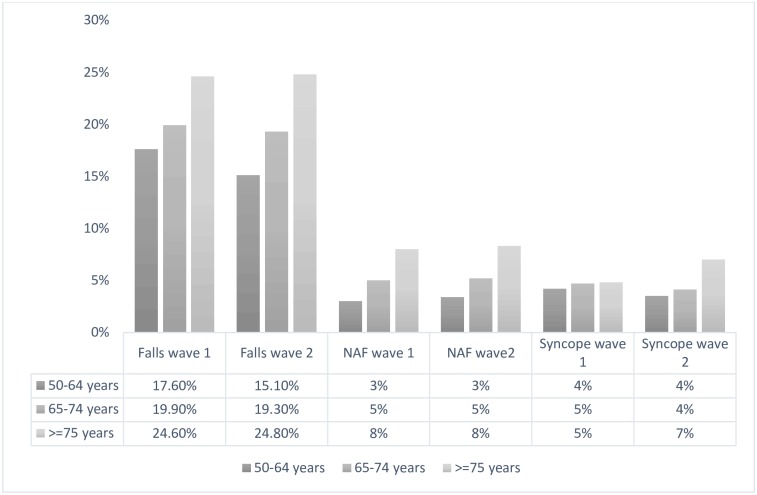
The prevalence of all falls in the past year was 19.2% or 192 per thousand persons and increased with age (50-64 years 17.5%; 65-74 years 19.4%; 75+ years 24.4%). Non-accidental falls had an estimated prevalence of 5.1% or 51 falls per thousand persons and accounted for 26.5% of all falls reported and also increased with age (50-64 years 4.0%; 65-74 years 5.5%; 75+ years 8.0%). The prevalence for syncope was estimated to be 4.4% or 44per thousand persons but did not show a similar age gradient. Participants with at least 5 cardiovascular conditions were more likely to report all falls (OR = 2.07, 95% CI 1.18-3.64, p<0.05) and NAF (OR = 2.89, 95%CI 1.28-6.52, p<0.05).
The prevalence of all falls and non-accidental falls increases with age but the same pattern was not consistently observed for syncope. There is an increased odds of reporting all three outcomes with increasing number of self-reported cardiovascular conditions. Further work is needed to uncover the interplay between cardiovascular disease and subsequent falls.
计算老年人群中所有跌倒、非意外跌倒和晕厥的患病率,并描述心血管风险概况。
前瞻性纵向队列研究。
爱尔兰老龄化纵向研究(TILDA)的前两波数据。
爱尔兰共和国8172名年龄在50岁及以上的社区居住成年人。
在收集前两波数据的前一年中自我报告的所有跌倒、非意外跌倒和晕厥的病史。使用人口统计学因素和自我报告的心血管疾病来描述心血管风险概况。
过去一年中所有跌倒的患病率为19.2%,即每千人中有192例,且随年龄增长而增加(50 - 64岁为17.5%;65 - 74岁为19.4%;75岁及以上为24.4%)。非意外跌倒的估计患病率为5.1%,即每千人中有51例,占所有报告跌倒的26.5%,也随年龄增长而增加(50 - 64岁为4.0%;65 - 74岁为5.5%;75岁及以上为8.0%)。晕厥的患病率估计为4.4%,即每千人中有44例,但未显示出类似的年龄梯度。患有至少5种心血管疾病的参与者更有可能报告所有跌倒(比值比 = 2.07,95%置信区间1.18 - 3.64,p<0.05)和非意外跌倒(比值比 = 2.89,95%置信区间1.28 - 6.52,p<0.05)。
所有跌倒和非意外跌倒的患病率随年龄增长而增加,但晕厥并非始终呈现相同模式。随着自我报告的心血管疾病数量增加,报告所有三种结果的几率也会增加。需要进一步开展工作以揭示心血管疾病与后续跌倒之间的相互作用。