da Silva Larissa Donatoni, Shiel Agnes, McIntosh Caroline
School of Health Sciences, National University of Ireland Galway, Galway, Ireland.
Department of Occupational Therapy, School of Health Sciences, National University of Ireland Galway, Galway, Ireland.
Front Med (Lausanne). 2021 Sep 1;8:708883. doi: 10.3389/fmed.2021.708883. eCollection 2021.
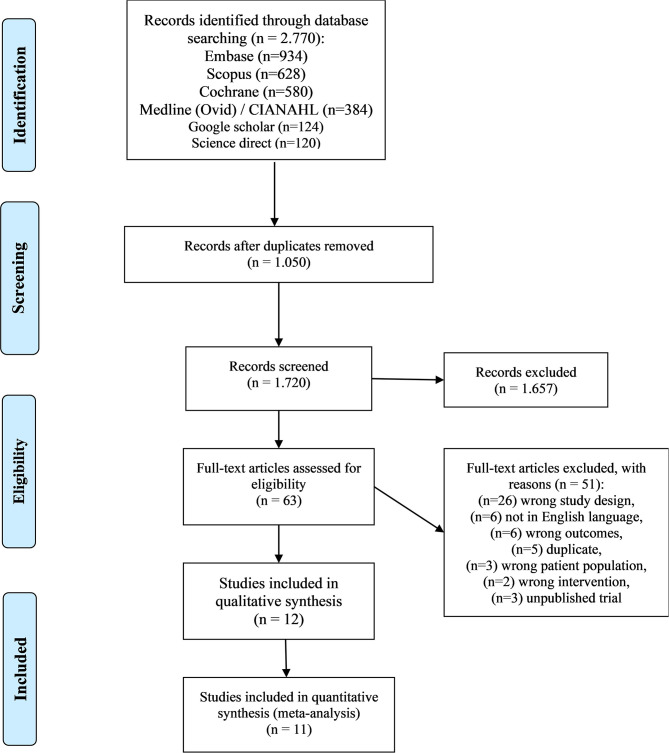
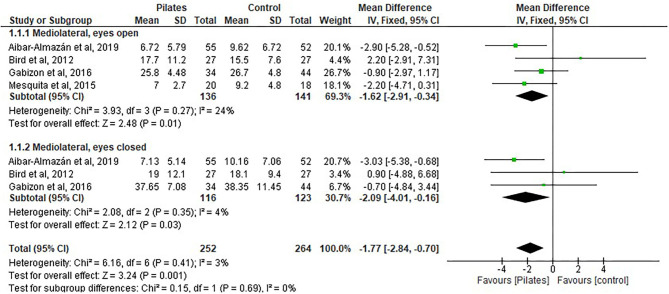
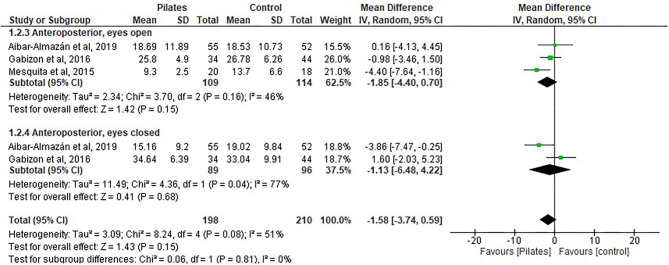
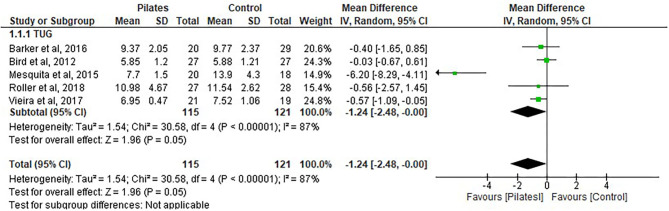
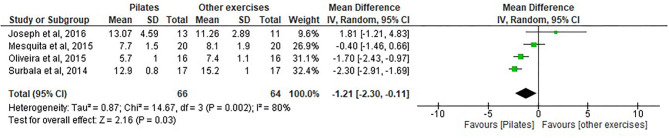
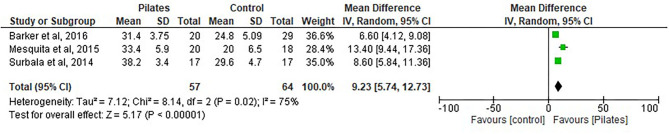
The main theme of this systematic review and meta-analysis is to synthesize the evidence of randomized controlled trial of evidence of Pilates intervention, in comparison to control groups and other forms of exercise, for falls prevention in healthy older adults. The following electronic databases were searched up to October 2020; EMBASE, Scopus, Google Scholar, MEDLINE (Ovid), Science Direct, Cochrane, and CINAHL. The recommendations of the Preferred Reporting Items of Systematic Reviews and Meta-Analyses were followed. A PICOS approach was adopted as a framework to formulate the research question and set the inclusion and exclusion criteria. Participants were healthy older adults, defined as older adults who have maintained functional ability, including participants of both genders, those with a falls history, non-fallers, and individuals who were considered to be sedentary or active. Randomized controlled trials studies, written in the English language, from the decade, were included if they focused on specific outcome measures to decrease falls risk; functional mobility, mobility, fear of falling, gait, and postural stability. The PEDro scale was used to assess risk of bias. There were included 12 studies. In total, 702 healthy older adults' participants were included. Pilates showed an effect in mediolateral directions in comparison to control groups (MD = -1.77, 95% CI, -2.84 to -0.70, = 0.001, heterogeneity: = 3%), mobility (MD = 9.23, 95% CI, 5.74 to 12.73, < 0.00001, heterogeneity: = 75%) and fear of falling (MD = -8.61, 95% CI, -10.16 to -7.07, < 0.00001, heterogeneity: = 88%). In relation to other exercises group, Pilates showed positive effects in functional mobility (MD = -1.21, 95% CI, -2.30 to -0.11, = 0.03, heterogeneity: = 80%), mobility (MD = 3.25, 95% CI, 1.46 to 5.04, < 0.0004, heterogeneity: = 0%). No evidence of an improvement was found between the groups for dynamic gait index (MD = 2.26, 95% CI, -0.05 to 4.56, = 0.06, heterogeneity: = 86%), anteroposterior directions of balance (MD = -1.58, 95% CI, -3.74 to -0.59, = 0.15, heterogeneity: = 51%) and functional mobility when compared to control groups (no exercise) (MD = -1.24, 95% CI, -2.48 to -0.00, = 0.05, heterogeneity: = 87%). Pilates may be effective in decreasing the risk of falls in older adults. Pilates intervention was found to improve functional mobility, mobility, gait, fear of falling and postural stability and therefore there is some evidence to suggest that Pilates reduces certain risk factors for falls in healthy older adults. However, there is an absence of high-quality evidence in regards to the impact of Pilates on reducing falls and further robust RCTs are needed. [PROSPERO], identifier [CRD42021206134].
本系统评价和荟萃分析的主要主题是综合普拉提干预与对照组及其他运动形式相比,在预防健康老年人跌倒方面的随机对照试验证据。检索了截至2020年10月的以下电子数据库:EMBASE、Scopus、谷歌学术、MEDLINE(Ovid)、科学Direct、Cochrane和CINAHL。遵循系统评价和荟萃分析的首选报告项目的建议。采用PICOS方法作为框架来制定研究问题并设定纳入和排除标准。参与者为健康老年人,定义为保持功能能力的老年人,包括男女参与者、有跌倒史者、未跌倒者以及被认为久坐或活跃的个体。纳入过去十年以英文撰写的随机对照试验研究,这些研究关注降低跌倒风险的特定结局指标;功能活动能力、活动能力、跌倒恐惧、步态和姿势稳定性。使用PEDro量表评估偏倚风险。共纳入12项研究。总共纳入了702名健康老年人参与者。与对照组相比,普拉提在内外侧方向(MD=-1.77,95%CI,-2.84至-0.70,P=0.001,异质性:I²=3%)、活动能力(MD=9.23,95%CI,5.74至12.73,P<0.00001,异质性:I²=75%)和跌倒恐惧(MD=-8.61,95%CI,-10.16至-7.07,P<0.00001,异质性:I²=88%)方面显示出效果。与其他运动组相比,普拉提在功能活动能力(MD=-1.21,95%CI,-2.30至-0.11,P=0.03,异质性:I²=80%)、活动能力(MD=3.25,95%CI,1.46至5.04,P<0.0004,异质性:I²=0%)方面显示出积极效果。在动态步态指数(MD=2.26,95%CI,-0.05至4.56,P=0.06,异质性:I²=86%)、前后平衡方向(MD=-1.58,95%CI,-3.74至-0.59,P=0.15,异质性:I²=51%)以及与对照组(无运动)相比的功能活动能力(MD=-1.24,95%CI,-2.48至-0.00,P=0.05,异质性:I²=87%)方面,未发现组间有改善的证据。普拉提可能对降低老年人跌倒风险有效。发现普拉提干预可改善功能活动能力、活动能力、步态、跌倒恐惧和姿势稳定性,因此有一些证据表明普拉提可降低健康老年人跌倒的某些风险因素。然而,关于普拉提对减少跌倒影响的高质量证据不足,需要进一步开展有力的随机对照试验。[PROSPERO],标识符[CRD42021206134]