Carmona-Torres Juan Manuel, Cobo-Cuenca Ana Isabel, Martín-Espinosa Noelia María, Piriz-Campos Rosa María, Laredo-Aguilera José Alberto, Rodríguez-Borrego María Aurora
Universidad de Castilla-La Mancha (UCLM), E.U. Enfermería y Fisioterapia de Toledo, Toledo, España; Instituto Maimónides de Investigación Biomédica de Córdoba (IMIBIC), Córdoba, España.
Universidad de Castilla-La Mancha (UCLM), E.U. Enfermería y Fisioterapia de Toledo, Toledo, España; Instituto Maimónides de Investigación Biomédica de Córdoba (IMIBIC), Córdoba, España.
Aten Primaria. 2018 Apr;50(4):228-237. doi: 10.1016/j.aprim.2017.03.007. Epub 2017 Jul 19.
To determine the frequency of the performance of mammography with preventive purpose of the screening of breast cancer in Spanish women, the evolution between the years 2006-2014, the sociodemographic profile of the women who undergo the mammography and to analyze the factors that influence in their adhesion.
Transversal study.
Spain.
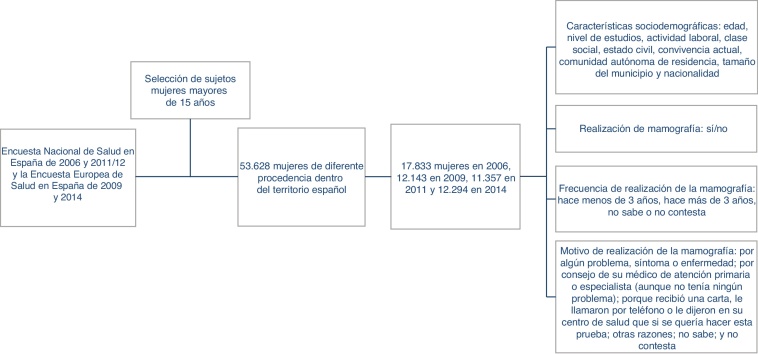
A total of 53.628 women over 15 years old that are surveyed in the National Health Survey in Spain 2006 and 2011/12 and the European Health Survey in Spain 2009 and 2014.
The following variables were used: mammography, frequency of mammography performance and the reason for the realization, as well as sociodemographic variables. Social class was obtained from the last occupation of the main family supporter. A logistic regression analysis was performed with sociodemographic variables.
The prevalence of mammography has been increasing from 2006 to 2014, and also for the reason that the participants had received a letter, they were telephoned or offered in their Health Center to undergo this test. There are significant differences in the performance of mammography in the different autonomous communities.
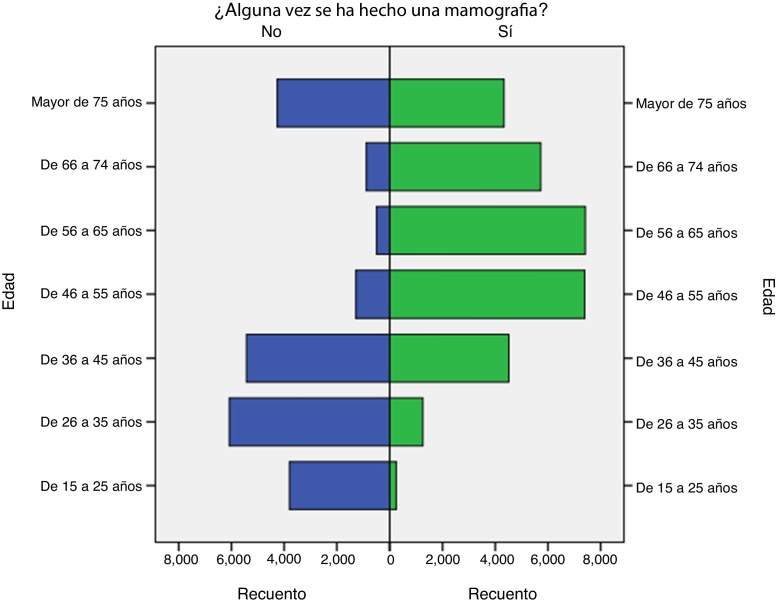
Performing mammography has increased significantly from 2006 to 2014, although there are still differences between autonomous communities, with Ceuta and Melilla being the least percentage of performed mammography. The factors that are related to greater performed mammography are: higher educational level, higher social class, married civil status, Spanish nationality and age.
确定西班牙女性为预防乳腺癌筛查而进行乳腺钼靶检查的频率、2006 - 2014年期间的变化情况、接受乳腺钼靶检查女性的社会人口学特征,并分析影响其接受检查的因素。
横断面研究。
西班牙。
共有53628名15岁以上女性,她们参与了2006年和2011/12年的西班牙国家健康调查以及2009年和2014年的西班牙欧洲健康调查。
使用了以下变量:乳腺钼靶检查、乳腺钼靶检查执行频率及检查原因,以及社会人口学变量。社会阶层由主要家庭供养者的最后职业得出。对社会人口学变量进行了逻辑回归分析。
从2006年到2014年,乳腺钼靶检查的普及率一直在上升,且由于参与者收到信件、接到电话或在其健康中心被提供该项检查。不同自治区在乳腺钼靶检查执行情况上存在显著差异。
从2006年到2014年,乳腺钼靶检查的执行率显著提高,尽管自治区之间仍存在差异,休达和梅利利亚的乳腺钼靶检查执行率最低。与更高的乳腺钼靶检查执行率相关的因素有:更高的教育水平、更高的社会阶层、已婚民事状态、西班牙国籍和年龄。