Rucker Frances, Henriksen Mark, Yanase Tiffany, Taylor Christopher
New England College of Optometry, Dept. of Biomedical Science, 424 Beacon St., Boston, MA 02115, United States.
Illinois College of Optometry, 3241 South Michigan Ave., Chicago, IL 60616, United States.
Vision Res. 2018 Oct;151:78-87. doi: 10.1016/j.visres.2017.07.003. Epub 2017 Aug 1.
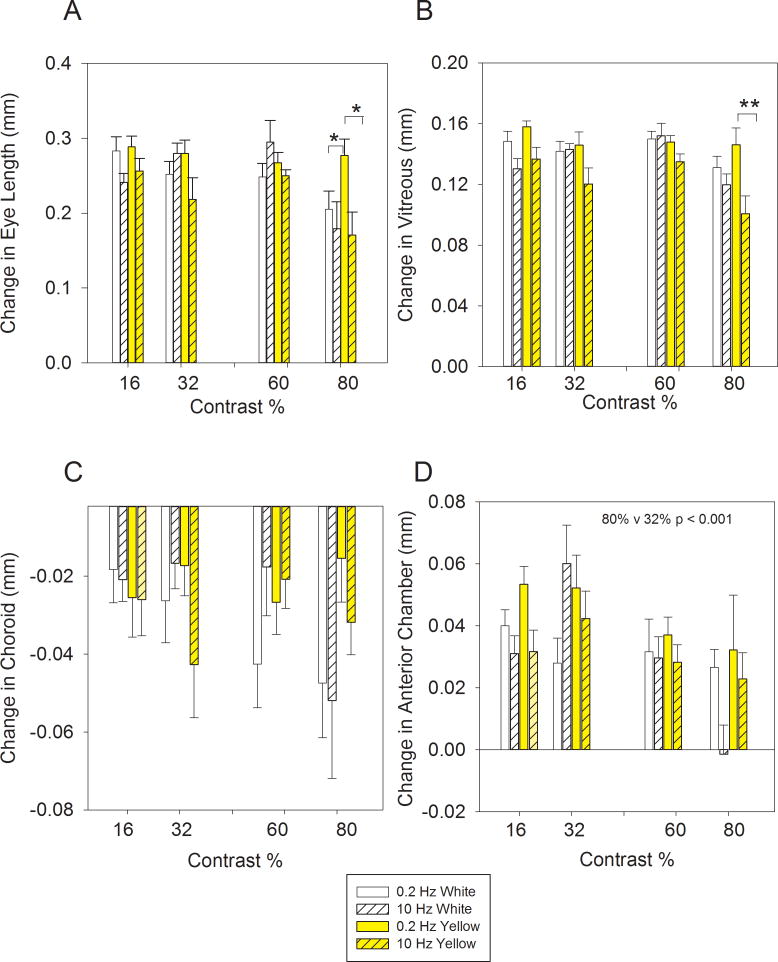
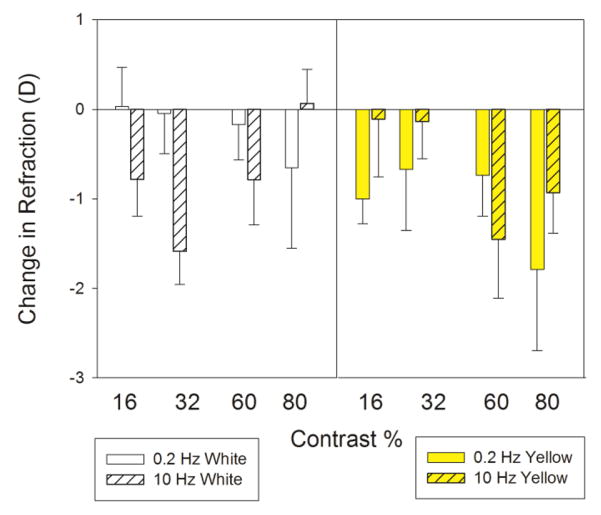
A previous experiment showed that blue light (as a component of white light) protected against low temporal frequency dependent eye growth. This experiment investigated the role of temporal contrast. White leghorn chicks were exposed to white (with blue) or yellow (without blue) LED lighting modulated at either low (0.2Hz) or high (10Hz) temporal frequencies. Four cone contrast conditions were used: low (16%), medium (32%), medium-high (60%) and very-high (80%). Chicks were exposed to the lighting condition for 3days (mean 680lux). Exposure to high temporal frequencies, with very high temporal contrast, reduced eye growth, regardless of spectral content. However, at low temporal frequencies, eye growth was dependent on the illuminant. At lower temporal contrast levels, growth increased regardless of temporal or spectral characteristics. To conclude, very high temporal contrast, white light, provides a "stop" signal for eye growth that overrides temporal cues for growth that manifest in yellow light.
先前的一项实验表明,蓝光(作为白光的一个组成部分)可防止与低时间频率相关的眼球生长。本实验研究了时间对比度的作用。将白来航鸡雏暴露于以低(0.2Hz)或高(10Hz)时间频率调制的白色(含蓝光)或黄色(不含蓝光)LED照明下。使用了四种视锥细胞对比度条件:低(16%)、中(32%)、中高(60%)和非常高(80%)。雏鸡在光照条件下暴露3天(平均680勒克斯)。无论光谱成分如何,暴露于具有非常高时间对比度的高时间频率下会减少眼球生长。然而,在低时间频率下,眼球生长取决于光源。在较低的时间对比度水平下,无论时间或光谱特征如何,生长都会增加。总之,非常高的时间对比度的白光为眼球生长提供了一个“停止”信号,该信号超越了在黄光中表现出的生长时间线索。