Skovdal Morten, Wringe Alison, Seeley Janet, Renju Jenny, Paparini Sara, Wamoyi Joyce, Moshabela Mosa, Ddaaki William, Nyamukapa Constance, Ondenge Kenneth, Bernays Sarah, Bonnington Oliver
Department of Public Health, University of Copenhagen, Copenhagen, Denmark.
Biomedical Research and Training Institute, Harare, Zimbabwe.
Sex Transm Infect. 2017 Jul;93(Suppl 3). doi: 10.1136/sextrans-2016-052977.
This article considers the potential of 'theories of practice' for studying and understanding varied (dis)engagement with HIV care and treatment services and begins to unpack the assemblage of elements and practices that shape the nature and duration of individuals' interactions with HIV services.
We obtained data from a multicountry qualitative study that explores the use of HIV care and treatment services, with a focus on examining the social organisation of engagement with care as a practice and as manifested in the lives of people living with HIV in sub-Saharan Africa. The dataset comprised of 356 interviews with participants from six countries.
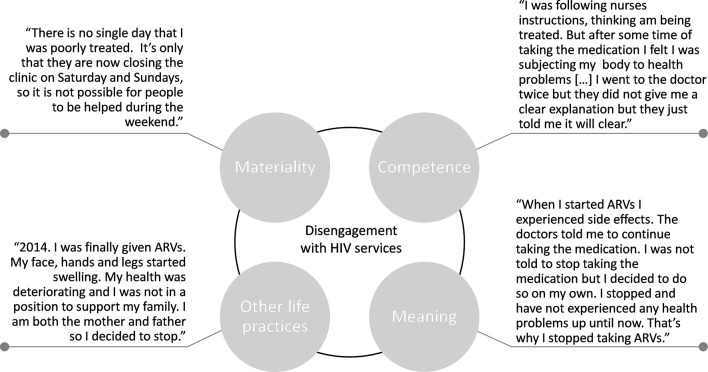
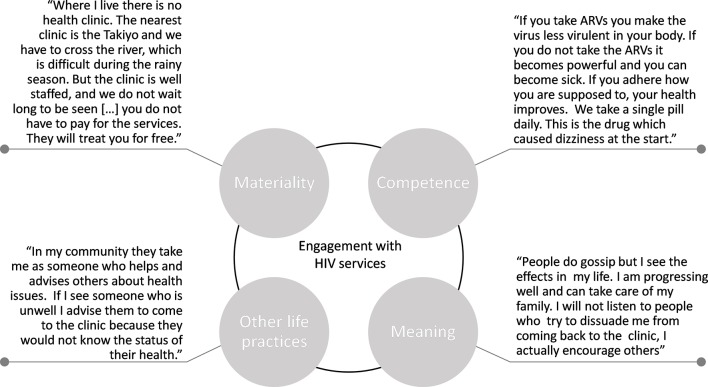
We noted fluctuating interactions with HIV services in all countries. In line with theories of practice, we found that such varied engagement can be explained by (1) the availability, absence and connections between requisite 'materialities' (eg, health infrastructure, medicines), 'competencies' (eg, knowing how to live with HIV) and 'meanings' (eg, trust in HIV services, stigma, normalisation of HIV) and (2) a host of other life practices, such as working or parenting. These dynamics either facilitated or inhibited engagement with HIV services and were intrinsically linked to the discursive, cultural, political and economic fabric of the participating countries.
Practice theory provides HIV researchers and practitioners with a useful vocabulary and analytical tools to understand and steer people's differentiated HIV service (dis)engagement. Our application of practice theory to engagement in HIV care, as experienced by HIV service users and providers in six sub-Saharan African countries, highlights the need for a practice-based approach in the delivery of differentiated and patient-centred HIV services.
本文探讨“实践理论”在研究和理解与艾滋病毒护理及治疗服务的不同(不)参与情况方面的潜力,并开始剖析构成个人与艾滋病毒服务互动性质和时长的要素及实践组合。
我们从一项多国定性研究中获取数据,该研究探索艾滋病毒护理及治疗服务的使用情况,重点是将接受护理的社会组织视为一种实践,并考察其在撒哈拉以南非洲艾滋病毒感染者生活中的体现。数据集包括对来自六个国家的参与者进行的356次访谈。
我们注意到在所有国家与艾滋病毒服务的互动都存在波动。与实践理论一致,我们发现这种不同的参与情况可由以下因素解释:(1)必要的“物质条件”(如卫生基础设施、药品)、“能力”(如知道如何与艾滋病毒共存)和“意义”(如对艾滋病毒服务的信任、耻辱感、艾滋病毒常态化)的可得性、缺失情况及相互联系;(2)一系列其他生活实践,如工作或养育子女。这些动态因素要么促进要么抑制了与艾滋病毒服务的参与,并且与参与国家的话语、文化、政治和经济结构有着内在联系。
实践理论为艾滋病毒研究人员和从业者提供了一个有用的词汇表和分析工具,以理解并引导人们对艾滋病毒服务的不同参与(或不参与)情况。我们将实践理论应用于撒哈拉以南非洲六个国家的艾滋病毒服务使用者和提供者所体验的艾滋病毒护理参与情况,凸显了在提供差异化和以患者为中心的艾滋病毒服务时采用基于实践的方法的必要性。