Gonzalez Victor J, Hullett Craig R, Burt Lindsay, Rassiah-Szegedi Prema, Sarkar Vikren, Tward Jonathan D, Hazard Lisa J, Huang Y Jessica, Salter Bill J, Gaffney David K
Department of Radiation Oncology, University of Arizona, Tucson, Arizona.
Department of Radiation Oncology, University of Wisconsin, Madison, Wisconsin.
Adv Radiat Oncol. 2017 Jan 24;2(2):235-243. doi: 10.1016/j.adro.2017.01.005. eCollection 2017 Apr-Jun.
To report the results of a prospective study that compares small bowel doses during prone and supine pelvic intensity modulated radiation therapy.
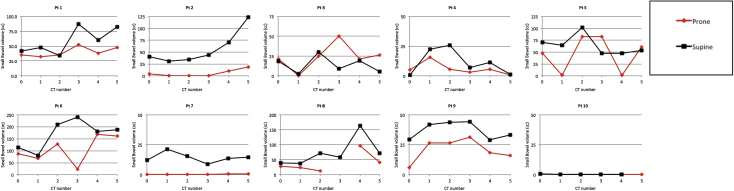
Ten patients receiving pelvic radiation therapy each had 2 intensity modulated radiation therapy plans generated: supine and prone on a belly board (PBB). Computed tomography on rails was performed weekly throughout treatment in both positions (10 scans per patient). After image fusion, doses to small bowel (SB) loops and clinical target volume were calculated for each scan. Changes between the planned and received doses were analyzed and compared between positions. The impact of bladder filling on SB dose was also assessed.
Prone treatment was associated with significantly lower volumes of SB receiving ≥20 Gy. On average, prone on a belly board positioning reduced the volume of SB receiving a given dose of radiation by 28% compared with supine positioning. Target coverage throughout the treatment course was similar in both positions with an average minimum clinical target volume dose of 88% of the prescribed prone dose and 89% of the supine ( = .54). For supine treatment, SB dose was inversely correlated with bladder filling ( = .001-.013; > .15 for prone). For 96% of treatments, the volume of SB that received a given dose deviated >10% from the plan. The deviation between the planned and delivered doses to SB did not differ significantly between the positions.
Prone positioning on a belly board during pelvic IMRT consistently reduces the volume of SB that receives a broad range of radiation doses. Prone IMRT is associated with interfraction dose variation to SB that is similar to that of supine positioning. These findings suggest that prone positioning with daily image guided radiation therapy is an effective method for maximizing SB sparing during pelvic IMRT.
报告一项前瞻性研究的结果,该研究比较了俯卧位和仰卧位盆腔调强放射治疗期间的小肠剂量。
10名接受盆腔放射治疗的患者分别生成了2个调强放射治疗计划:仰卧位和俯卧于腹托板(PBB)上。在整个治疗过程中,每周在两个体位下进行滑轨计算机断层扫描(每位患者10次扫描)。图像融合后,计算每次扫描时小肠(SB)肠袢和临床靶区的剂量。分析并比较两个体位下计划剂量与实际接受剂量之间的变化。还评估了膀胱充盈对SB剂量的影响。
俯卧位治疗时,接受≥20 Gy照射的SB体积显著更低。平均而言,与仰卧位相比,俯卧于腹托板定位可使接受给定剂量辐射的SB体积减少28%。两个体位在整个治疗过程中的靶区覆盖情况相似,平均最小临床靶区剂量为俯卧位处方剂量的88%,仰卧位的89%(P = 0.54)。对于仰卧位治疗,SB剂量与膀胱充盈呈负相关(P = 0.001 - 0.013;俯卧位时P > 0.15)。在96%的治疗中,接受给定剂量的SB体积与计划偏差>10%。两个体位下计划剂量与实际给予SB剂量之间的偏差无显著差异。
盆腔调强放射治疗期间俯卧于腹托板可持续减少接受广泛辐射剂量的SB体积。俯卧位调强放射治疗时SB的分次间剂量变化与仰卧位相似。这些发现表明,每日图像引导放射治疗下的俯卧位是在盆腔调强放射治疗期间最大限度减少SB受量的有效方法。