• 文献检索
  • 文档翻译
  • 深度研究
  • 学术资讯
  • Suppr Zotero 插件Zotero 插件
  • 邀请有礼
  • 套餐&价格
  • 历史记录
应用&插件
Suppr Zotero 插件Zotero 插件浏览器插件Mac 客户端Windows 客户端微信小程序
定价
高级版会员购买积分包购买API积分包
服务
文献检索文档翻译深度研究API 文档MCP 服务
关于我们
关于 Suppr公司介绍联系我们用户协议隐私条款
关注我们

Suppr 超能文献

核心技术专利:CN118964589B侵权必究
粤ICP备2023148730 号-1Suppr @ 2026

文献检索

告别复杂PubMed语法,用中文像聊天一样搜索,搜遍4000万医学文献。AI智能推荐,让科研检索更轻松。

立即免费搜索

文件翻译

保留排版,准确专业,支持PDF/Word/PPT等文件格式,支持 12+语言互译。

免费翻译文档

深度研究

AI帮你快速写综述,25分钟生成高质量综述,智能提取关键信息,辅助科研写作。

立即免费体验

重型颅脑损伤患者颅内压和脑血管反应性的时间变化及其与死亡结局的关系:一项观察性研究

Temporal profile of intracranial pressure and cerebrovascular reactivity in severe traumatic brain injury and association with fatal outcome: An observational study.

作者信息

Adams Hadie, Donnelly Joseph, Czosnyka Marek, Kolias Angelos G, Helmy Adel, Menon David K, Smielewski Peter, Hutchinson Peter J

机构信息

Division of Neurosurgery, Department of Clinical Neuroscience, Addenbrooke's Hospital, University of Cambridge, Cambridge, United Kingdom.

Institute of Electronic Systems, Warsaw University of Technology, Warsaw, Poland.

出版信息

PLoS Med. 2017 Jul 25;14(7):e1002353. doi: 10.1371/journal.pmed.1002353. eCollection 2017 Jul.

DOI:10.1371/journal.pmed.1002353
PMID:28742817
原文链接:https://pmc.ncbi.nlm.nih.gov/articles/PMC5526498/
Abstract

BACKGROUND

Both intracranial pressure (ICP) and the cerebrovascular pressure reactivity represent the dysregulation of pathways directly involved in traumatic brain injury (TBI) pathogenesis and have been used to inform clinical management. However, how these parameters evolve over time following injury and whether this evolution has any prognostic importance have not been studied.

METHODS AND FINDINGS

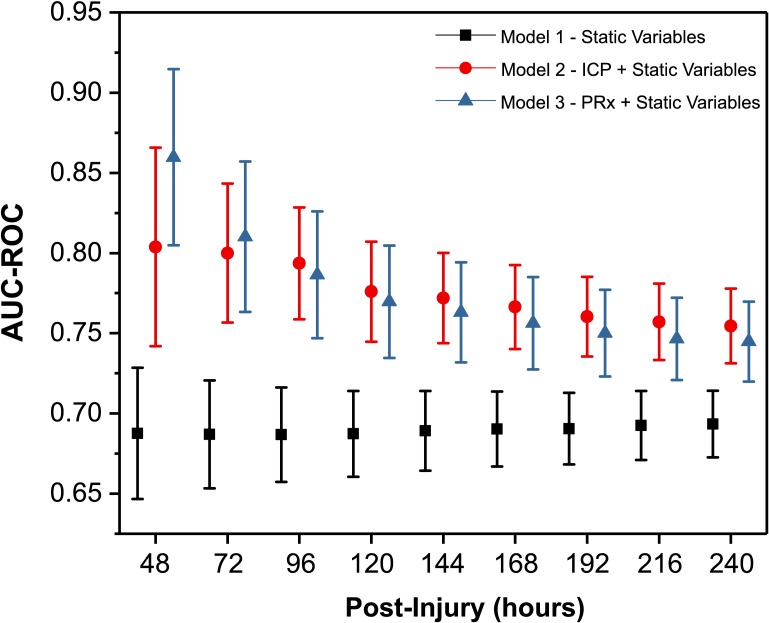
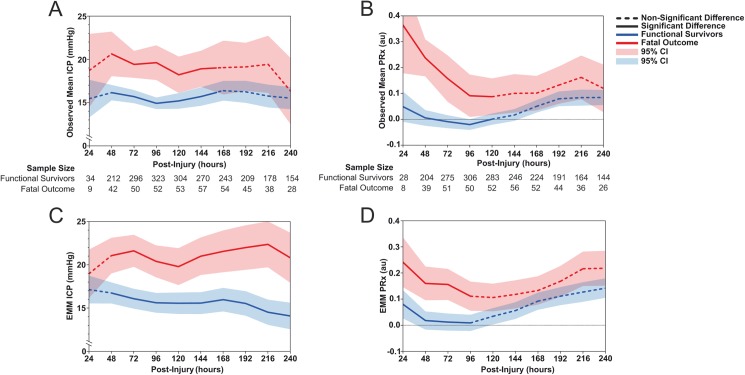
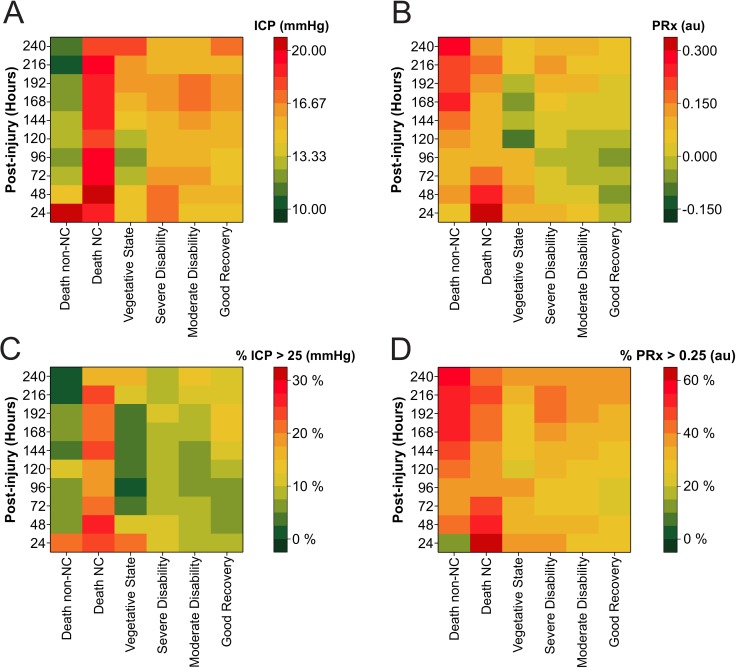
We analysed the temporal profile of ICP and pressure reactivity index (PRx), examined their relation to TBI-specific mortality, and determined if the prognostic relevance of these parameters was affected by their temporal profile using mixed models for repeated measures of ICP and PRx for the first 240 hours from the time of injury. A total of 601 adults with TBI, admitted between September 2002 to January 2016, and with high-resolution continuous monitoring from a single centre, were studied. At 6 months postinjury, 133 (19%) patients had a fatal outcome; of those, 88 (78%) died from nonsurvivable TBI or brain death. The difference in mean ICP between those with a fatal outcome and functional survivors was only significant for the first 168 hours after injury (all p < 0.05). For PRx, those patients with a fatal outcome also had a higher (more impaired) PRx throughout the first 120 hours after injury (all p < 0.05). The separation of ICP and PRx was greatest in the first 72 hours after injury. Mixed models demonstrated that the explanatory power of the PRx decreases over time; therefore, the prognostic weight assigned to PRx should similarly decrease. However, the ability of ICP to predict a fatal outcome remained relatively stable over time. As control of ICP is the central purpose of TBI management, it is likely that some of the information that is reflected in the natural history of ICP changes is no longer apparent because of therapeutic intervention.

CONCLUSIONS

We demonstrated the temporal evolution of ICP and PRx and their relationship with fatal outcome, indicating a potential early prognostic and therapeutic window. The combination of dynamic monitoring variables and their time profile improved prediction of outcome. Therefore, time-driven dynamic modelling of outcome in patients with severe TBI may allow for more accurate and clinically useful prediction models. Further research is needed to confirm and expand on these findings.

摘要

背景

颅内压(ICP)和脑血管压力反应性均代表了直接参与创伤性脑损伤(TBI)发病机制的通路失调,并已用于指导临床管理。然而,这些参数在受伤后如何随时间演变以及这种演变是否具有任何预后意义尚未得到研究。

方法与结果

我们分析了ICP和压力反应性指数(PRx)的时间变化情况,研究了它们与TBI特异性死亡率的关系,并使用受伤后最初240小时内ICP和PRx的重复测量混合模型,确定这些参数的预后相关性是否受其时间变化情况的影响。共研究了601例2002年9月至2016年1月间收治的、来自单一中心进行高分辨率连续监测的TBI成年患者。受伤后6个月时,133例(19%)患者出现致命结局;其中,88例(78%)死于不可存活的TBI或脑死亡。致命结局患者与功能存活者之间的平均ICP差异仅在受伤后的前168小时有统计学意义(所有p<0.05)。对于PRx,致命结局患者在受伤后的前120小时内PRx也更高(受损更严重)(所有p<0.05)。ICP和PRx在受伤后的前72小时内分离最大。混合模型表明,PRx的解释力随时间下降;因此,赋予PRx的预后权重也应相应降低。然而,ICP预测致命结局的能力随时间保持相对稳定。由于控制ICP是TBI管理的核心目标,由于治疗干预,ICP变化自然史中反映的一些信息可能不再明显。

结论

我们展示了ICP和PRx的时间演变及其与致命结局的关系,表明存在潜在的早期预后和治疗窗口。动态监测变量及其时间变化情况的结合改善了结预测。因此,对重度TBI患者的结局进行时间驱动的动态建模可能会产生更准确且临床有用的预测模型。需要进一步的研究来证实和扩展这些发现。
https://cdn.ncbi.nlm.nih.gov/pmc/blobs/d0b1/5526498/6b9fcc2559ee/pmed.1002353.g003.jpg
https://cdn.ncbi.nlm.nih.gov/pmc/blobs/d0b1/5526498/6cfccee6bb67/pmed.1002353.g001.jpg
https://cdn.ncbi.nlm.nih.gov/pmc/blobs/d0b1/5526498/7e85515fa1cb/pmed.1002353.g002.jpg
https://cdn.ncbi.nlm.nih.gov/pmc/blobs/d0b1/5526498/6b9fcc2559ee/pmed.1002353.g003.jpg
https://cdn.ncbi.nlm.nih.gov/pmc/blobs/d0b1/5526498/6cfccee6bb67/pmed.1002353.g001.jpg
https://cdn.ncbi.nlm.nih.gov/pmc/blobs/d0b1/5526498/7e85515fa1cb/pmed.1002353.g002.jpg
https://cdn.ncbi.nlm.nih.gov/pmc/blobs/d0b1/5526498/6b9fcc2559ee/pmed.1002353.g003.jpg

相似文献

1
Temporal profile of intracranial pressure and cerebrovascular reactivity in severe traumatic brain injury and association with fatal outcome: An observational study.重型颅脑损伤患者颅内压和脑血管反应性的时间变化及其与死亡结局的关系:一项观察性研究
PLoS Med. 2017 Jul 25;14(7):e1002353. doi: 10.1371/journal.pmed.1002353. eCollection 2017 Jul.
2
Novel index for predicting mortality during the first 24 hours after traumatic brain injury.预测创伤性脑损伤后 24 小时内死亡率的新指标。
J Neurosurg. 2018 Dec 21;131(6):1887-1895. doi: 10.3171/2018.7.JNS18995. Print 2019 Dec 1.
3
Critical thresholds of long-pressure reactivity index and impact of intracranial pressure monitoring methods in traumatic brain injury.长时压力反应指数的临界阈值与颅脑损伤中颅内压监测方法的影响。
Crit Care. 2024 Jul 29;28(1):256. doi: 10.1186/s13054-024-05042-7.
4
Cerebrovascular reactivity is not associated with therapeutic intensity in adult traumatic brain injury: a CENTER-TBI analysis.脑血管反应性与成人创伤性脑损伤的治疗强度无关:CENTER-TBI 分析。
Acta Neurochir (Wien). 2019 Sep;161(9):1955-1964. doi: 10.1007/s00701-019-03980-8. Epub 2019 Jun 25.
5
Alternative continuous intracranial pressure-derived cerebrovascular reactivity metrics in traumatic brain injury: a scoping overview.创伤性脑损伤中替代连续颅内压衍生的脑血管反应性指标:范围概述。
Acta Neurochir (Wien). 2020 Jul;162(7):1647-1662. doi: 10.1007/s00701-020-04378-7. Epub 2020 May 8.
6
Association between Cerebrovascular Reactivity Monitoring and Mortality Is Preserved When Adjusting for Baseline Admission Characteristics in Adult Traumatic Brain Injury: A CENTER-TBI Study.脑血流反应性监测与成人创伤性脑损伤患者死亡率之间的相关性:CENTER-TBI 研究。
J Neurotrauma. 2020 May 15;37(10):1233-1241. doi: 10.1089/neu.2019.6808. Epub 2019 Dec 30.
7
Cerebrovascular pressure reactivity monitoring using wavelet analysis in traumatic brain injury patients: A retrospective study.采用小波分析对创伤性脑损伤患者进行脑血管压力反应性监测:一项回顾性研究。
PLoS Med. 2017 Jul 25;14(7):e1002348. doi: 10.1371/journal.pmed.1002348. eCollection 2017 Jul.
8
Pressure autoregulation monitoring and cerebral perfusion pressure target recommendation in patients with severe traumatic brain injury based on minute-by-minute monitoring data.基于逐分钟监测数据的重型颅脑损伤患者压力自动调节监测及脑灌注压目标推荐
J Neurosurg. 2014 Jun;120(6):1451-7. doi: 10.3171/2014.3.JNS131500. Epub 2014 Apr 18.
9
Statistical Cerebrovascular Reactivity Signal Properties after Secondary Decompressive Craniectomy in Traumatic Brain Injury: A CENTER-TBI Pilot Analysis.创伤性脑损伤二次去骨瓣减压术后的统计脑血管反应性信号特征:CENTER-TBI 初步分析。
J Neurotrauma. 2020 Jun 1;37(11):1306-1314. doi: 10.1089/neu.2019.6726. Epub 2020 Feb 25.
10
Autoregulatory-guided management in traumatic brain injury: does age matter?创伤性脑损伤的自动调节引导管理:年龄有影响吗?
Acta Neurochir (Wien). 2025 Feb 28;167(1):55. doi: 10.1007/s00701-025-06474-y.

引用本文的文献

1
Continuous personalized cerebrovascular reactivity-based physiologic metrics in neurocritical care: a narrative review of the current landscape, limitations, and future directions.神经重症监护中基于持续个性化脑血管反应性的生理指标:对当前现状、局限性及未来方向的叙述性综述
Front Physiol. 2025 May 6;16:1582813. doi: 10.3389/fphys.2025.1582813. eCollection 2025.
2
Individualized autoregulation-guided arterial blood pressure management in neurocritical care.神经重症监护中基于个体化自动调节指导的动脉血压管理
Neurotherapeutics. 2025 Jan;22(1):e00526. doi: 10.1016/j.neurot.2025.e00526. Epub 2025 Jan 18.
3
The crisis of the third day in intracranial pressure dynamics following traumatic brain injury, fact or fiction?

本文引用的文献

1
Trial of Decompressive Craniectomy for Traumatic Intracranial Hypertension.创伤性颅内高压减压性颅骨切除术试验
N Engl J Med. 2016 Sep 22;375(12):1119-30. doi: 10.1056/NEJMoa1605215. Epub 2016 Sep 7.
2
Regulation of the cerebral circulation: bedside assessment and clinical implications.脑循环的调节:床旁评估及临床意义
Crit Care. 2016 May 5;20(1):129. doi: 10.1186/s13054-016-1293-6.
3
Autonomic Impairment in Severe Traumatic Brain Injury: A Multimodal Neuromonitoring Study.重度创伤性脑损伤中的自主神经功能障碍:一项多模态神经监测研究
创伤性脑损伤后颅内压动态变化中第三天危机:事实还是虚构?
Brain Spine. 2024 Nov 14;4:104135. doi: 10.1016/j.bas.2024.104135. eCollection 2024.
4
Semantic Memory, Traumatic Brain Injury, and the Iceberg Effect: What Deficits May Lie Below the Surface?语义记忆、创伤性脑损伤与冰山效应:表面之下可能存在哪些缺陷?
Am J Speech Lang Pathol. 2025 Jun 26;34(3S):1878-1895. doi: 10.1044/2024_AJSLP-24-00145. Epub 2024 Dec 3.
5
The association of acute and chronic phase cerebrovascular reactivity with patient reported quality of life following moderate-to-severe traumatic brain injury.中重度创伤性脑损伤患者报告的生活质量与急慢性期脑血管反应性的关系。
Sci Rep. 2024 Sep 5;14(1):20737. doi: 10.1038/s41598-024-71843-z.
6
Should Patients with Traumatic Brain Injury with Significant Contusions be Treated with Different Neurointensive Care Targets?创伤性脑损伤伴大挫伤患者是否应采用不同的神经重症监护目标治疗?
Neurocrit Care. 2024 Oct;41(2):511-522. doi: 10.1007/s12028-024-01954-y. Epub 2024 Mar 20.
7
Prognostic value of near-infrared spectroscopy regional oxygen saturation and cerebrovascular reactivity index in acute traumatic neural injury: a CAnadian High-Resolution Traumatic Brain Injury (CAHR-TBI) Cohort Study.近红外光谱区域性氧饱和度和脑血管反应性指数对急性创伤性神经损伤的预后价值:加拿大高分辨率创伤性脑损伤(CAHR-TBI)队列研究。
Crit Care. 2024 Mar 14;28(1):78. doi: 10.1186/s13054-024-04859-6.
8
Non-Invasive Estimation of Intracranial Pressure-Derived Cerebrovascular Reactivity Using Near-Infrared Spectroscopy Sensor Technology in Acute Neural Injury: A Time-Series Analysis.利用近红外光谱传感器技术无创估计急性神经损伤患者颅内压衍生的脑血管反应性:时间序列分析。
Sensors (Basel). 2024 Jan 13;24(2):499. doi: 10.3390/s24020499.
9
Associations between intracranial pressure thresholds and multimodal monitoring in acute traumatic neural injury: a scoping review.急性创伤性神经损伤中颅内压阈值与多模态监测的关联:范围综述。
Acta Neurochir (Wien). 2023 Jul;165(7):1987-2000. doi: 10.1007/s00701-023-05587-6. Epub 2023 Apr 17.
10
Association between temporal patterns of baroreflex sensitivity after traumatic brain injury and prognosis: a preliminary study.创伤性脑损伤后压力感受性反射敏感性的时间模式与预后的关系:一项初步研究。
Neurol Sci. 2023 May;44(5):1653-1663. doi: 10.1007/s10072-022-06579-7. Epub 2023 Jan 7.
Crit Care Med. 2016 Jun;44(6):1173-81. doi: 10.1097/CCM.0000000000001624.
4
Mortality Patterns in Patients with Multiple Trauma: A Systematic Review of Autopsy Studies.多发伤患者的死亡模式:尸检研究的系统评价
PLoS One. 2016 Feb 12;11(2):e0148844. doi: 10.1371/journal.pone.0148844. eCollection 2016.
5
The gut reaction to traumatic brain injury.对创伤性脑损伤的肠道反应。
Fly (Austin). 2015;9(2):68-74. doi: 10.1080/19336934.2015.1085623.
6
New Guideline for the Reporting of Studies Developing, Validating, or Updating a Multivariable Clinical Prediction Model: The TRIPOD Statement.建立、验证或更新多变量临床预测模型的研究报告新指南:TRIPOD 声明。
Adv Anat Pathol. 2015 Sep;22(5):303-5. doi: 10.1097/PAP.0000000000000072.
7
Visualizing the pressure and time burden of intracranial hypertension in adult and paediatric traumatic brain injury.可视化成人和儿童创伤性脑损伤中颅内压的压力和时间负担。
Intensive Care Med. 2015 Jun;41(6):1067-76. doi: 10.1007/s00134-015-3806-1. Epub 2015 Apr 18.
8
The Effect of Red Blood Cell Transfusion on Cerebral Autoregulation in Patients with Severe Traumatic Brain Injury.红细胞输注对重型颅脑损伤患者脑自动调节功能的影响
Neurocrit Care. 2015 Oct;23(2):210-6. doi: 10.1007/s12028-015-0141-x.
9
An observational near-infrared spectroscopy study on cerebral autoregulation in post-cardiac arrest patients: time to drop 'one-size-fits-all' hemodynamic targets?一项关于心脏骤停后患者脑自动调节功能的观察性近红外光谱研究:是时候摒弃“一刀切”的血流动力学目标了吗?
Resuscitation. 2015 May;90:121-6. doi: 10.1016/j.resuscitation.2015.03.001. Epub 2015 Mar 10.
10
Optimal Cerebral Perfusion Pressure Management at Bedside: A Single-Center Pilot Study.床边最佳脑灌注压管理:一项单中心试点研究。
Neurocrit Care. 2015 Aug;23(1):92-102. doi: 10.1007/s12028-014-0103-8.