Geng Xiang, Huang Dichao, Wang Xu, Zhang Chao, Huang Jiazhang, Ma Xin, Chen Li, Wang Chen, Yang Junsheng, Wang Heng
Department of Orthopedics, Huashan Hospital, Fudan University, 12 Middle Wulumuqi Road, Shanghai, 200040, China.
J Orthop Surg Res. 2017 Jul 25;12(1):120. doi: 10.1186/s13018-017-0622-z.
Postoperative transfer metatarsalgia is a common complication after hallux valgus surgeries. Shortening of the first metatarsal is traditionally thought to be the primary cause of it. However, we speculate the abnormal loading pattern during gait is the real reason. This study is to determine specific differences in the loading patterns between reconstructive hallux valgus (HV) feet with and without postoperative transfer metatarsalgia, so as to find risky loading characteristics of this complication.
Thirty feet with postoperative transfer metatarsalgia were recruited as pain group, while another 30 postoperative feet without pain as controls. All participants were asked to walk barefoot at self-selected speed through a plantar force measuring plate (Rs-Scan Inc.) for three times. Certain plantar load variables were recorded or calculated, and their differences between two groups were compared.
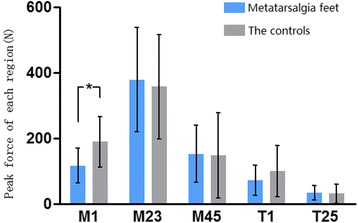
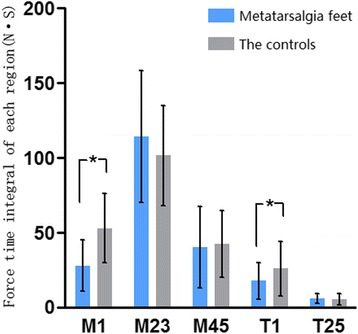
For pain group, the maximum plantar force and force time integral of the first metatarsal decrease significantly; the force time integral of the central rays (second plus third metatarsal) does not significantly differ with that in the controls, but their cumulative load percentage to the whole foot is higher. In pain group, the time point when central rays reached their peak force during the push-off is significantly later than that in controls. And the regional instant load percentage at this moment presented significantly higher for central rays, while significantly lower for the first metatarsal and the hallux compared to the controls.
For hallux valgus feet with postoperative metatarsalgia, the load function of the first metatarsal is obviously impaired. But for central rays, indicative difference is not reflected in either peak or cumulative load during the gait cycle, but in the instant load distribution when central rays reach their peak load. So we can conclude that whether the remaining regions can adequately share certain load during walking, especially around the time metatarsalgia often occurs, plays an unnegligible role. So surgeons should pay more attention to reconstruct a foot where load can be evenly distributed.
术后转移性跖痛症是拇外翻手术后的常见并发症。传统上认为第一跖骨缩短是其主要原因。然而,我们推测步态中异常的负荷模式才是真正原因。本研究旨在确定有或无术后转移性跖痛症的拇外翻重建足在负荷模式上的具体差异,以找出该并发症的危险负荷特征。
招募30例有术后转移性跖痛症的足作为疼痛组,另外30例术后无疼痛的足作为对照组。所有参与者被要求以自选速度赤脚通过足底测力板(Rs-Scan公司)行走三次。记录或计算某些足底负荷变量,并比较两组之间的差异。
对于疼痛组,第一跖骨的最大足底力和力时间积分显著降低;中足(第二和第三跖骨)的力时间积分与对照组无显著差异,但其对全足的累积负荷百分比更高。在疼痛组,中足在蹬离期达到最大力的时间点明显晚于对照组。此时,中足的区域瞬间负荷百分比明显高于对照组,而第一跖骨和拇趾的区域瞬间负荷百分比则明显低于对照组。
对于有术后跖痛症的拇外翻足,第一跖骨的负荷功能明显受损。但对于中足,在步态周期中的峰值或累积负荷方面没有明显差异,而是在中足达到最大负荷时的瞬间负荷分布上有差异。因此,我们可以得出结论,行走过程中其余区域能否充分分担一定负荷,尤其是在跖痛症常发生的时间段附近,起着不可忽视的作用。所以外科医生应更加注重重建一个负荷能均匀分布的足部。