Chaix Gautier, Roger Frédéric, Berthe Thierry, Lamy Brigitte, Jumas-Bilak Estelle, Lafite Robert, Forget-Leray Joëlle, Petit Fabienne
UNIROUEN, UNICAEN, CNRS, M2C, Normandie UniversitéRouen, France.
CNRS 5569 HSM, Équipe Pathogènes Hydriques Santé Environnements, Université de MontpellierMontpellier, France.
Front Microbiol. 2017 Jul 11;8:1259. doi: 10.3389/fmicb.2017.01259. eCollection 2017.
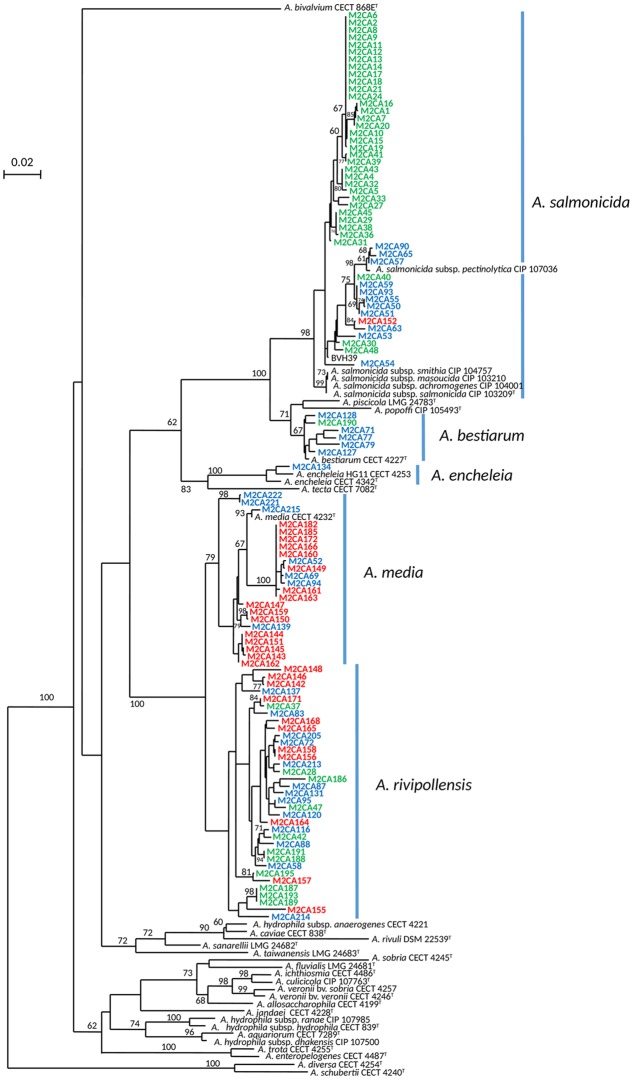
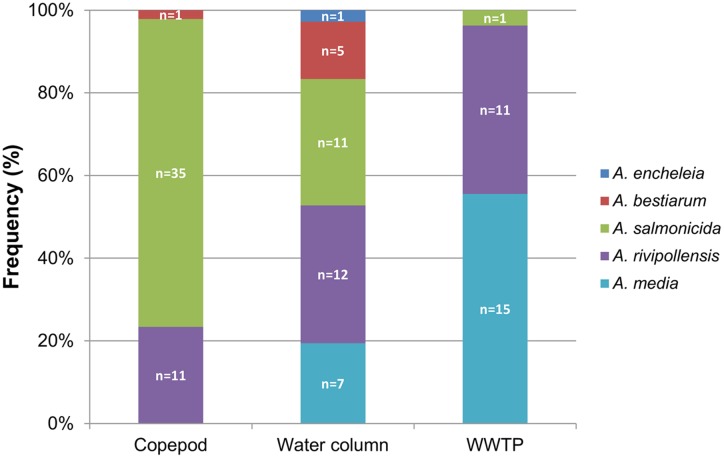
spp. are ubiquitous bacteria primarily recovered from aquatic ecosystems. They are found in fresh water as well as estuarine and marine waters, and in association with numerous autochthonous aquatic organisms in these environments. However, aeromonads are also etiologic agents of fish diseases and are now recognized as emerging pathogens in humans. The estuary is therefore a key environment, harboring autochthonous aeromonads, and aeromonads originating from humans and animals, mainly released by treated WWTP effluent or watershed run-off via tributaries. The present study compares the abundance and the diversity of populations. Over 2 years of monitoring (eight campaigns from February 2013 to November 2015), the occurrence of was investigated within the water column (water and fluid mud) and in association with copepods. Moreover, the diversity of populations was ascertained by analyzing and sequences, and the antibiotic-resistance phenotypes were determined using the disk diffusion method. This study shows, for the first time, the presence of spp. in water (1.1 × 10 to 1.2 ± 0.3 × 10 CFU.100 mL), fluid mud (2.6 ± 2.6 × 10 to 9.8 ± 0.9 × 10 CFU.g) and in association with living copepods (1.9 ± 0.7 × 10 to >1.1 × 10 CFU.g) in the Seine estuary. Moreover, the diversity study, conducted on 36 strains isolated from the water column and 47 strains isolated from copepods, indicates distinct populations within these two compartments. Strains distributed in five clusters corresponding to ( = 6; 5.45%), ( = 1; 0.91%), ( = 22; 20.0%), ( = 34; 30.91%) and ( = 47; 42.73%). is the most abundant species associated with ( = 35; 74.47%). In contrast, accounts for only 30.56% ( = 11) of isolates in the water column. This study shows the coexistence of distinct populations of in the oligohaline area of an anthropized estuary. Moreover, , a putative human pathogen, present in the water column and abundant in the WWTP samples, was not detected in association with living copepods.
气单胞菌属是普遍存在的细菌,主要从水生生态系统中分离得到。它们存在于淡水、河口和海水中,并与这些环境中的众多本地水生生物相关联。然而,气单胞菌也是鱼类疾病的病原体,现在被认为是人类中的新兴病原体。因此,河口是一个关键环境,既含有本地气单胞菌,也含有源自人类和动物的气单胞菌,主要通过经处理的污水处理厂废水或通过支流的流域径流排放。本研究比较了气单胞菌种群的丰度和多样性。在两年的监测期间(从2013年2月到2015年11月进行了八次采样),调查了水柱(水和流体淤泥)中气单胞菌的存在情况以及与桡足类动物相关的气单胞菌。此外,通过分析16S rRNA和gyrB序列确定了气单胞菌种群的多样性,并使用纸片扩散法确定了抗生素抗性表型。本研究首次表明,在塞纳河口的水中(1.1×10至1.2±0.3×10 CFU/100 mL)、流体淤泥(2.6±2.6×10至9.8±0.9×10 CFU/g)以及与活桡足类动物相关联的情况下(1.9±0.7×10至>1.1×10 CFU/g)存在气单胞菌属。此外,对从水柱中分离出的36株菌株和从桡足类动物中分离出的47株菌株进行的多样性研究表明,这两个区室中的种群不同。菌株分布在五个簇中,分别对应于嗜水气单胞菌(n = 6;5.45%)、温和气单胞菌(n = 1;0.91%)、豚鼠气单胞菌(n = 22;20.0%)、维氏气单胞菌(n = 34;30.91%)和杀鲑气单胞菌(n = 47;42.73%)。杀鲑气单胞菌是与桡足类动物相关的最丰富的物种(n = 35;74.47%)。相比之下,维氏气单胞菌仅占水柱中分离株的30.56%(n = 11)。本研究表明,在一个受人类活动影响的河口的低盐度区域中,不同的气单胞菌种群共存。此外,在水柱中存在且在污水处理厂样本中丰富的一种推定的人类病原体维氏气单胞菌,在与活桡足类动物相关联的情况下未被检测到。