Song Tian, Pan Yuesong, Chen Ruoling, Li Hao, Zhao Xingquan, Liu Liping, Wang Chunxue, Wang Yilong, Wang Yongjun
Department of Neurology, Beijing Tiantan Hospital, Capital Medical University, Beijing, China.
China National Clinical Research Center for Neurological Diseases, Beijing, China.
PLoS One. 2017 Jul 26;12(7):e0181196. doi: 10.1371/journal.pone.0181196. eCollection 2017.
To investigate the impact of low socioeconomic status (SES), indicated by low level of education, occupation and income, on 3 months functional outcome after ischemic stroke.
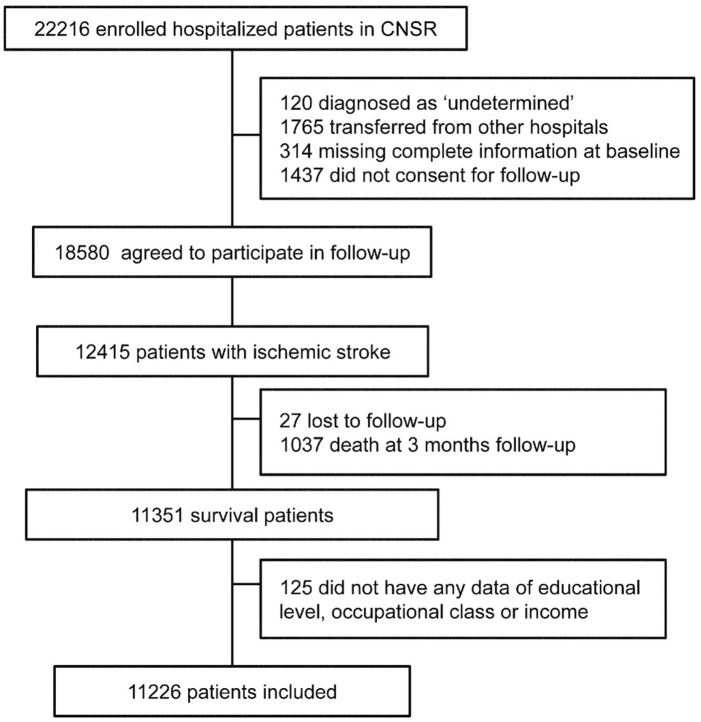
We analyzed data from the China National Stroke Registry (CNSR), a multicenter and prospective registry of consecutive patients with acute cerebrovascular events occurred between September 2007 and August 2008. 11226 patients with ischemic stroke had SES and clinical characteristics data collected at baseline and mRS measured as indicator of functional outcome in 3 months follow up. Multinomial and ordinal logistic regression models were performed to examine associations between SES and the functional outcome.
At 3 months after stroke, 5.3% of total patients had mRS scored at 5, 11.3% at score 4, 11.1% at score 3, 14.4% at score 2, 34.2% at score 1 and 23.7% at score 0. Compared to patients with educational level of ≥ 6 years and non-manual laboring, those < 6 years and manual laboring tended to have higher mRS score (P<0.001). Multinomial adjusted odds ratios (ORs) of outcome in manual workers were significantly increased (ORs from1.38 to 1.87), but OR in patients with less income was not significant. There were similar patterns of association The impact may be stronger in patients aged <65 years (P = 0.003, P<0.001 respectively) and being male (P = 0.001, P<0.001 respectively).
Our study provides evidence that people who are relatively more deprived in socioeconomic status suffer poorer outcome after ischemic stroke. The influence of low educational level and manual laboring can be more intensive than low income level on 3-month outcome. Health policy and service should target the deprived populations to reduce the public health burden in the society.
探讨以低教育水平、职业和收入所表征的低社会经济地位(SES)对缺血性卒中后3个月功能转归的影响。
我们分析了中国国家卒中登记(CNSR)的数据,这是一项多中心前瞻性登记研究,纳入了2007年9月至2008年8月期间连续发生急性脑血管事件的患者。11226例缺血性卒中患者在基线时收集了SES和临床特征数据,并在3个月随访时测量了mRS作为功能转归指标。采用多项和有序逻辑回归模型来检验SES与功能转归之间的关联。
卒中后3个月时,全部患者中5.3%的mRS评分为5分,11.3%为4分,11.1%为3分,14.4%为2分,34.2%为1分,23.7%为0分。与教育水平≥6年且非体力劳动者相比,教育水平<6年且从事体力劳动者的mRS评分往往更高(P<0.001)。体力劳动者转归的多项调整优势比(OR)显著升高(OR为1.38至1.87),但收入较低患者的OR无显著意义。存在相似的关联模式。在年龄<65岁的患者(分别为P = 0.003,P<0.001)和男性患者(分别为P = 0.001,P<0.001)中,这种影响可能更强。
我们的研究提供了证据表明,社会经济地位相对更贫困的人群在缺血性卒中后转归较差。低教育水平和体力劳动对3个月转归的影响可能比低收入水平更为强烈。卫生政策和服务应针对贫困人群,以减轻社会中的公共卫生负担。