Department of Surgical Oncology, University of Groningen, University Medical Center Groningen, Groningen, The Netherlands.
Department of Radiation Oncology, Netherlands Cancer Institute, Amsterdam, The Netherlands.
Ann Surg Oncol. 2017 Oct;24(11):3279-3288. doi: 10.1245/s10434-017-6003-3. Epub 2017 Jul 26.
Optimal management of soft tissue sarcoma (STS) remains a challenge. A nationwide survey assessed the quality of STS care in the Netherlands, thereby aiming to identify potentialities for improvement through more centralized disease management.
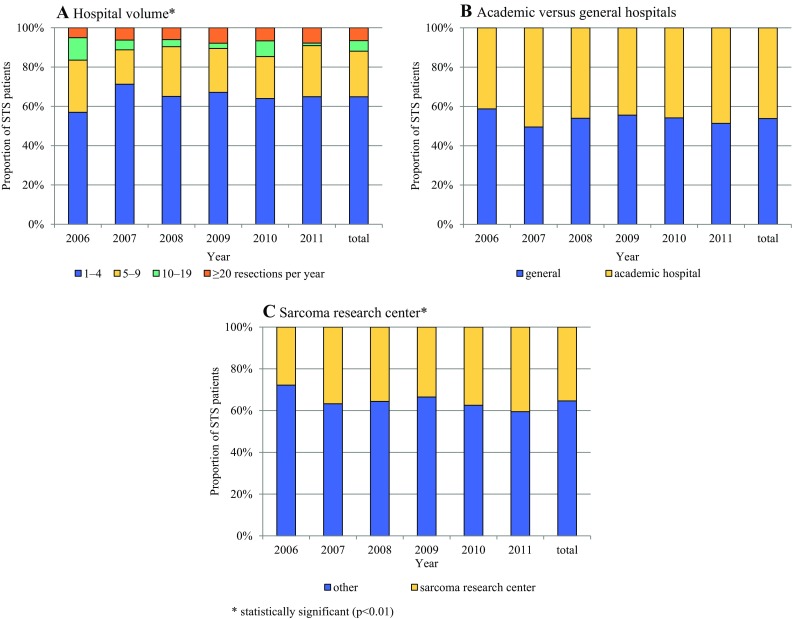
From the Netherlands Cancer Registry (NCR), data were obtained on 3317 adult STS patients (excluding gastrointestinal stromal tumor, GIST) diagnosed in 2006-2011. Logistic regression models were employed to compare outcomes on selected clinical indicators reflecting prevailing STS guidelines between high-volume (≥10 resections annually) and low-volume (<10 resections) hospitals, between academic and general hospitals, and between sarcoma research centers and other hospitals, adjusted for case mix. Analyses were performed on imputed datasets (m = 50), generated through multiple imputations by chained equations.
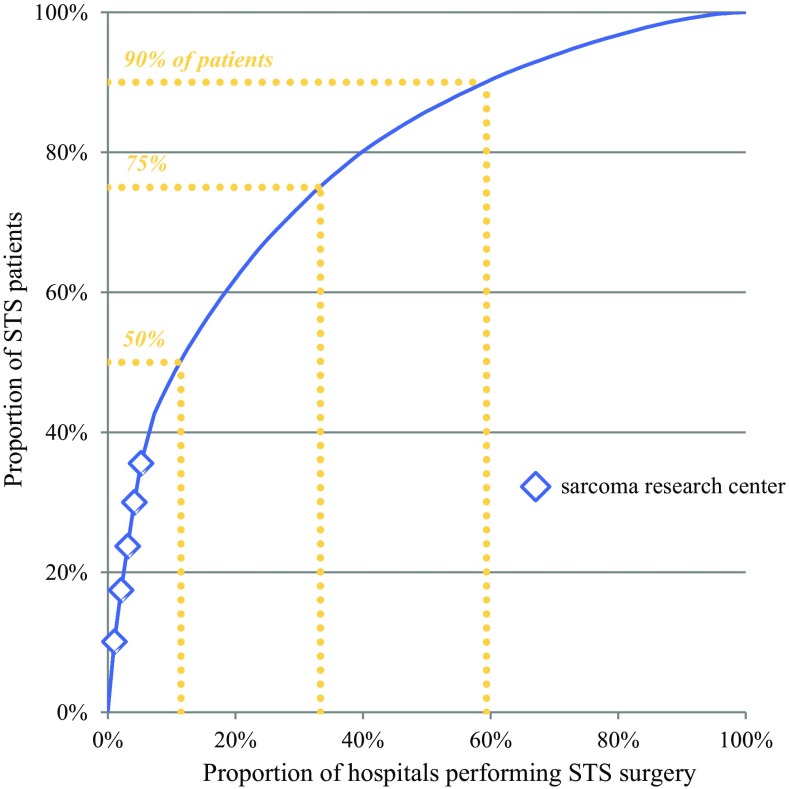
Overall, 89% of patients underwent surgical resection. Resection status remained unknown in 24% (excluding those with metastasized disease), and grade was not documented for one-third of tumors. Microscopic residual disease was detected in 20% with an increased risk for older patients, larger and deeply located tumors, and those located in the (retro)peritoneum or upper extremity. Almost half of patients with an R1 resection received adjuvant radiotherapy. Following adjustment for case mix factors, patients treated in high-volume hospitals less often had macroscopic residual disease (R2 resection; adjusted odds ratio: 0.54). A strongly skewed distribution of surgical volumes was observed.
These survey results indicate a potential for improving Dutch STS care. More centralized sarcoma management should improve definitive pathology reporting on tumor characteristics, adherence to treatment guidelines and overall disease outcome.
软组织肉瘤(STS)的最佳治疗仍然是一个挑战。一项全国性调查评估了荷兰 STS 治疗的质量,旨在通过更集中的疾病管理来发现改进的可能性。
从荷兰癌症登记处(NCR)获取了 2006-2011 年诊断的 3317 例成人 STS 患者(不包括胃肠道间质瘤,GIST)的数据。使用逻辑回归模型比较了反映现行 STS 指南的选定临床指标的结果,这些指标在高容量(每年≥10 例切除术)和低容量(<10 例切除术)医院、学术医院和普通医院之间,以及肉瘤研究中心和其他医院之间进行比较,调整了病例组合。分析是在通过链方程进行多次插补生成的模拟数据集(m=50)上进行的。
总体而言,89%的患者接受了手术切除。24%(不包括转移性疾病患者)的切除状态未知,三分之一的肿瘤未记录分级。20%的肿瘤检测到显微镜下残留疾病,且患者年龄较大、肿瘤较大且位置较深、位于(腹膜后)或上肢时风险增加。近一半的 R1 切除患者接受了辅助放疗。在调整病例组合因素后,高容量医院治疗的患者中,肉眼残留疾病(R2 切除)的发生率较低(调整后的优势比:0.54)。手术量的分布呈明显偏态。
这些调查结果表明荷兰 STS 治疗有改进的潜力。更集中的肉瘤管理应改善肿瘤特征的确定性病理报告、治疗指南的依从性和整体疾病结局。