Pajer Petr, Dresler Jiri, Kabíckova Hana, Písa Libor, Aganov Pavel, Fucik Karel, Elleder Daniel, Hron Tomas, Kuzelka Vitezslav, Velemínsky Petr, Klimentova Jana, Fucikova Alena, Pejchal Jaroslav, Hrabakova Rita, Benes Vladimir, Rausch Tobias, Dundr Pavel, Pilin Alexander, Cabala Radomir, Hubalek Martin, Stríbrny Jan, Antwerpen Markus H, Meyer Hermann
Military Health Institute, Military Medical Agency, Tychonova 1, 160 01 Prague 6, Czech Republic.
Institute of Molecular Genetics of the ASCR, v. v. i., Vídeňská 1083, 142 20 Prague 4, Czech Republic.
Viruses. 2017 Jul 27;9(8):200. doi: 10.3390/v9080200.
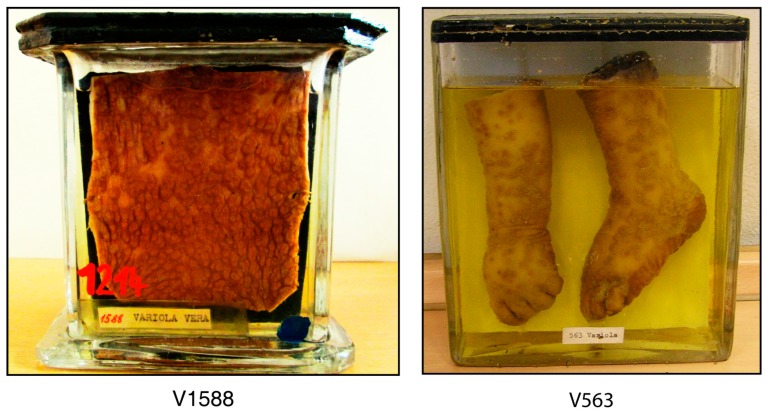
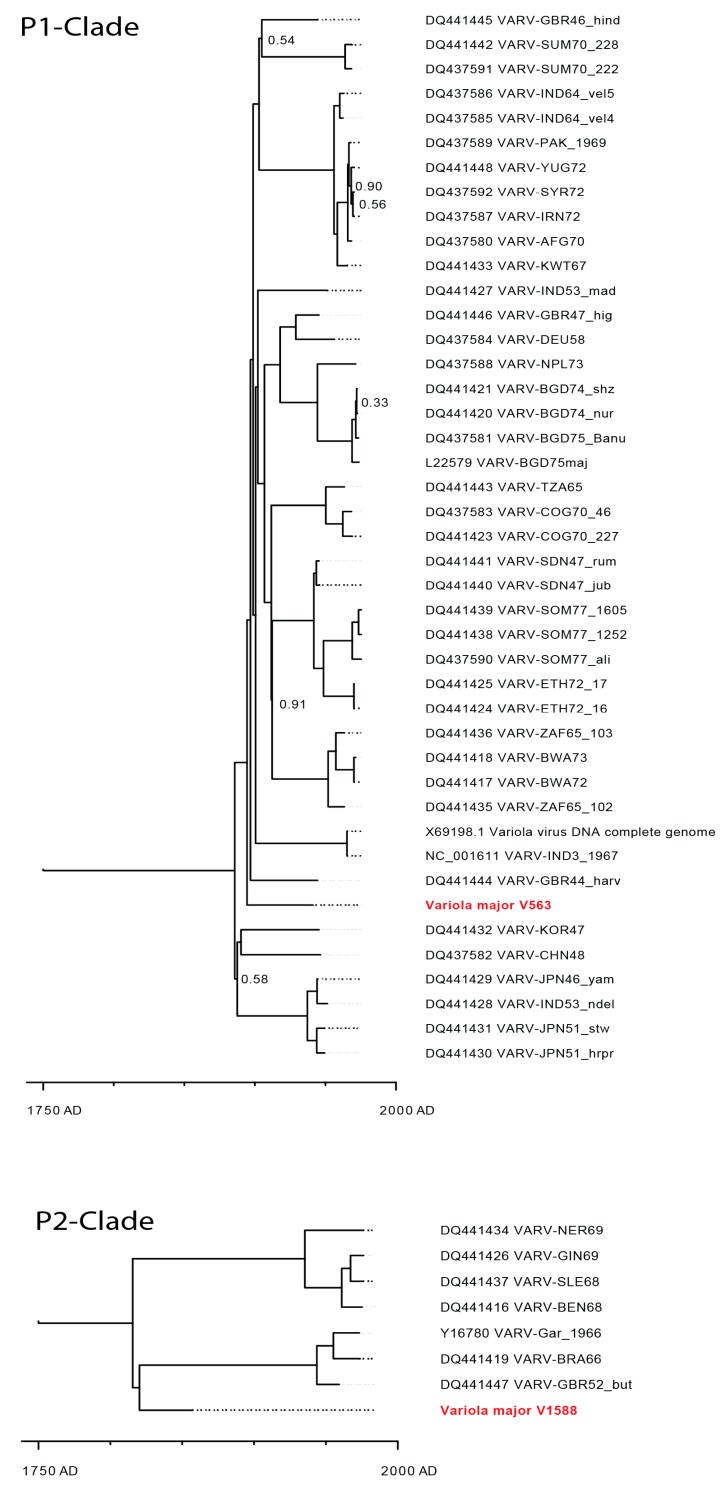
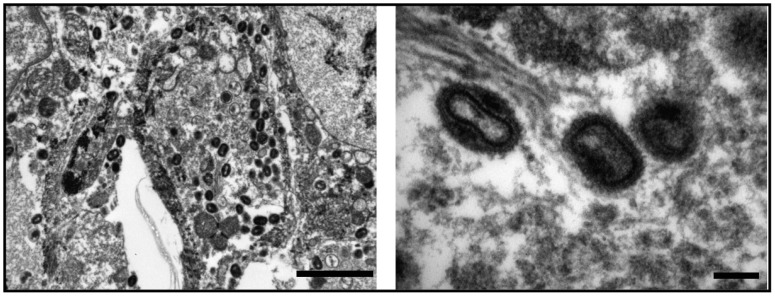
Although smallpox has been known for centuries, the oldest available variola virus strains were isolated in the early 1940s. At that time, large regions of the world were already smallpox-free. Therefore, genetic information of these strains can represent only the very last fraction of a long evolutionary process. Based on the genomes of 48 strains, two clades are differentiated: Clade 1 includes variants of variola major, and clade 2 includes West African and variola minor (Alastrim) strains. Recently, the genome of an almost 400-year-old Lithuanian mummy was determined, which fell basal to all currently sequenced strains of variola virus on phylogenetic trees. Here, we determined two complete variola virus genomes from human tissues kept in a museum in Prague dating back 60 and 160 years, respectively. Moreover, mass spectrometry-based proteomic, chemical, and microscopic examinations were performed. The 60-year-old specimen was most likely an importation from India, a country with endemic smallpox at that time. The genome of the 160-year-old specimen is related to clade 2 West African and variola minor strains. This sequence likely represents a new endemic European variant of variola virus circulating in the midst of the 19th century in Europe.
尽管天花已为人所知数百年,但现存最古老的天花病毒毒株是在20世纪40年代初分离出来的。当时,世界上大片地区已经没有天花。因此,这些毒株的遗传信息只能代表漫长进化过程的最后一小部分。基于48个毒株的基因组,可区分出两个进化枝:进化枝1包括重症天花变种,进化枝2包括西非和轻症天花(类天花)毒株。最近,测定了一具近400年前的立陶宛木乃伊的基因组,在系统发育树上,该基因组位于所有目前已测序的天花病毒毒株的基部。在这里,我们从布拉格一家博物馆保存的分别有60年和160年历史的人体组织中测定了两个完整的天花病毒基因组。此外,还进行了基于质谱的蛋白质组学、化学和显微镜检查。这个有60年历史的样本很可能是从当时天花流行的印度输入的。这个有160年历史的样本的基因组与进化枝2的西非和轻症天花毒株有关。该序列可能代表了19世纪中叶在欧洲流行的一种新的欧洲天花地方变种。