Department of Gastroenterology, The First Affiliated Hospital, Nanchang University, Nanchang 330006, Jiangxi, China.
Cell Death Dis. 2017 Jul 27;8(7):e2963. doi: 10.1038/cddis.2017.360.
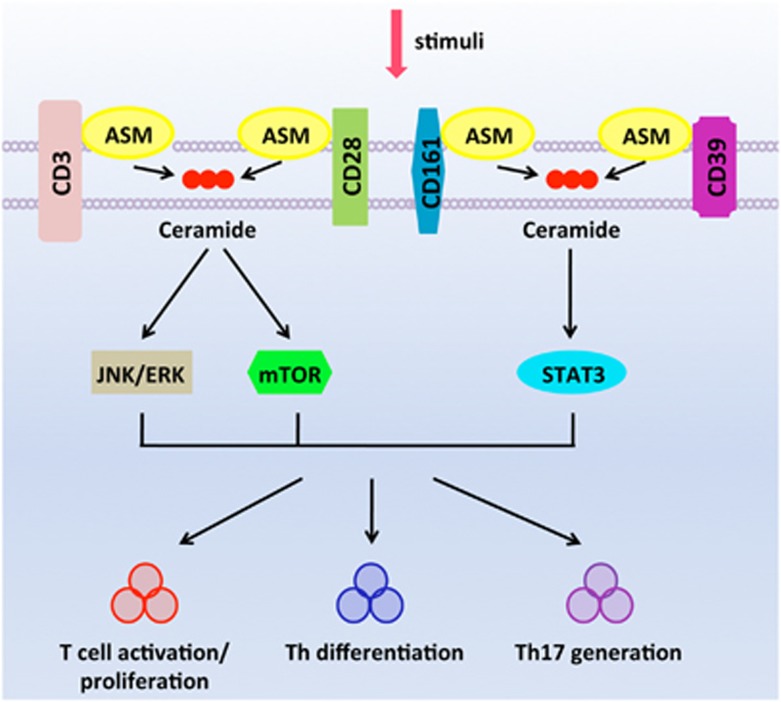
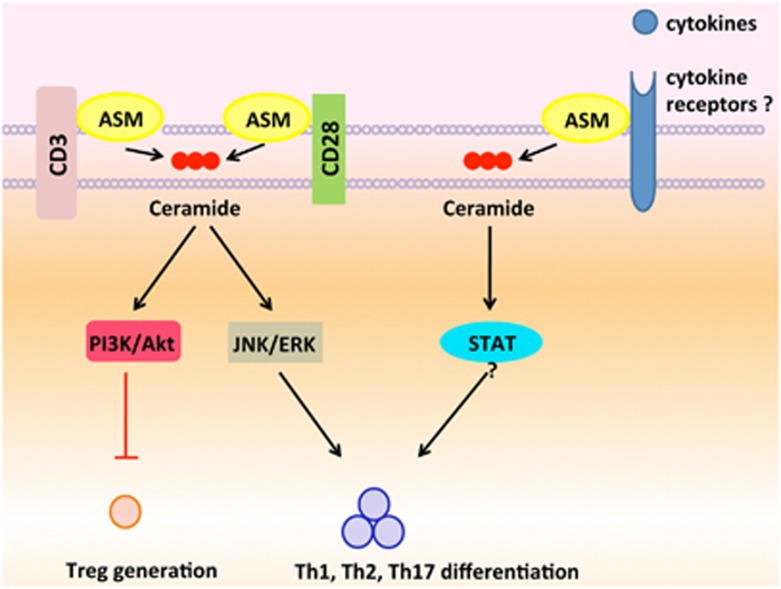
Acid sphingomyelinase (ASM) is a lipid hydrolase. By generating ceramide, ASM had been reported to have an important role in regulating immune cell functions inclusive of macrophages, NK cells, and CD8 T cells, whereas the role of ASM bioactivity in regulation of human CD4 T-cell functions remained uncertain. Recent studies have provided novel findings in this field. Upon stimulation of CD3 and/or CD28, ASM-dependent ceramide signaling mediates intracellular downstream signal cascades of CD3 and CD28, and regulates CD4 T-cell activation and proliferation. Meanwhile, CD39 and CD161 have direct interactions with ASM, which mediates downstream signals inclusive of STAT3 and mTOR and thus defines human Th17 cells. Intriguingly, ASM mediates Th1 responses, but negatively regulates Treg functions. In this review, we summarized the pivotal roles of ASM in regulation of human CD4 T-cell activation and responses. ASM/sphingolipid signaling may be a novel target for the therapy of human autoimmune diseases.
酸性鞘磷脂酶(ASM)是一种脂质水解酶。通过生成神经酰胺,ASM 被报道在调节免疫细胞功能方面发挥着重要作用,包括巨噬细胞、自然杀伤细胞和 CD8 T 细胞,而 ASM 生物活性在调节人类 CD4 T 细胞功能方面的作用尚不确定。最近的研究在这一领域提供了新的发现。在 CD3 和/或 CD28 的刺激下,ASM 依赖性神经酰胺信号转导介导 CD3 和 CD28 的细胞内下游信号级联反应,调节 CD4 T 细胞的激活和增殖。同时,CD39 和 CD161 与 ASM 有直接相互作用,介导包括 STAT3 和 mTOR 的下游信号,从而定义人类 Th17 细胞。有趣的是,ASM 介导 Th1 反应,但负调节 Treg 功能。在这篇综述中,我们总结了 ASM 在调节人类 CD4 T 细胞激活和反应中的关键作用。ASM/鞘脂信号可能是人类自身免疫性疾病治疗的一个新靶点。