USDA-ARS Robert Holley Center for Agriculture and Health, Ithaca, NY 14853, USA.
Division of Nutritional Sciences, 220 Savage Hall, Cornell University, Ithaca, NY 14853, USA.
Nutrients. 2017 Jul 21;9(7):787. doi: 10.3390/nu9070787.
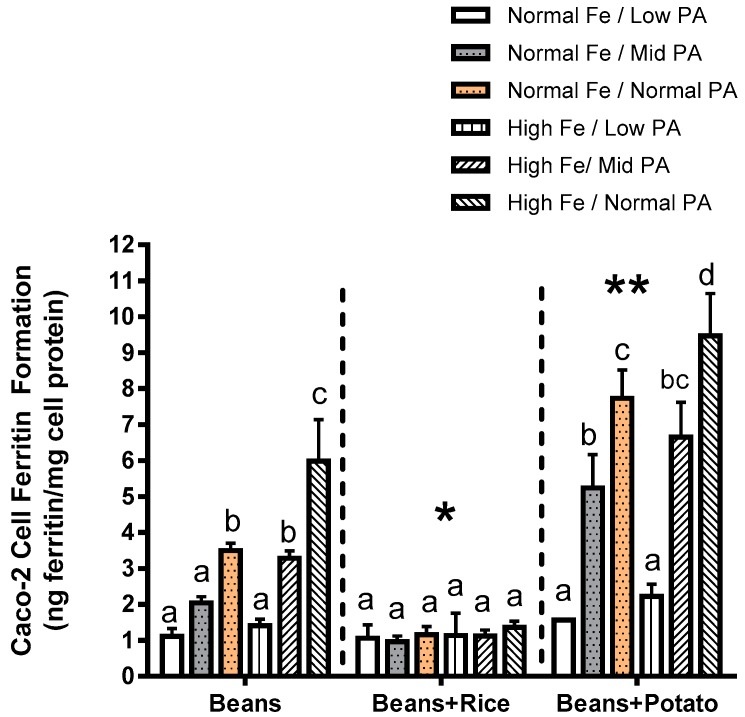
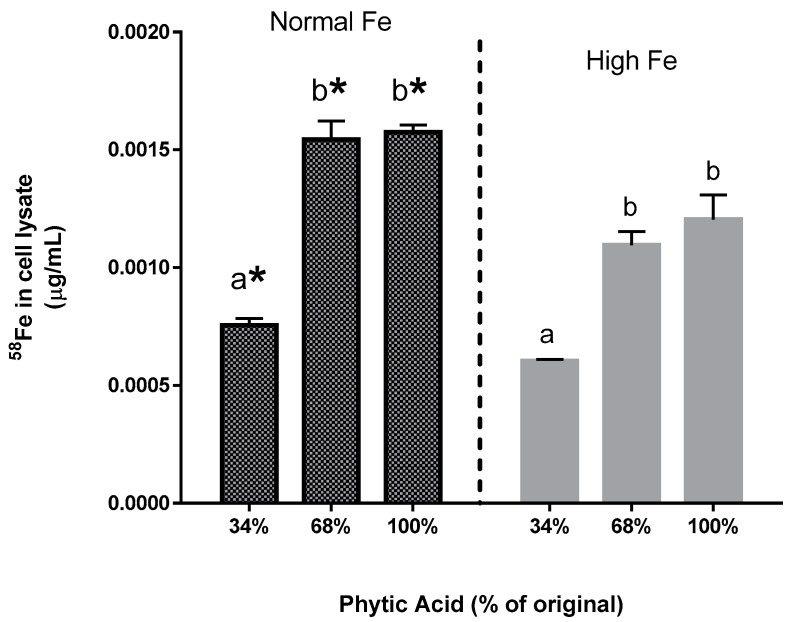
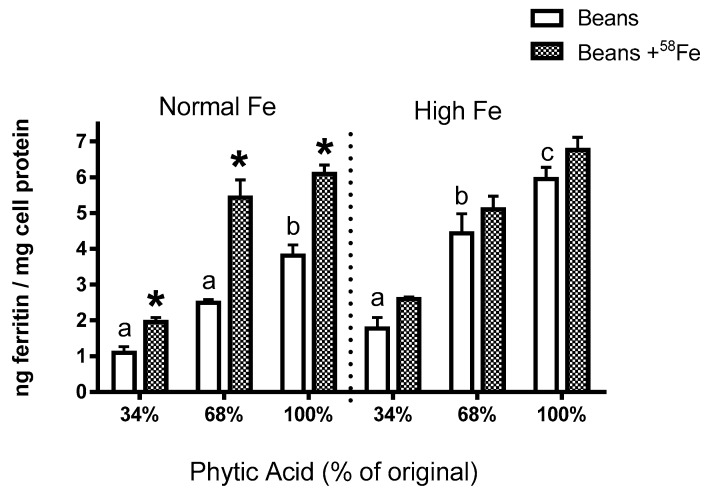
This paper represents a series of in vitro iron (Fe) bioavailability experiments, Fe content analysis and polyphenolic profile of the first generation of Fe biofortified beans () selected for human trials in Rwanda and released to farmers of that region. The objective of the present study was to demonstrate how the Caco-2 cell bioassay for Fe bioavailability can be utilized to assess the nutritional quality of Fe in such varieties and how they may interact with diets and meal plans of experimental studies. Furthermore, experiments were also conducted to directly compare this in vitro approach with specific human absorption studies of these Fe biofortified beans. The results show that other foods consumed with beans, such as rice, can negatively affect Fe bioavailability whereas potato may enhance the Fe absorption when consumed with beans. The results also suggest that the extrinsic labelling approach to measuring human Fe absorption can be flawed and thus provide misleading information. Overall, the results provide evidence that the Caco-2 cell bioassay represents an effective approach to evaluate the nutritional quality of Fe-biofortified beans, both separate from and within a targeted diet or meal plan.
本文介绍了一系列体外铁(Fe)生物利用度实验、Fe 含量分析以及第一代用于卢旺达人体试验并分发给该地区农民的 Fe 生物强化豆的多酚谱。本研究的目的是展示如何利用 Caco-2 细胞生物测定法评估此类品种中 Fe 的营养质量,以及它们如何与实验研究的饮食和膳食计划相互作用。此外,还进行了实验以直接比较这种体外方法与这些 Fe 生物强化豆的特定人体吸收研究。结果表明,与豆类一起食用的其他食物,如大米,可能会降低 Fe 的生物利用度,而与豆类一起食用的土豆可能会增强 Fe 的吸收。结果还表明,衡量人体 Fe 吸收的外在标记方法可能存在缺陷,因此提供了误导性信息。总体而言,结果表明 Caco-2 细胞生物测定法是一种评估 Fe 生物强化豆营养质量的有效方法,无论是单独使用还是在目标饮食或膳食计划内使用。