Wang Shuo, Song Jieyun, Yang Yide, Zhang Yining, Chawla Nitesh V, Ma Jun, Wang Haijun
Institute of Child and Adolescent Health of Peking University, School of Public Health, Peking University Health Science Center, Beijing, 100191, China.
Interdisciplinary Center for Network Science and Applications (iCeNSA), University of Notre Dame, Notre Dame, IN, 46556, USA.
BMC Med Genet. 2017 Jul 28;18(1):80. doi: 10.1186/s12881-017-0437-0.
Hypoxia Inducible Factor 3 Alpha Subunit (HIF3A) DNA has been demonstrated to be associated with obesity in the methylation level, and it also has a Body Mass Index (BMI)-independent association with plasma alanine aminotransferase (ALT). However, the relation among obesity, plasma ALT, HIF3A polymorphism and methylation remains unclear. This study aims to identify the association between HIF3A polymorphism and plasma ALT, and further to determine whether the effect of HIF3A polymorphism on ALT could be modified by obesity or mediated by DNA methylation.
The HIF3A rs3826795 polymorphism was genotyped in a case-control study including 2030 Chinese children aged 7-18 years (705 obese cases and 1325 non-obese controls). Furthermore, the HIF3A DNA methylation of the peripheral blood was measured in 110 severely obese children and 110 age- and gender- matched normal-weight controls.
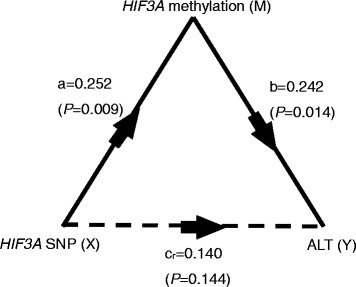
There was no overall association between the HIF3A rs3826795 polymorphism and ALT. A significant interaction between obesity and rs3826795 in relation with ALT was found (P = 0.042), with rs3826795 G-allele number elevating ALT significantly only in obese children (β' = 0.075, P = 0.037), but not in non-obese children (β' = -0.009, P = 0.741). Additionally, a mediation effect of HIF3A methylation was found in the association between the HIF3A rs3826795 polymorphism and ALT among obese children (β' = 0.242, P = 0.014).
This is the first study to report the interaction between obesity and HIF3A gene in relation with ALT, and also to reveal a mediation effect among the HIF3A polymorphism, methylation and ALT. This study provides new evidence to the function of HIF3A gene, which would be helpful for future risk assessment and personalized treatment of liver diseases.
缺氧诱导因子3α亚基(HIF3A)基因的DNA甲基化水平已被证明与肥胖有关,并且它与血浆丙氨酸氨基转移酶(ALT)存在独立于体重指数(BMI)的关联。然而,肥胖、血浆ALT、HIF3A基因多态性和甲基化之间的关系仍不清楚。本研究旨在确定HIF3A基因多态性与血浆ALT之间的关联,并进一步确定HIF3A基因多态性对ALT的影响是否会受到肥胖的影响或由DNA甲基化介导。
在一项病例对照研究中,对2030名7至18岁的中国儿童(705例肥胖儿童和1325例非肥胖对照)进行了HIF3A rs3826795基因多态性基因分型。此外,对110名重度肥胖儿童和110名年龄和性别匹配的正常体重对照者的外周血HIF3A DNA甲基化进行了检测。
HIF3A rs3826795基因多态性与ALT之间没有总体关联。发现肥胖与rs3826795与ALT之间存在显著的相互作用(P = 0.042),rs3826795 G等位基因数量仅在肥胖儿童中显著升高ALT(β' = 0.075,P = 0.037),而在非肥胖儿童中则没有(β' = -0.009,P = 0.741)。此外,在肥胖儿童中发现HIF3A甲基化在HIF3A rs3826795基因多态性与ALT之间的关联中起中介作用(β' = 0.242,P = 0.014)。
这是第一项报道肥胖与HIF3A基因在与ALT关系中的相互作用的研究,同时也揭示了HIF3A基因多态性、甲基化和ALT之间的中介作用。本研究为HIF3A基因的功能提供了新的证据,这将有助于未来肝脏疾病的风险评估和个性化治疗。