Anderson Emma L, Howe Laura D, Jones Hayley E, Higgins Julian P T, Lawlor Debbie A, Fraser Abigail
MRC Integrative Epidemiology Unit at the University of Bristol, Bristol, United Kingdom; School of Social and Community Medicine, University of Bristol, Bristol, United Kingdom.
School of Social and Community Medicine, University of Bristol, Bristol, United Kingdom.
PLoS One. 2015 Oct 29;10(10):e0140908. doi: 10.1371/journal.pone.0140908. eCollection 2015.
BACKGROUND & AIMS: Narrative reviews of paediatric NAFLD quote prevalences in the general population that range from 9% to 37%; however, no systematic review of the prevalence of NAFLD in children/adolescents has been conducted. We aimed to estimate prevalence of non-alcoholic fatty liver disease (NAFLD) in young people and to determine whether this varies by BMI category, gender, age, diagnostic method, geographical region and study sample size.
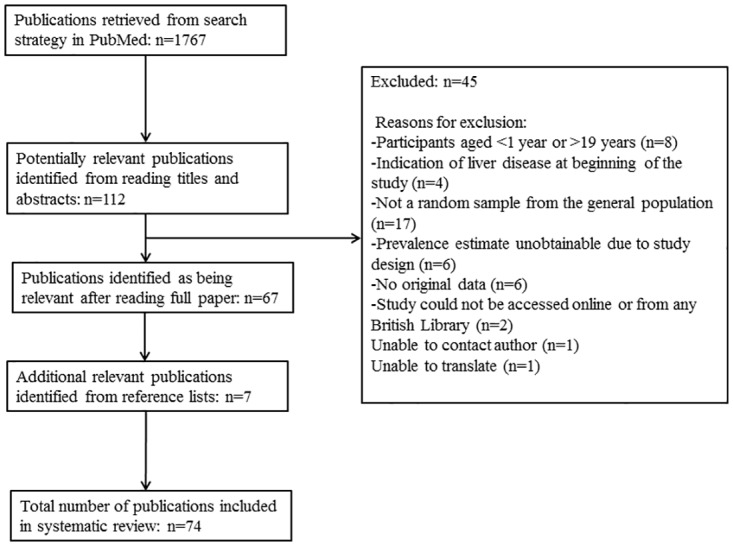
We conducted a systematic review and meta-analysis of all studies reporting a prevalence of NAFLD based on any diagnostic method in participants 1-19 years old, regardless of whether assessing NAFLD prevalence was the main aim of the study.
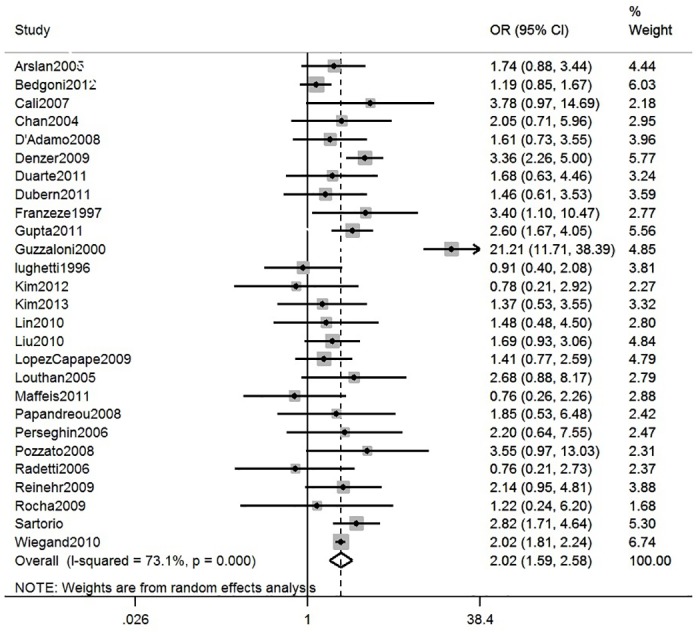
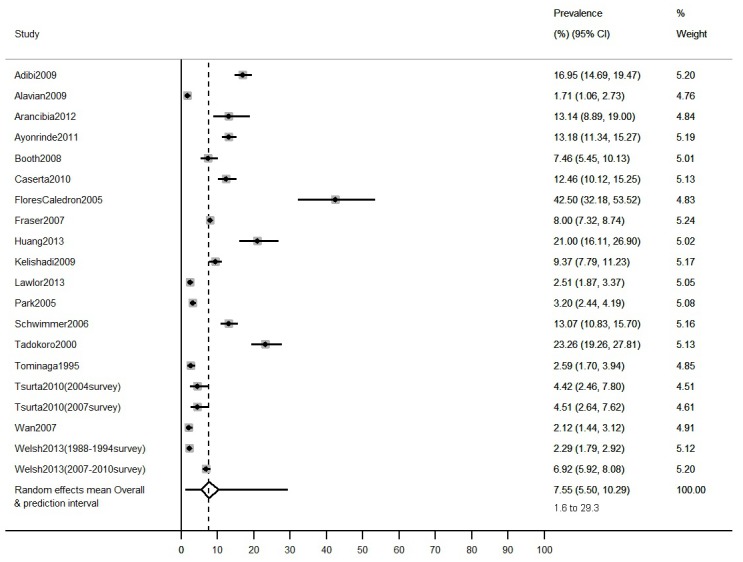
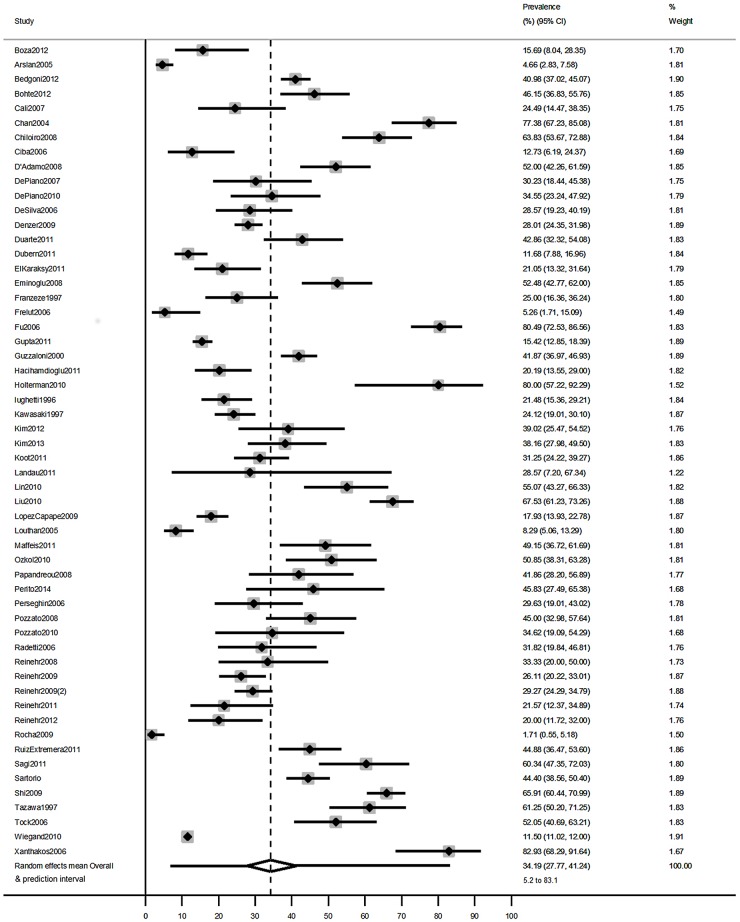
The pooled mean prevalence of NAFLD in children from general population studies was 7.6% (95%CI: 5.5% to 10.3%) and 34.2% (95% CI: 27.8% to 41.2%) in studies based on child obesity clinics. In both populations there was marked heterogeneity between studies (I2 = 98%). There was evidence that prevalence was generally higher in males compared with females and increased incrementally with greater BMI. There was evidence for differences between regions in clinical population studies, with estimated prevalence being highest in Asia. There was no evidence that prevalence changed over time. Prevalence estimates in studies of children/adolescents attending obesity clinics and in obese children/adolescents from the general population were substantially lower when elevated alanine aminotransferase (ALT) was used to assess NAFLD compared with biopsies, ultrasound scan (USS) or magnetic resonance imaging (MRI).
Our review suggests the prevalence of NAFLD in young people is high, particularly in those who are obese and in males.
关于儿童非酒精性脂肪性肝病(NAFLD)的叙述性综述引用的普通人群患病率在9%至37%之间;然而,尚未对儿童/青少年中NAFLD的患病率进行系统综述。我们旨在估计年轻人中非酒精性脂肪性肝病(NAFLD)的患病率,并确定其是否因体重指数类别、性别、年龄、诊断方法、地理区域和研究样本量而有所不同。
我们对所有报告了1至19岁参与者中基于任何诊断方法的NAFLD患病率的研究进行了系统综述和荟萃分析,无论评估NAFLD患病率是否为该研究的主要目的。
普通人群研究中儿童NAFLD的合并平均患病率为7.6%(95%置信区间:5.5%至10.3%),而基于儿童肥胖诊所的研究中该患病率为34.2%(95%置信区间:27.8%至41.2%)。在这两类人群中,研究之间均存在明显的异质性(I² = 98%)。有证据表明,男性的患病率通常高于女性,且随着体重指数的增加而逐步上升。在临床人群研究中,有证据表明不同地区之间存在差异,亚洲的估计患病率最高。没有证据表明患病率随时间变化。与活检、超声扫描(USS)或磁共振成像(MRI)相比,当使用丙氨酸氨基转移酶(ALT)升高来评估NAFLD时,肥胖诊所中儿童/青少年以及普通人群中肥胖儿童/青少年的患病率估计值要低得多。
我们的综述表明,年轻人中NAFLD的患病率很高,尤其是肥胖者和男性。